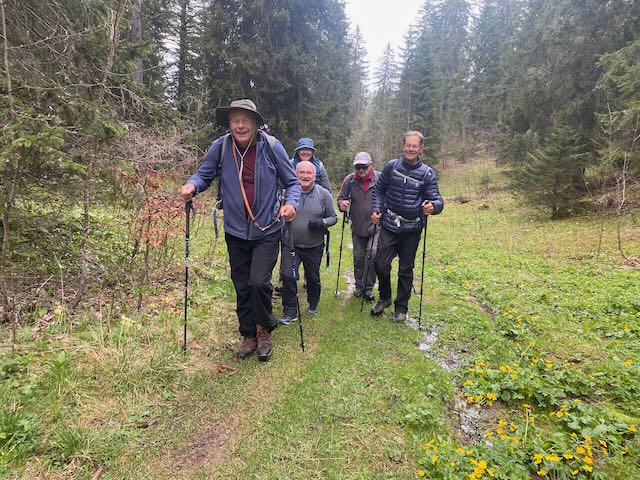
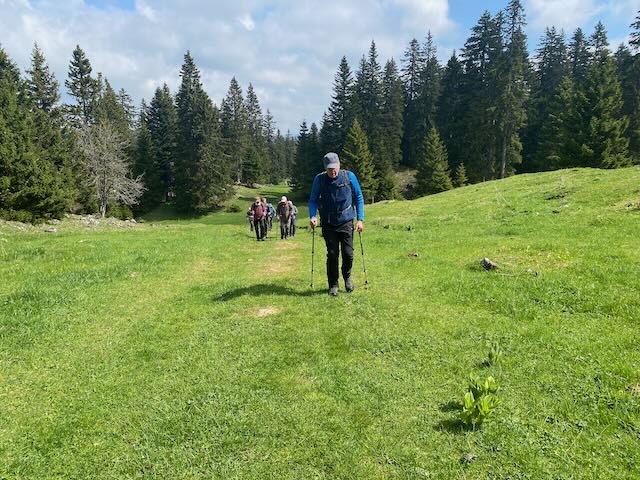
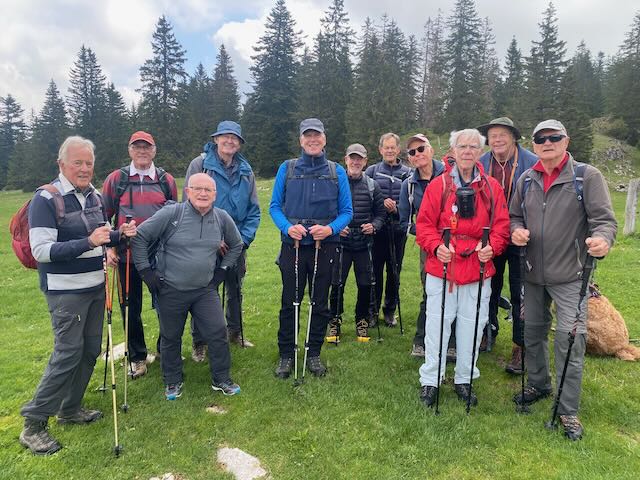
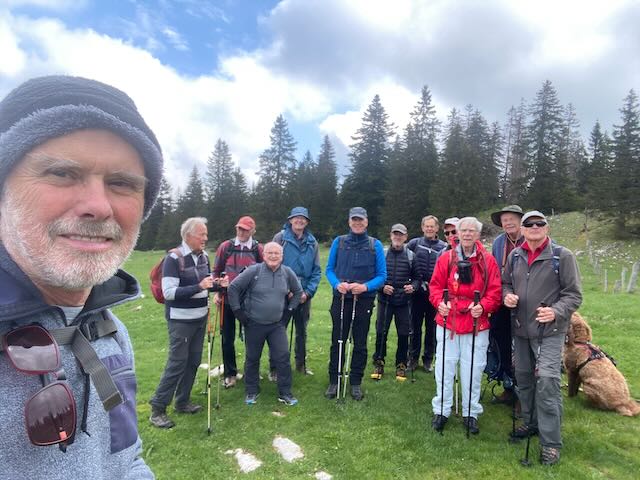
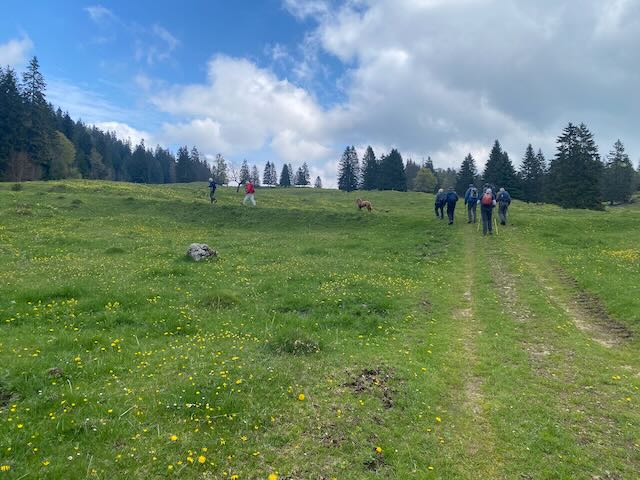
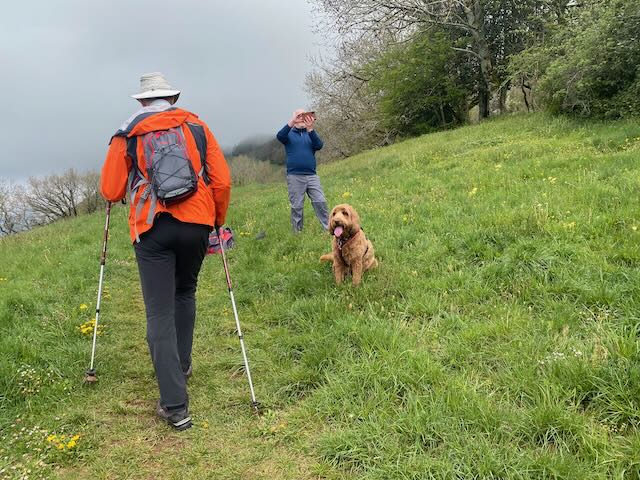
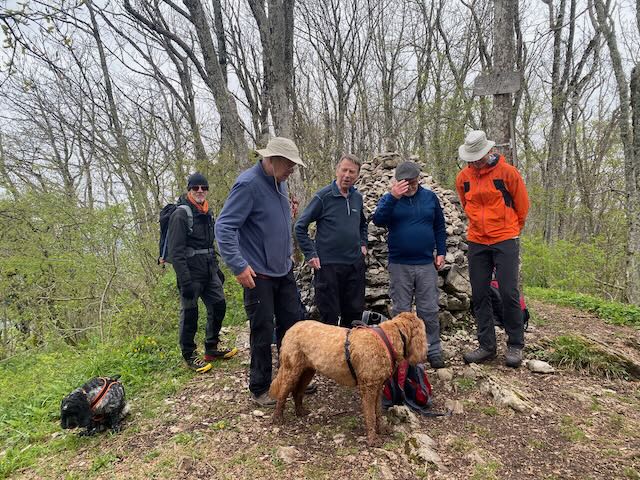
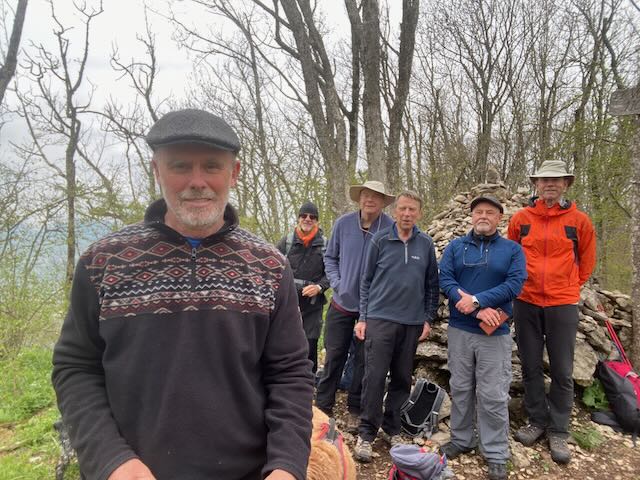
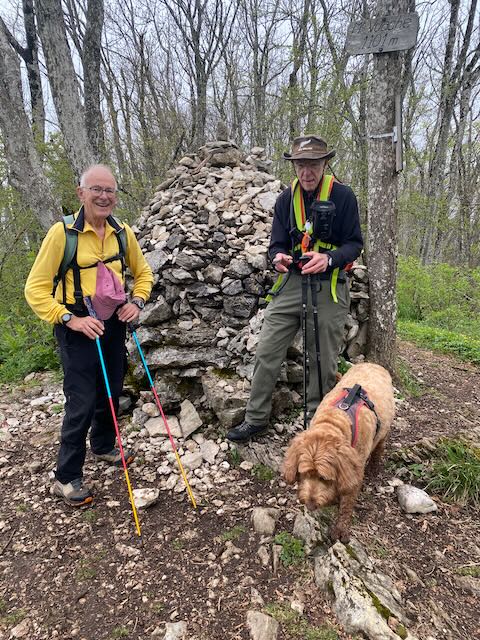
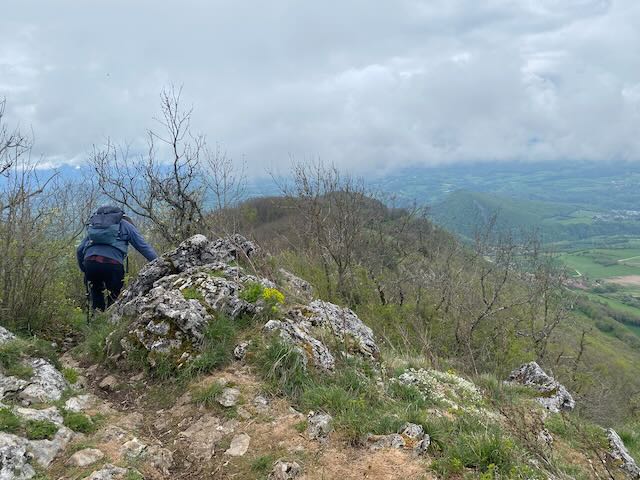
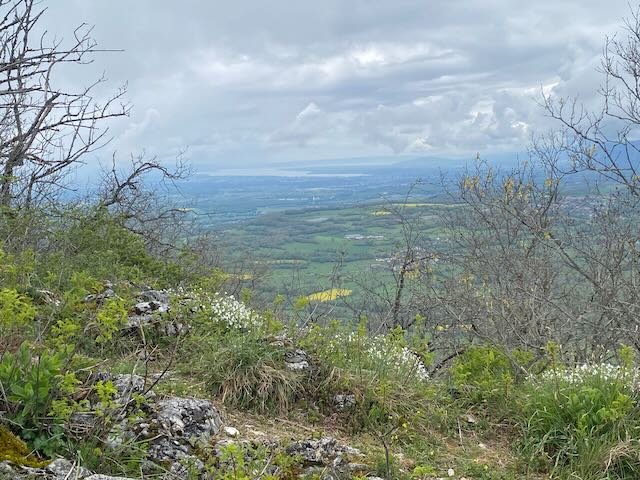
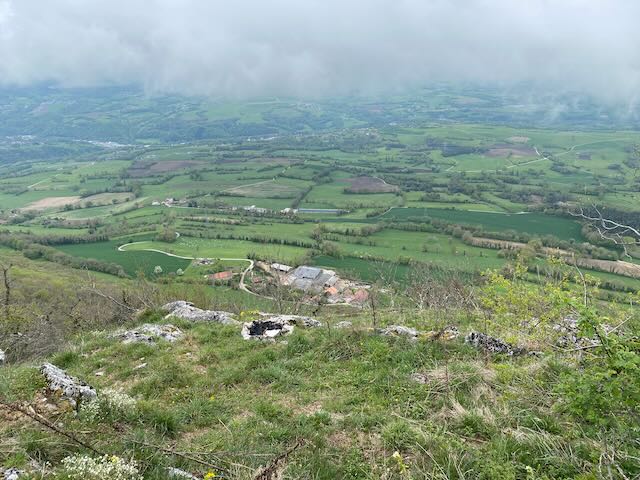
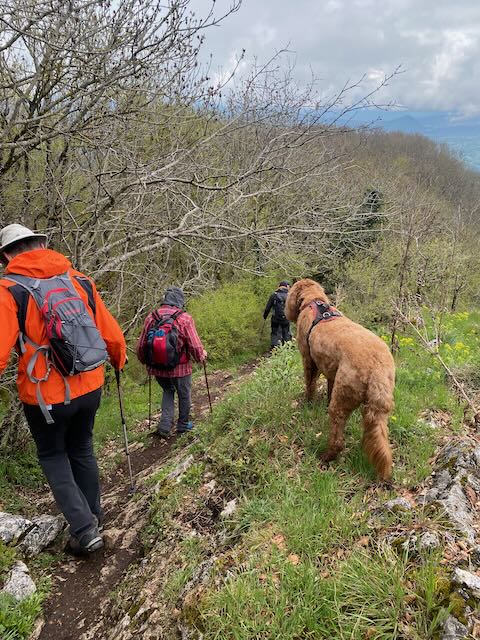
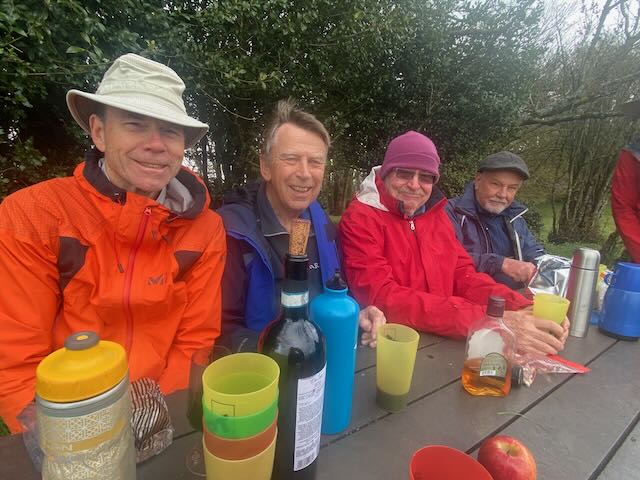
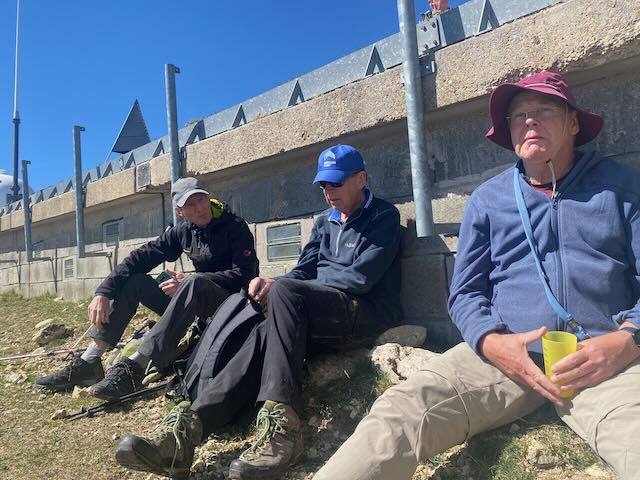
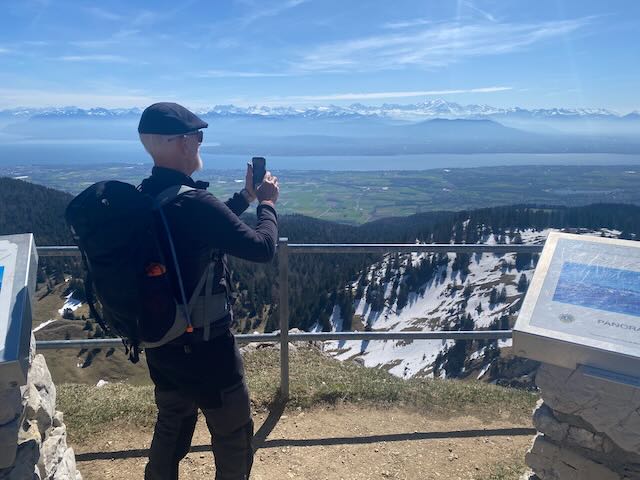
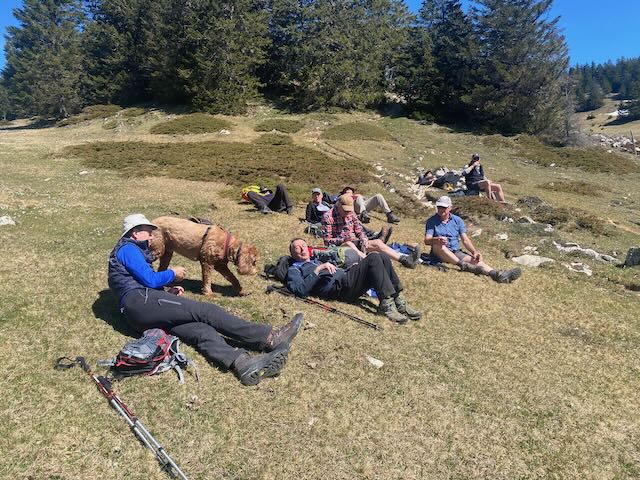
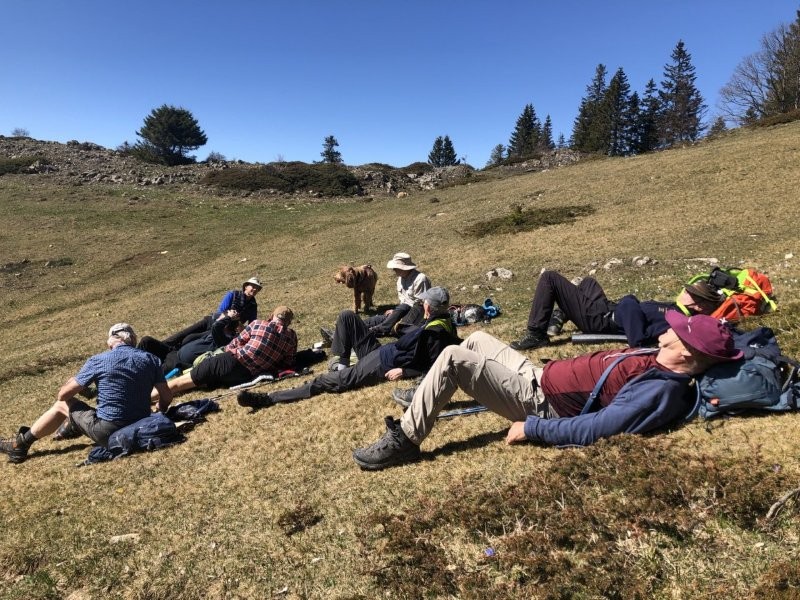
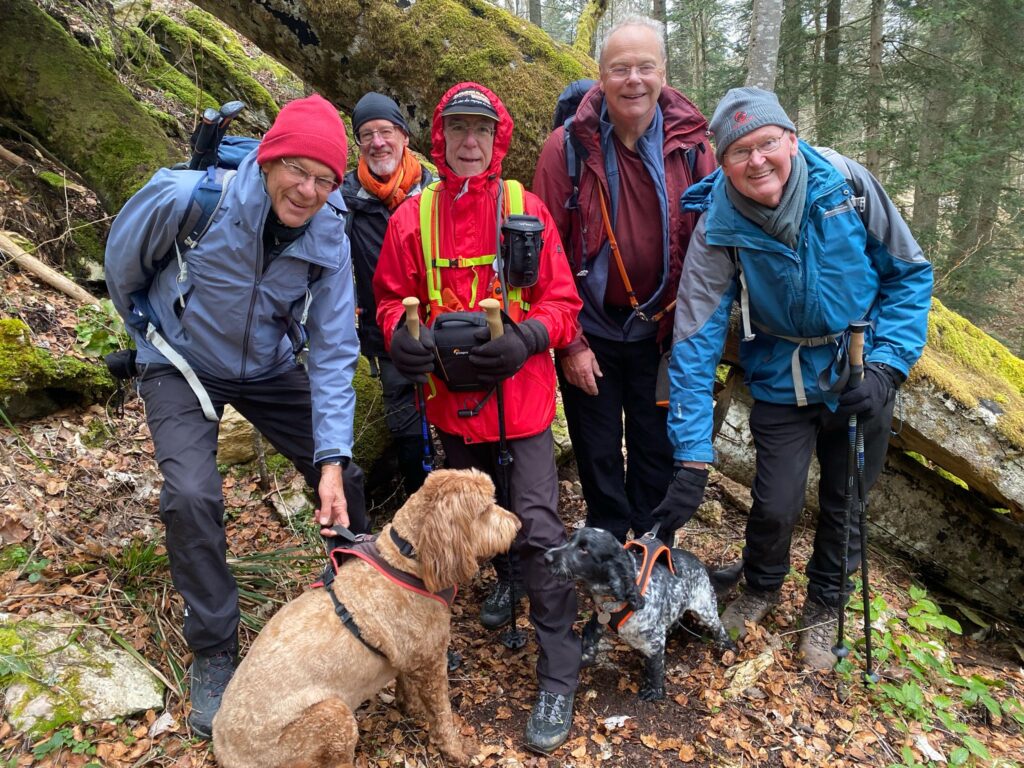
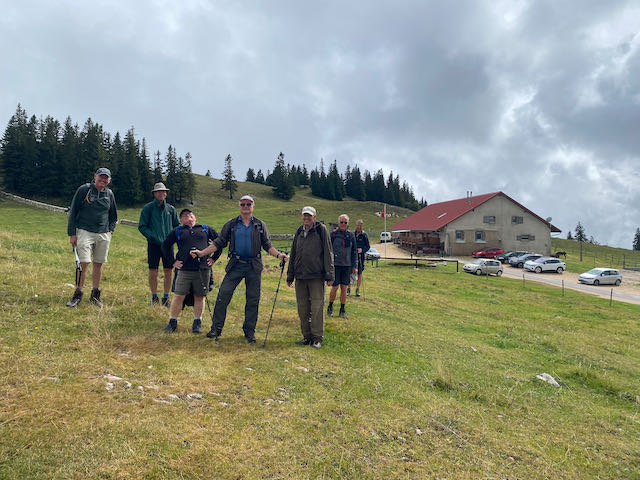
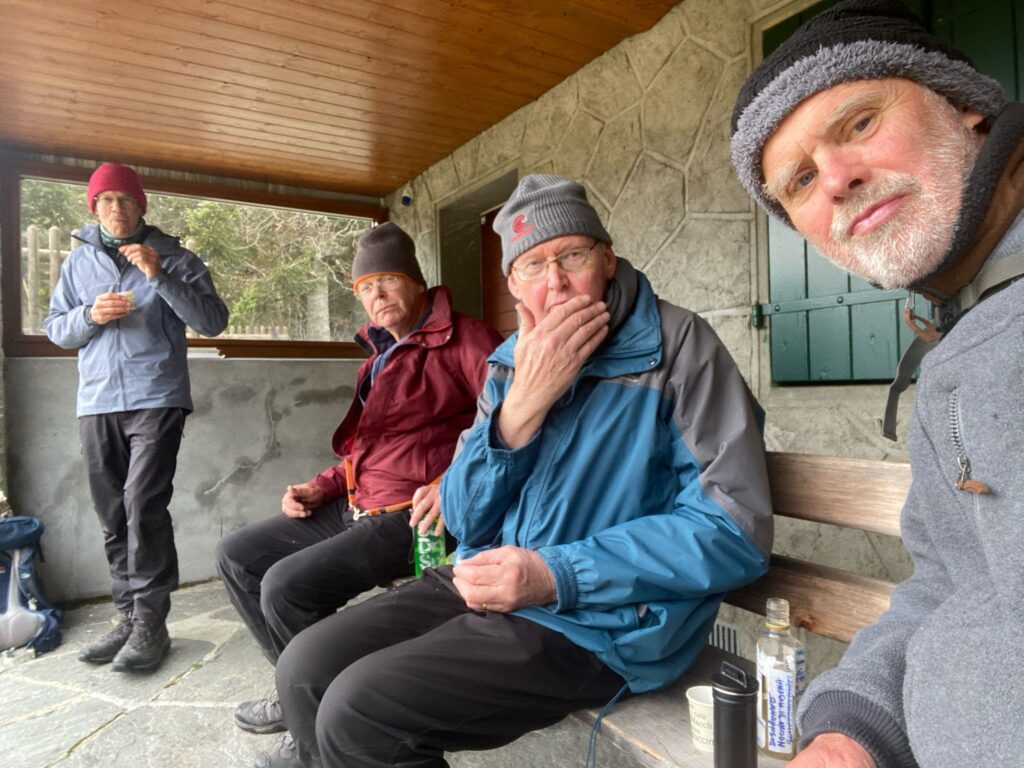
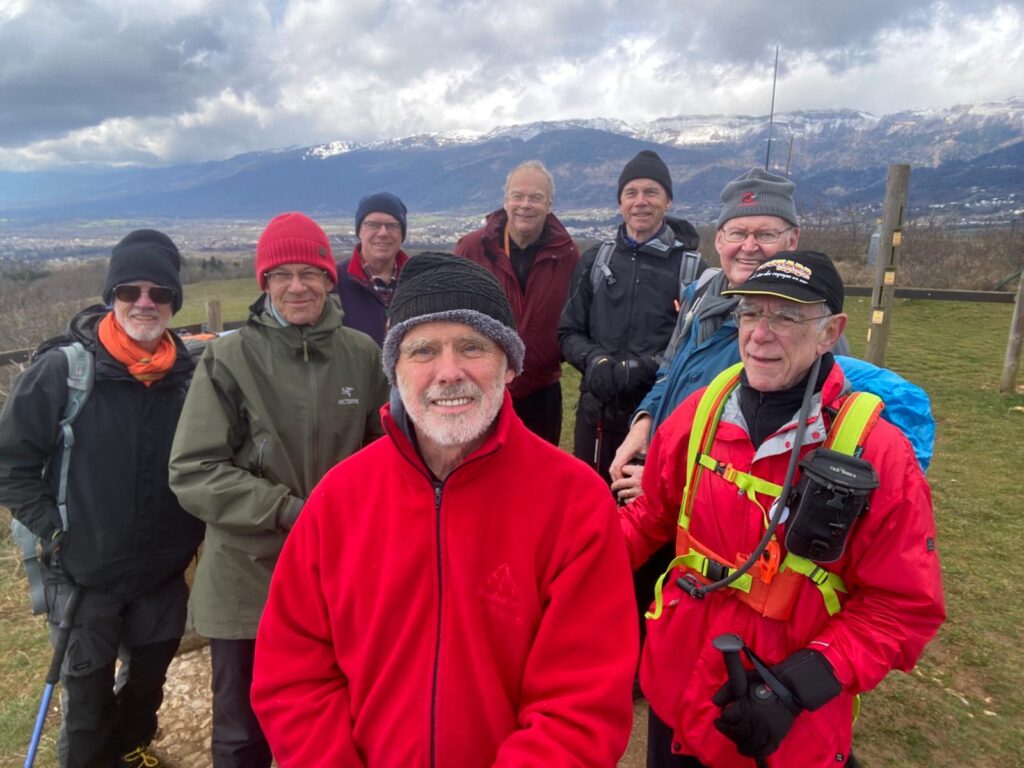
So this was billed as a hike up to the Creux du Van with a height gain of about 700m but turned into a walk from Morges to Ouchy with a height gain of all of 40m.
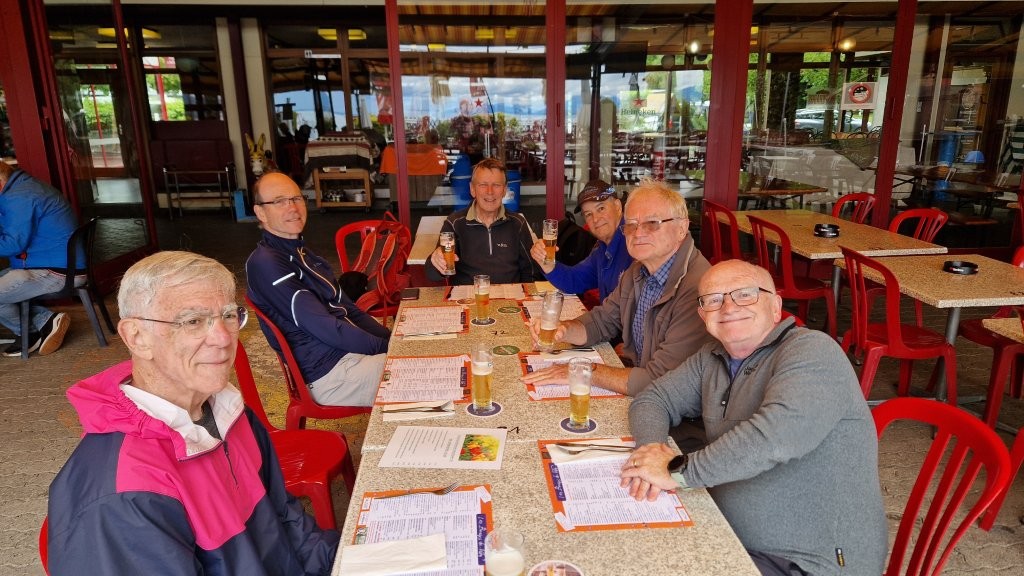
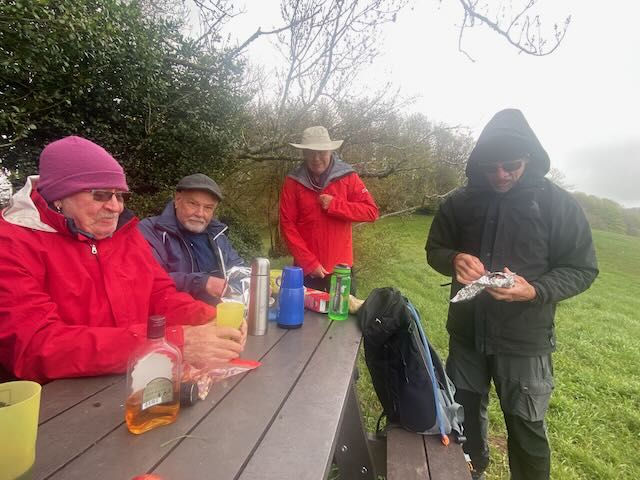
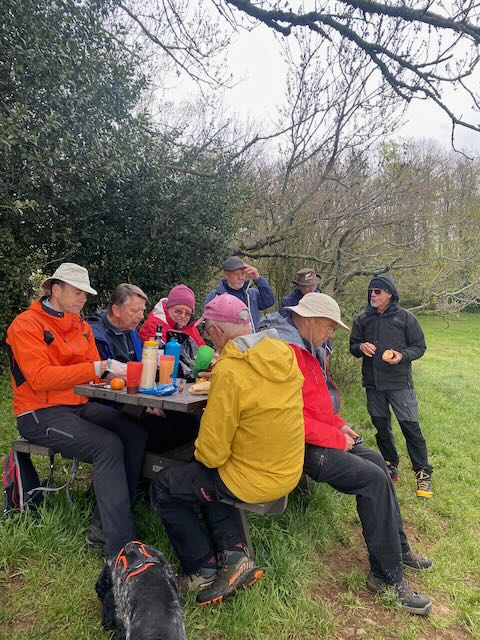
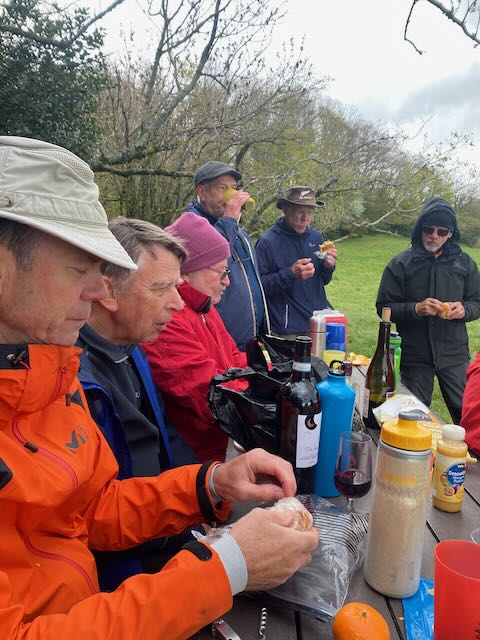
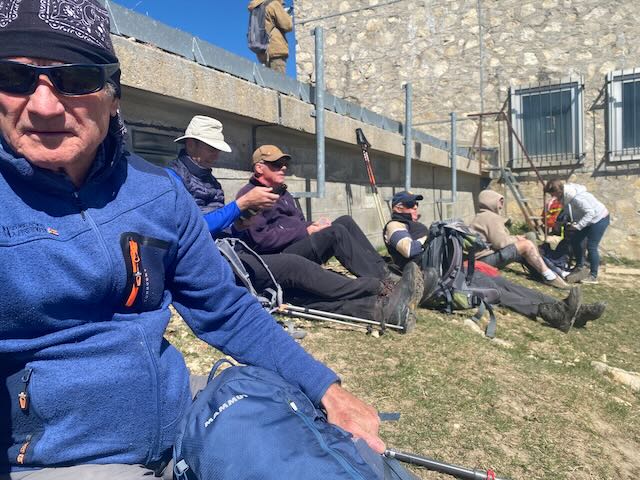
Thursday’s forecast was not great with temperatures of 5 degrees predicted at Creux du Van and rain much of the day so when 7 of us turned up at 8am at the parking in Divonne the immediate question was “what’s plan B?” It didn’t take us long to decide to stay lakeside and follow the very pleasant walk from Morges to Ouchy returning by train.
The 8am start was to allow us to get to Noiraigue so we could set off hiking at 10. This was an unnecessarily early start if we were only going to Morges. However the traffic Gods soon got together and made sure that we didn’t arrive in Morges until about 9:15. Then suitably attired and booted and parking metered up we set off, initially through the tulip display (tulips all gone) then past the apartments where Ian Cappin and Dave Knewstubb used to live.
We soon arrived at the ile aux oiseaux where much time was spent identifying the many birds, aided by the very helpful posters, and removing all the extra layers we’d added in anticipation of rain or coolth.
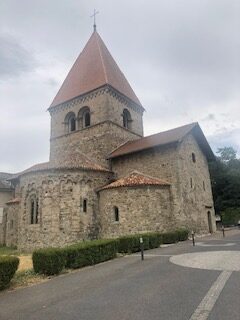
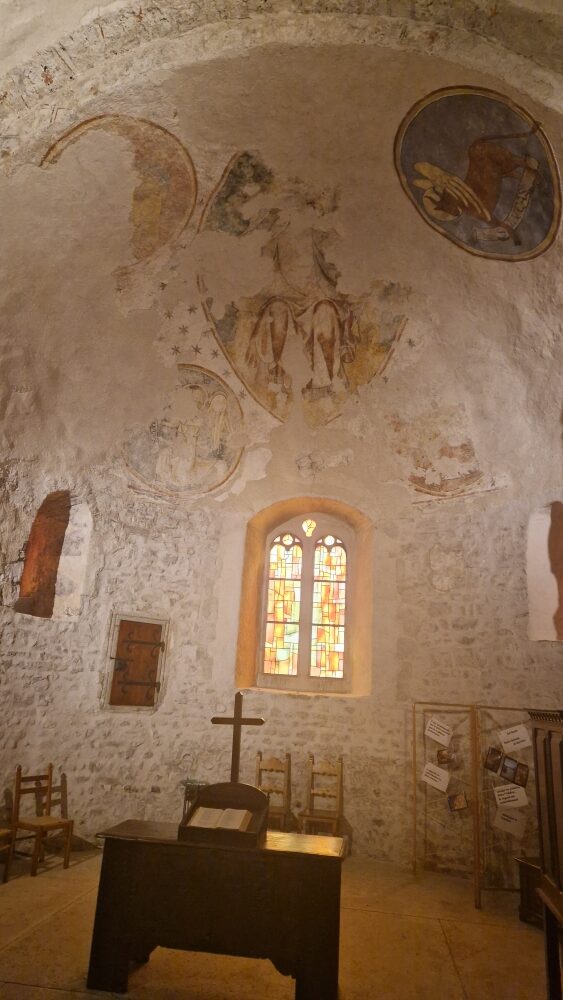
Then it was on again to the wonderful old (11th century) church in St Sulpice. We’d visited this on the previous walk and it was well worth a second visit.
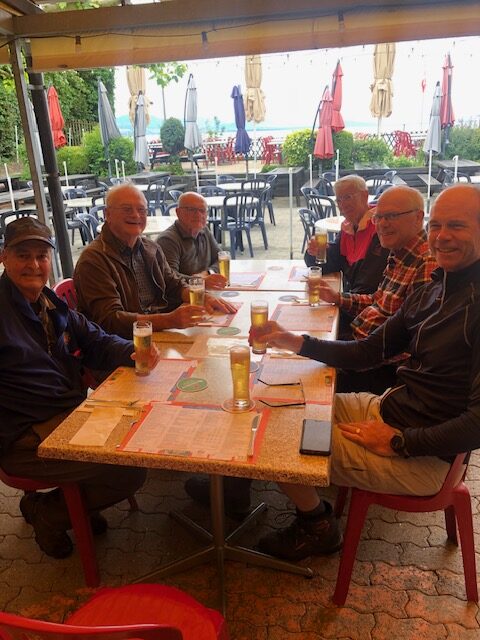
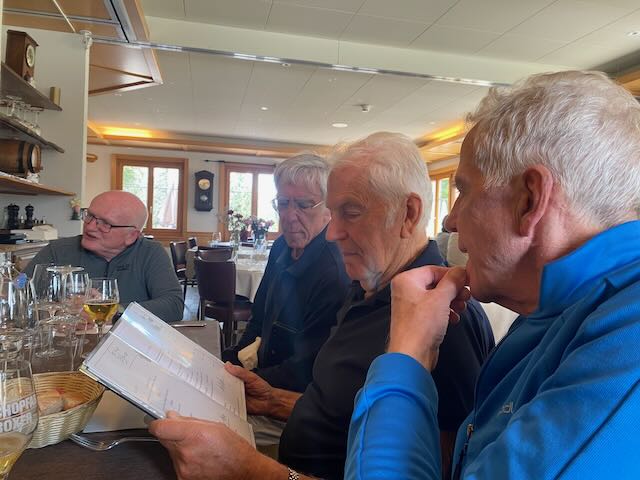
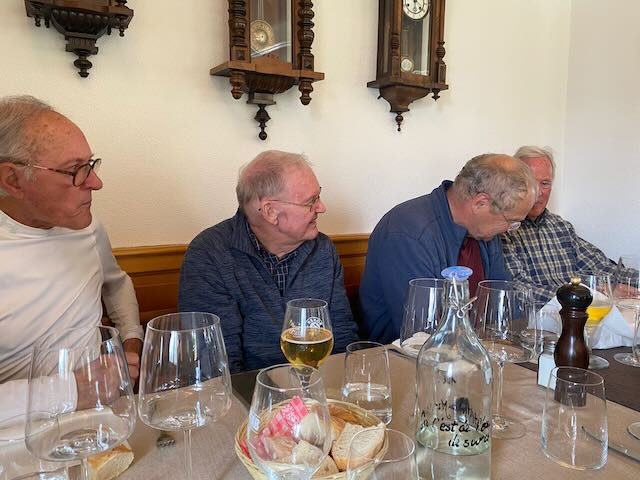
We then continued to the camping at Vidy where we had an early lunch. The campsite restaurant serves indifferent but edible food and decent beers so, duly refreshed, we were able to continue to Ouchy.
The last part of the walk is alongside the road which had been closed off for a bike race, unfortunately not yet started.
At Ouchy we simply caught the metro up to Lausanne gare then caught the train to Morges.
About 14 km with a height gain of all of 40 m. Not quite as strenuous as the Cret du Van but a pleasant walk mostly dry and somewhat warmer than 5 degrees. All agreed it was a good plan B but we need to reschedule the Cret du Van and make sure we do it on a good day this summer.
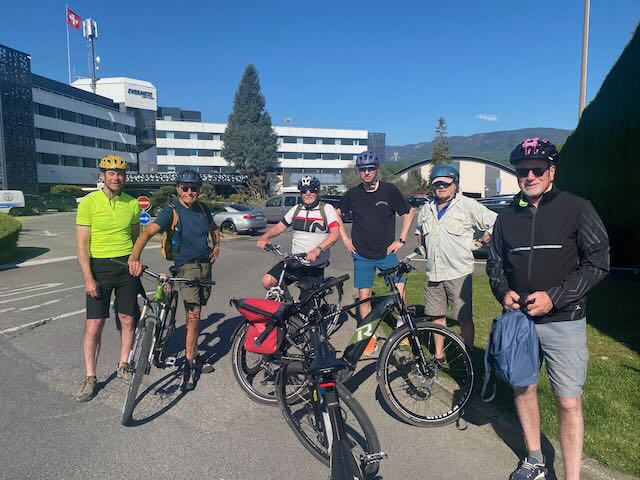
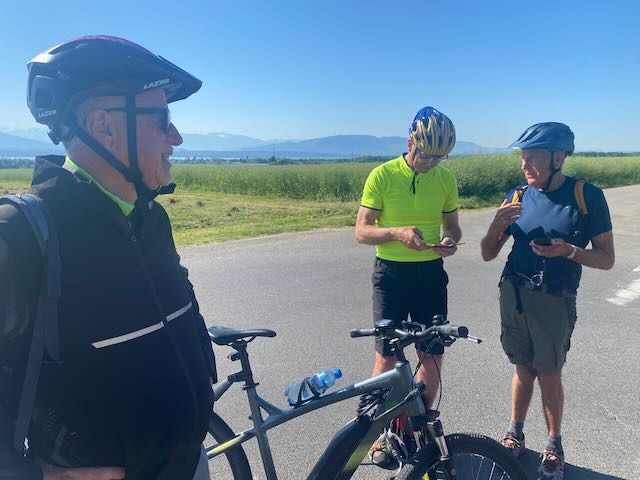
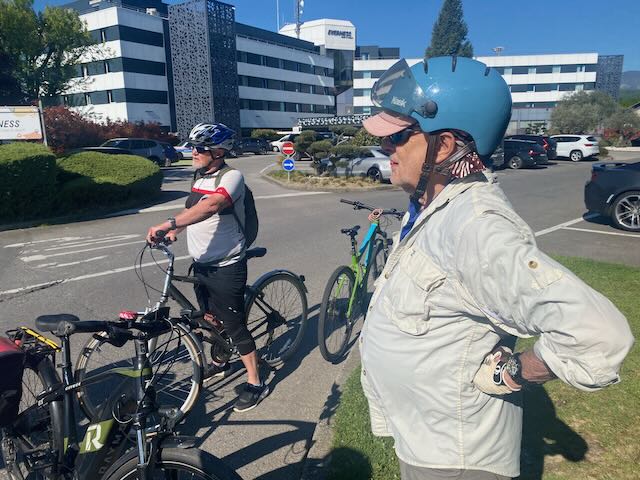
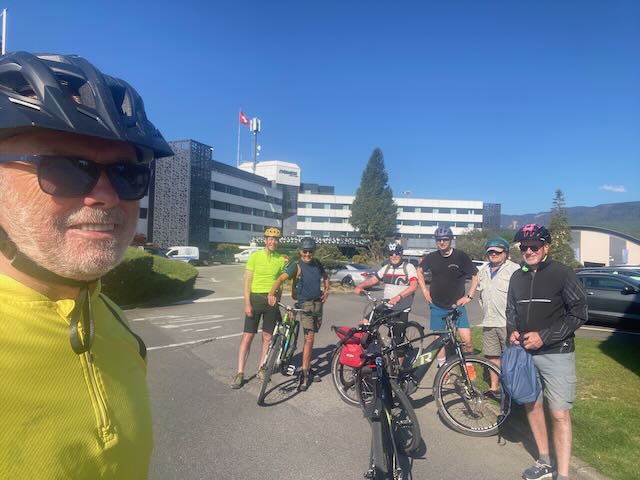
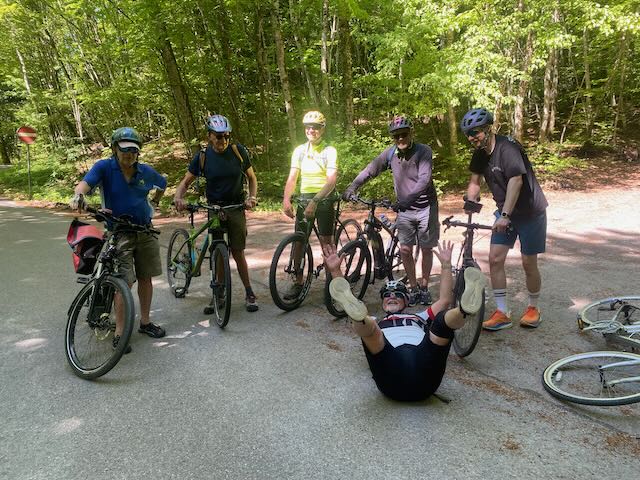
Seven keen GIN Bikers met at the Everness Hotel at 10h on Thursday, May 15th. Once again the gods were smiling happily and allowed us warm, sunny weather, although there was some wind ….. as we found out on the return leg. The starters were:
Stephen (Bleader) e-Reinier Peter D e-Richard e-Thatcher Mervyn Ivan
e-Paul joined us later on the route, avoiding his usual commute from Grand Saconnex. It was good to see the return of Reinier after a couple of years out but looking very fit and certainly the most practised of the group.
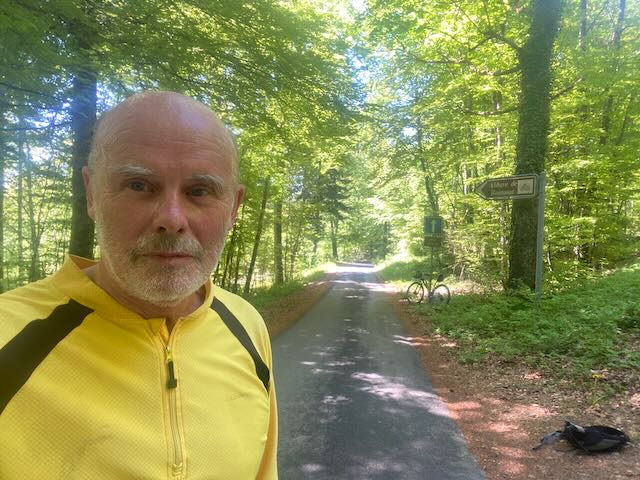
The Bleader had promised a tour to the vineyards around Satigny on the far side of Geneva. We set off promptly in order to make the planned rendez-vous with e-Paul at the Vireloup crossing into France. We followed the well-cycled Route 50, through the Versoix woods towards Collex. At one point Ivan decided to exercise his one gear fully, took the lead and left the peloton behind. Unfortunately for him, he was not aware of the twists and turns of the Route 50 and had to backtrack in order to recover the group. On the flat tracks to Collex the e-bikes could not show their uphill advantage, but with the first slope exiting the woods, it became clear that ageing muscle power alone was not sufficient to keep up with modern technology. However, the e-bikers graciously waited patiently in the knowledge that on the flat and downhill their 25km/h limitation would show a reversal in their fortunes.
For the first time in the Bleader’s memory, meeting up with Paul at the border was completely flawless…..the rest of the group and Paul being at the correct meeting point at the correct time. Earlier suggestions of a coffee in Fernex were overruled with an unopposed proposal that we could carry on to Choully and enjoy refreshment overlooking the vineyards. Fernex was somewhat more exciting than expected due to roadworks in the centre and diversions (which were neglected by the group leader at that time). After some further attempts at a breakaway group we managed to unite up the initial gentle slopes of the Geneva wine territories, through Bourdigny and onto Choully. This is a delightful part of the Swiss countryside and meandering through the small wine villages with views all around made those of us without electrical support almost forget the effort we were having to exert. Unfortunately, the Auberge de Choully seemed to be having an unscheduled break in operations. We attempted to gate crash a party being set up in a local vintner, who turned down the economic benefits of 8 coffees and directed us through Peissy to Russin, where we would be sure to find refreshment. This was in the opposite direction to the planned route but the Bleader recognised that a second outing without a coffee stop could jeopardise his future career and so he led the pack to a very welcome, if late, coffee (and in PeterD’s case the first beer of the day…..well, we assumed it was his first). Ivan very kindly picked up the tab.
Relaxed and relaxing we considered options. Lunch was booked in Meyrin at 13h. Ivan and Richard needed to get back by early afternoon. Across the road was a very adequate and tempting communal auberge. There was also the possibility of a short track back to Meyrin. In a democratic vote (some voters thought there was a lack of impartiality in the way the options were listed) the shorter and less strenuous routes back were rejected in favour of completing the original loop on the cycle track 172, albeit in reverse direction to the original plan. Unfortunately, this meant that Ivan and Richard made their own direct route back in order to meet their domestic commitments. The remaining 6 then started on the attractive but relatively hilly circuit back to Peissy. This passed through Dardagny, Essertines and through the Allondon Nature Reserve. It is amazing how perspectives change when you try things in reverse….what you thought were short downhill stretches one way become long, steep, endless hills in the other direction. However, e-bikers and conventional pedal-pushers alike completed the circuit without incident….but on a slightly differing timescale.
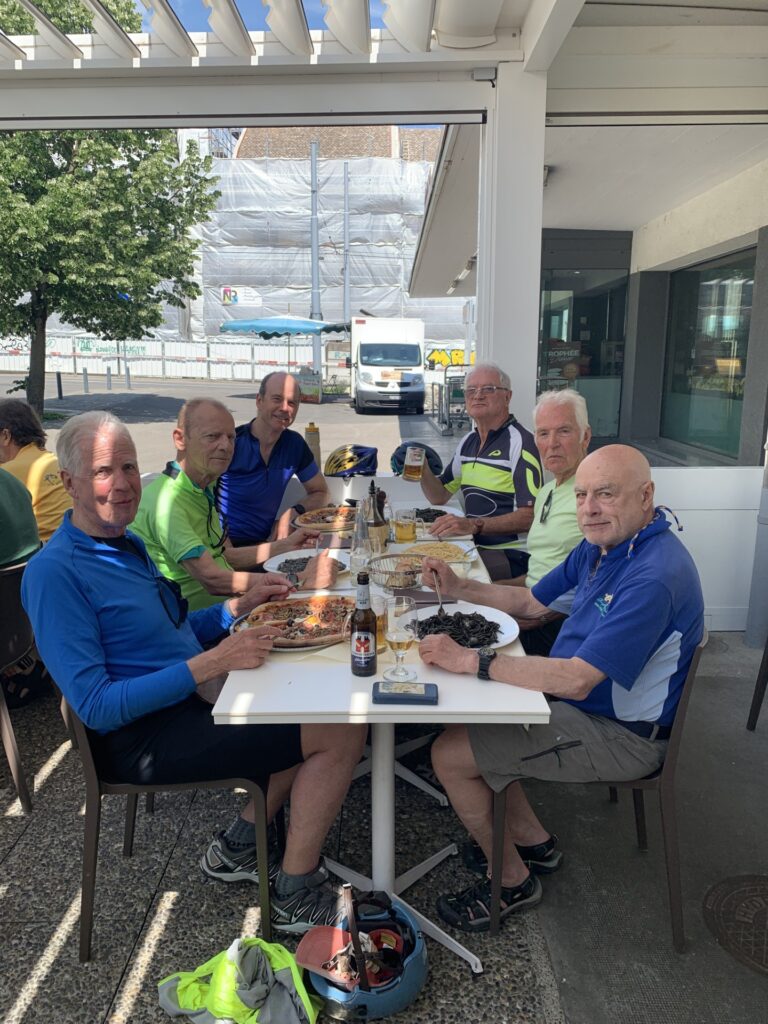
We re-congregated for the return to the bright lights of the city and to the centre of Meyrin for lunch at La Meyrinoise, which was in the top 4 restaurants in Trip Advisor. The route to the restaurant had changed since the Bleader was last there and at one point necessitated a climb up steps. At last a positive advantage for the conventional bikes to the extent that Thatcher drew blood in manoeuvring his heavy machine. Happily, nothing too serious and it didn’t seem to impede progress after lunch. Lunch started at an early hour for Spanish eaters but at the later 13.30h sitting for this Italian/Swiss establishment. Beers and other refreshments were orders and consumed and the meals were copious and filling, so much so that at least 2 pizzas were unfinished and there was still some pasta. Conversation was lively as you would expect.
An urban lunch after a ride in the countryside.
Movement after lunch was distinctly slower, impeded by the lack of blood flow to the legs and the headwind which became noticeable out of the woods. Paul took the direct path home from Meyrin and the remaining 5 of us retraced our path through Fernex, Collex, Versoix woods and to the Everness Hotel. Thatcher left us at Jumbo (leg repair kit?) and the rest of us dispersed to our respective homes and a well earned rest.
Formal route (Everness to Everness) was just under 60km with 645m ascent and an average speed of 18.8km/h.
12 good men and true assembled at the Col du Marchairuz for our GIN hike. 2 hounds also assembled who were good in parts but not in the least true!. We had some extremely welcome participants who had not been available recently in the form of Rudy P, Rob Pashley (again with non matching boots), Thatcher and Peter Drew. Stalwarts include Peter Taylor, Nathan F, Ross Linsley, Mervyn P, Peter Strebel, David Colledge, and Richard Saynor and myself. The canine section was as usual Kobie and Rocco. The weather was somewhat overcast and on the cool side but Peter T’s forecast ice age failed to materialise. No rain fell.
The assembled company set off more or less on time, descending behind the hotel towards the Valley de Joux before heading off to the southwest.
Early in the hike – all happy Looking aheadEven a bit of sunDavid, Rudi, Rob, RichardS, Thatcher, Ross, PeterS,PeterD,Nathan, MikeH, MervynWith PeterT
There were a number of ‘competing’ groups on the trail who were quickly overtaken and we soon reached the turning point where we crossed the ridgeline on to the lake side of the Jura.
The way homeBeginning to rise
We then had a gently declining stroll back towards the Col, appropriate for the gently declining GIN members, before beginning the ascent back up to the hotel. The last part of the walk was a fairly steep ascent which split the group for a while before we reunited at the Hotel for lunch. Three had to depart early but 9 of us assembled for lunch in the very convivial Hotel du Marchairuz.
The wine committee
Beers were had before the Wine Committee (Peter Drew and Thatcher) chose a highly quaffable red. The croute au fromage soufflé came highly recommended and the entrecôte was also approved of, not least by Kobie. Pig’s ears were found most acceptable by both Rocco and Kobie.
Time flew – above us
We tried to avoid talking about Donald Trump and mostly succeeded. Lunch can fairly be described as convivial.
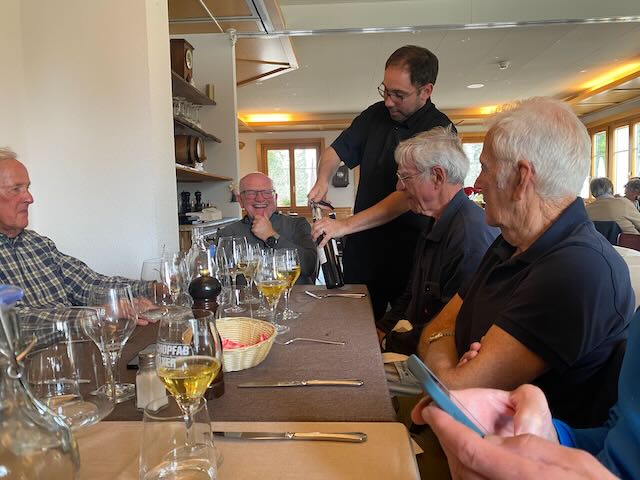
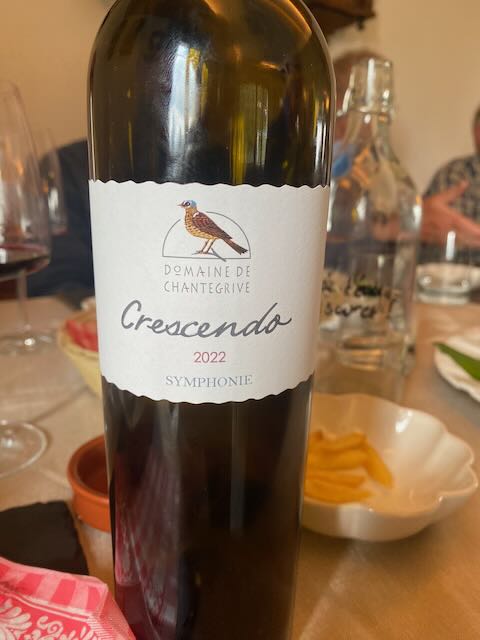
Kobie was on a training session – how to behave properly in a restaurant – it did not go too well at times…The excellent wine arrivesWe reached a crescendo – really a rather good local wine. 2 bottles sufficed
Distance walked was approx 11 kilometres and vertical height gained was 350 metres.
Rob and I did discuss a plan for later in the summer which involve starting at St Cergue and walking to the Hotel du Marchairuz and staying overnight before walking down to the Vallee de Joux and taking a train back via Vallorbe. Early stages but we are thinking of perhaps July. We will do our research and come back with a firmed up proposal.
Mayday mayday. Normally a call for help – but happily no infarctions or other incidents occurred on this first bike ride for a while and the first with our BLeader for 2 years (he recounts).
There should have been eight of us but sadly Drew had to pull out so we were the Magnificent Seven instead of a Great Eight. It was indeed a magnificent day and we all assembled at 10 am at the Everness. Attending Stephen (Bleader), PeterD, Ralph, Ivan, E-Paul (who had biked out from Geneva) and E-Richard, with me (out on my 3rd ride of the year).
Only one small cloud at the Everness meeting point
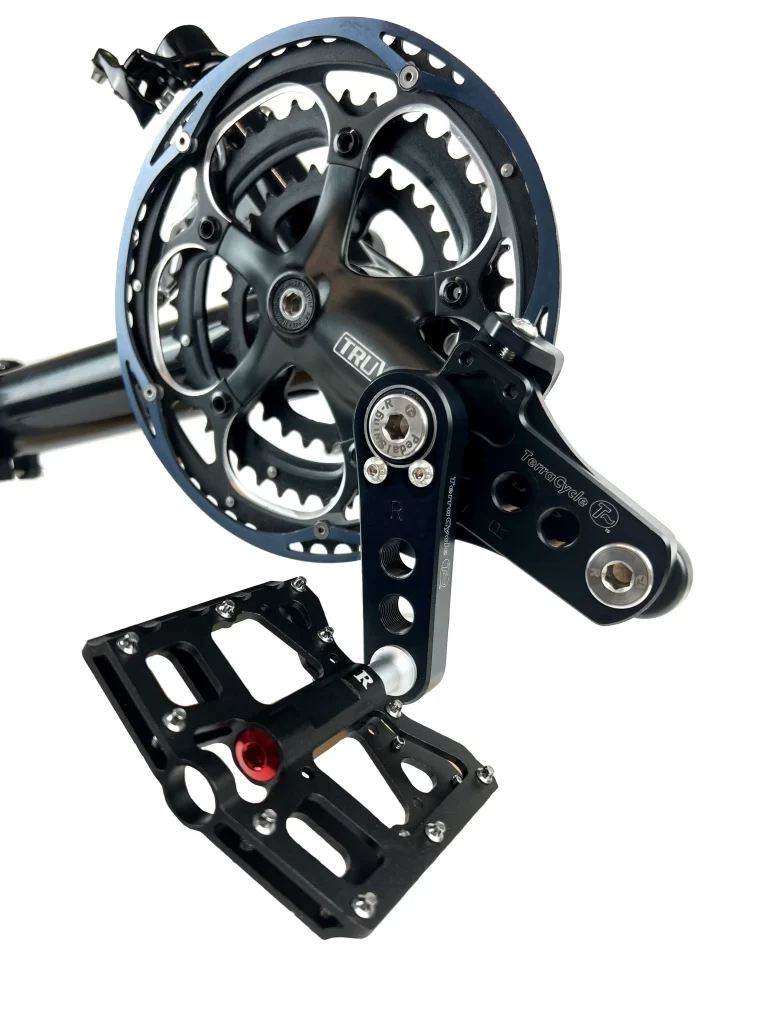
Stephen has adapted his bike to accommodate a leg that does not (yet) bend quite enough, after his knee replacement. A fascinating but simple additional pedal and crank attached to the original pedal crank.
I found an example on the internet that looks similar to the one he has on his bike.
An amazing crank device that does the trick for Stephen
There was a feeling of good cheer in the team, a shining sun, a lunch at Coinsins and only a Bonmont in prospect to spoil the pleasure.
E-Richard with Stephen and PeterDRalph and E-PaulAll seven of us.
We set off gently through the woods and over the Versoix River to Grilly. Talk of a coffee at Crassier morphed into a coffee at Givrins after achieving the Bonmont goal. We traversed Divonne and headed up towards Bonmont passing Tranchepied. The angle increased as did the effort. E-Bikers sailed up the hill while 5 of us struggled up. Ralph complained that his bike was designed more for flat and downhill riding, but he made it. The temperature was perfect.
Me with my bike at the St Bernard sign (I have 240 similar photos from 2020)The team at Bonmont with Ralph adopting the brace position
After a period of self congratulation we headed off down for a Givrins coffee. Except that our BLeader took an executive decision to forego coffee in favour of earlier beer at Coinsins. We freewheeled down in the warm morning weather and turned into the carpark at the Coinsins restaurant. Being 1 May there were quite a number of diners in place already.
There followed some excellent beers and we all chose the steak frites, except Richard who chose the sausage but with frites not rösti. Much discussion still about Trump, the state of the world and growing vegetables. Paul had just returned from Indonesia and was still jet lagged, but he was energised by the wonderful sub aqua and temples he had just experienced. Ivan was recovering from a bad knee accident playing basketball but now seems on the mend. Stephen seemed relaxed and indeed cruised the whole route with his offset crank. Richard back from 3 months in S.Africa seemed good to be back.
After coffees we all heading back to Gods Crossing, with first Paul turning left to the Nyon train, then Ivan breaking off to his home.
A really pleasant ride with a Bonmont that looking back did not seem too hard, and a great lunch outside on the terrace under a substantial sunshade.
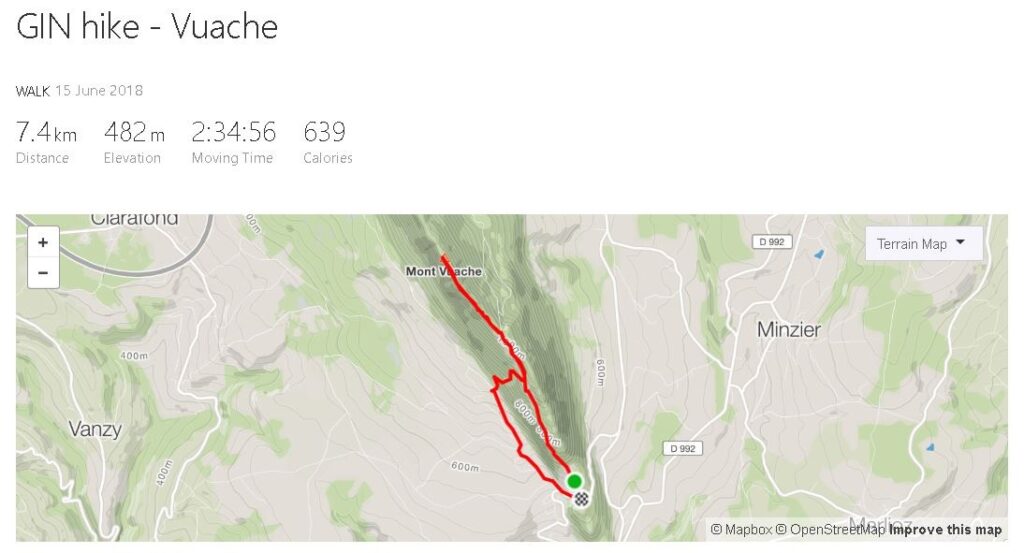
Nathan organised this excellent hike warning us however, in view of the uncertain weather forecast, to “be prepared”. He recommended us to refer to Philip’s description of the terrain, from his 30 March 2023 blog. See below in blue. (Philip also reported in 2023 that his search of the “dusty GIN blog archives” revealed that a similar hike was organised in June 2018 by David Colledge. There were three participants then, an indication of the significant increase over the last 5 years in GIN hiking interest.) I note that David wrote – Lunch in La Cave de la Ferme in nearby Frangy – highly recommended with 4 course lunch at €16.50.
Further research into the dusty GB archives showed that David organised another hike up the far end of the Vuache in May 2019 from Chevrier with 4 attending. David wrote “altogether about 3.30hrs followed by a very reasonable lunch at Restaurant du Vuache.”
Philip : “The Vuache is a long lean mountain. Not at all a Fujiyama. Not even a Môle. But I see it every morning from my kitchen balcony. And it tells me what the day’s weather will bring. Geologically it’s part of the Jura range. Good Jurassic limestone, no doubt riddled, like the Salève, with water-filled cavities. And maybe bottomless potholes that nobody has explored. But physically it’s an isolated mountain, cut off eons ago by the melt waters from the immense Rhone Glacier that filled the whole Lemanic basin. And it holds secrets known only to those who explore it in early Springtime.”
On that hike in March 2023 hike we were 11 : two Marks, PeterT, Nathan, Rudi, Richard, Mike M, Ralph, Drew, Mervyn and Philip and hounds Kobie and Nessie. On this hike we missed Mark 2ts, Rudi, Richard, Mike M (and Nessie) and Mervyn. We added on this occasion Mike H (and Rocco), Stephen and Ross and were thus 9.
(I was told that several absent members have poor knees – at least they gave that as an excuse to Nathan. I can only recommend daily taking Pernaton tablets – they have saved my knees. )
Unhappily the timing this year was different, it not being early Springtime. So we missed the wonderful display of daffodils (that we had seen two weeks ago on Mark’s Dôle hike). And unhappily too the warm sunshine we had enjoyed two weeks ago was missing and we experienced instead a cold dry and windy day almost exactly as per 30 March 2023.
Same route as in 2018 – but my watch showed 9.2km and 546m denivellation
It did not start that way as there was some weak sunshime as we ascended the ridge from Chaumont attempting to catch up with Philip who had started 15 minutes earlier.
Nice early sun – luring us up into the cold grey Vuache againNear where we met Philip
We caught Philip up after about 300m of ascent. He was gayly and gently elevating himself up the ridge, stopping to take close-up photos of the plants he loves (not daffodils though).
Philip writes : –
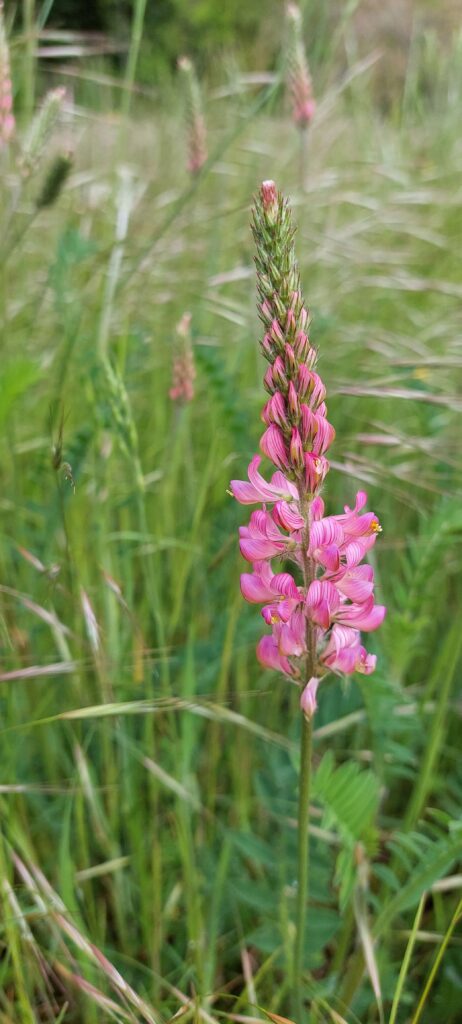
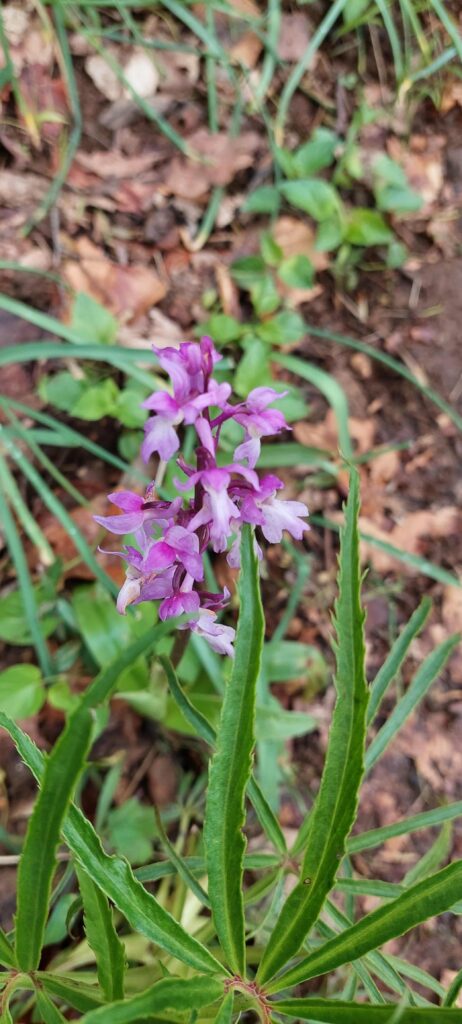
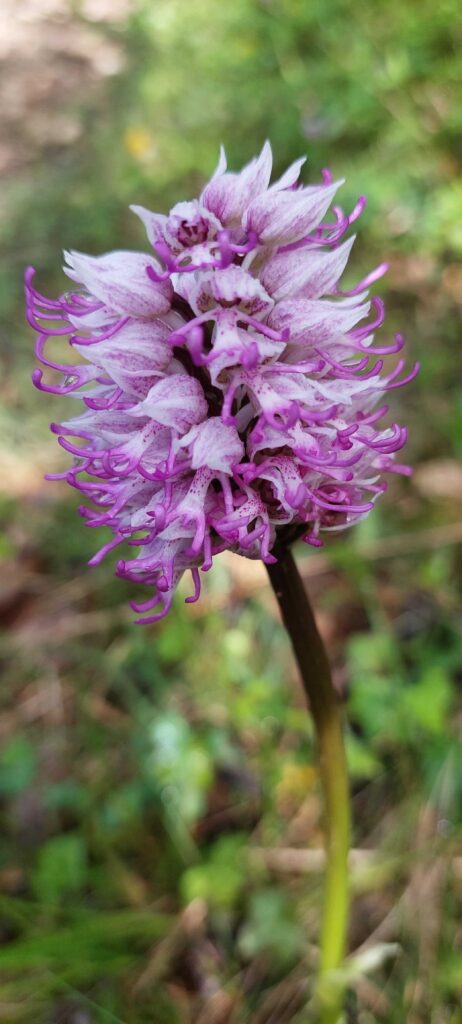
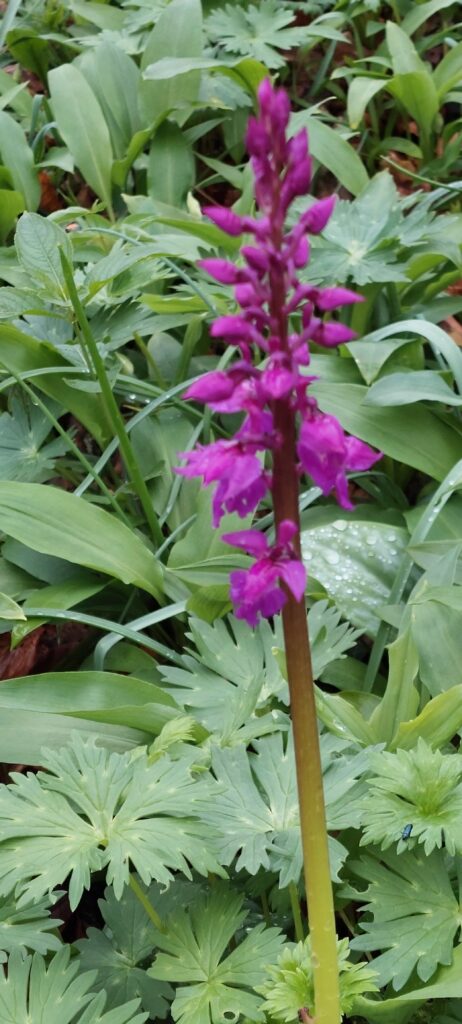
Thursday’s ascent was the first time that I had seen wild orchids actually in flower on the Vuache. Having given myself a 15 minute head start on the peloton, I had time to photograph them (and have a breather!). The GIN plant enthusiasts, of which I’m sure there are many, will no doubt welcome this botanic addition.
I have given the relevant plant names to the photo files. I’ve also added one non-orchid, Sainfoin, the reason being that it’s a real beauty, whose identity had me initially confused until PlantNet put me right.
At one point Ralph kindly offered us all a cup of his hot strong black (and good value) coffee. Excellent! I almost did not miss Mervyn and his milk.
Onwards into the gloom
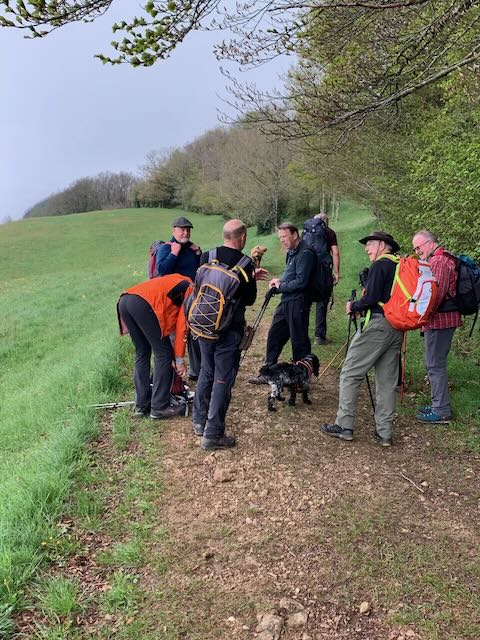
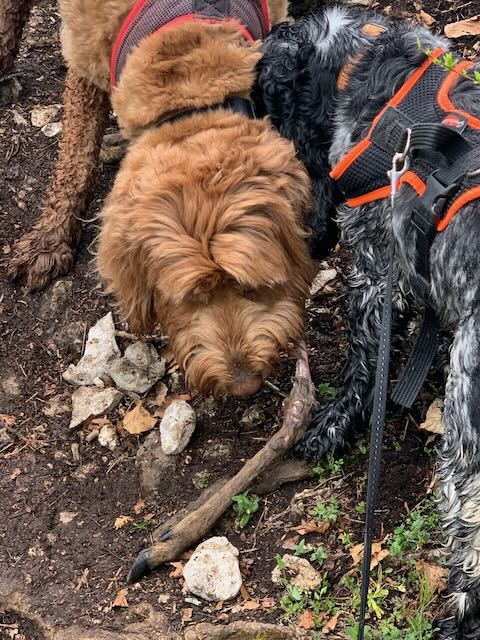
At a large green field two chamois (or deer according to Mark) broke cover and Kobie went off to investigate but soon came back. It was not long however before he found a leg bone of a deer (or chamois) left by hunters and he and Rocco spent some time arguing over who should eat it. Both won.
A bone struggle
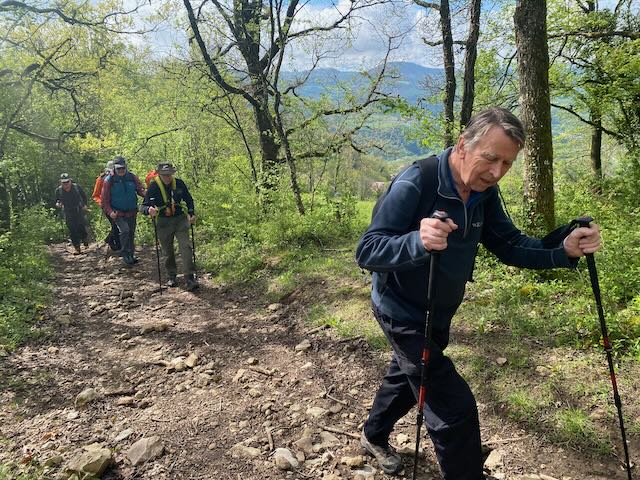
We wandered on up along the woodland path which traces the spine of the hill, in places steep and rocky. I spotted only 3 daffodils still in flower, but there were many other flowers (Philip will tell us).
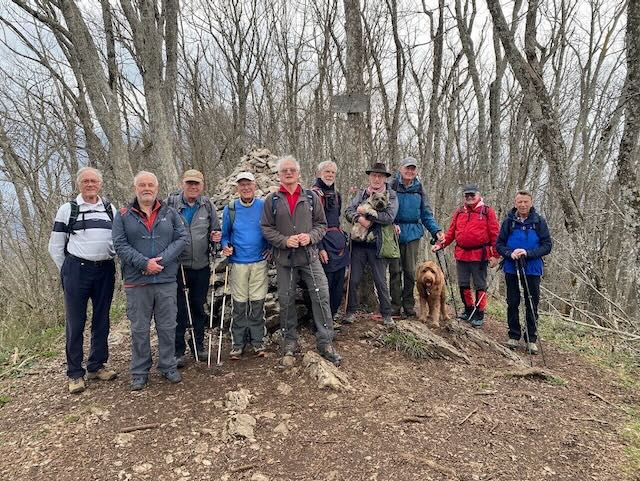
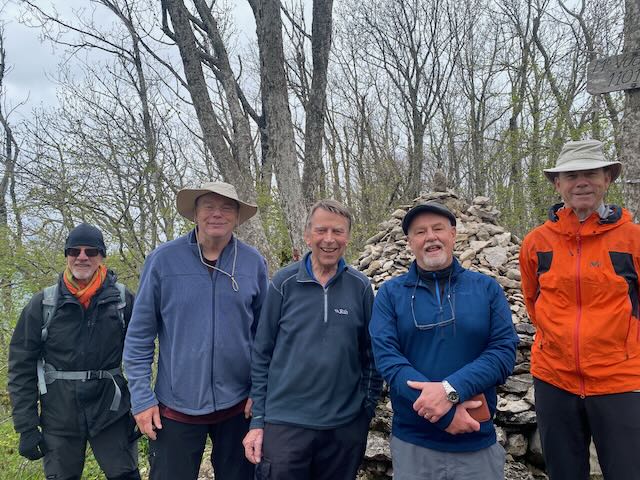
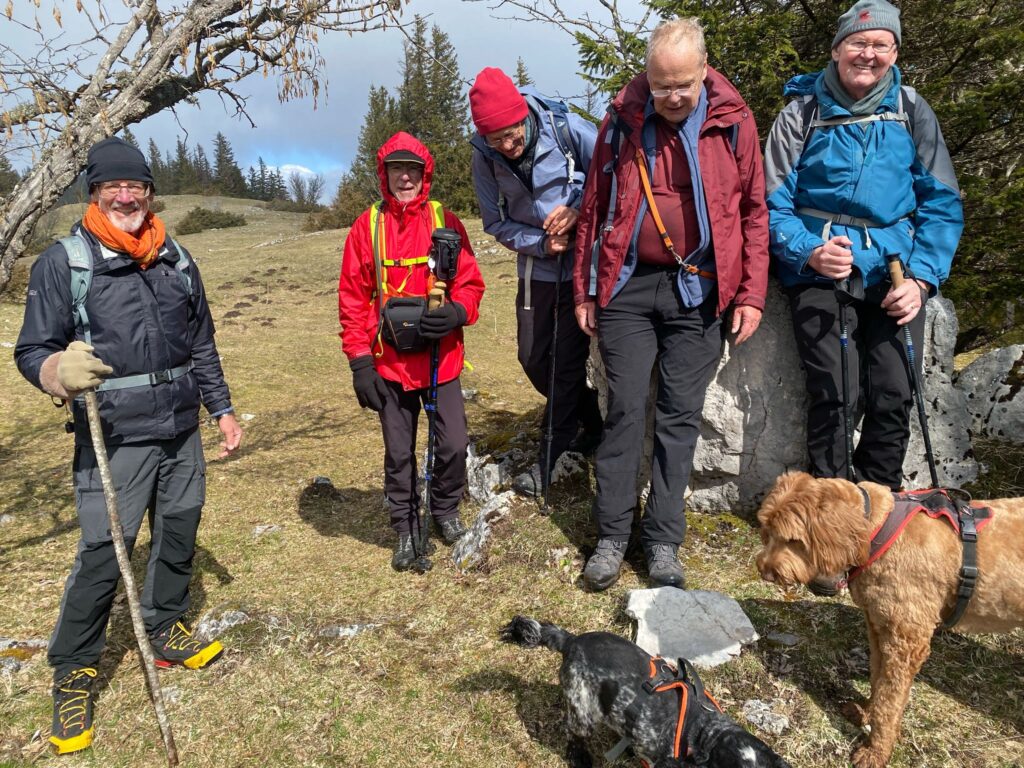
Summit party 2023Summiters 2025 – 1101m Vuache With hounds Using my (good value) selfie stickPhilip and Nathan came along a little later
On the way up we had noticed a picnic table at the top of the green field and members retraced steps back to it, keen to tuck into some warming sustenance and whatever wines were on offer. In this case a Nero d’Avola and a Rasteau. Drew of course had his flask, but we missed Richard and his abominable bottle.
Philip wrote 2 years ago :- There was no handy auberge nearby, so we ate our picnics (in a particularly windy spot) with extensive views over the Rhone Valley and in the distance the Plateau de Retord. This time we had the same wind and views, but the advantage of a (slanting) table that sat 8 of us, albeit we were 9.
Descending – not like spring here.View back to Lac LemanThe view below – with scudding low cloudDescent to lunchLunch table – uphill sideThe picnic table was not exactly level..
All too soon it was over. No time or inclination to discuss Scottish independence. This was a time of Trump Tariff madness.
On the return, we initially retraced our steps but then Nathan again deviated down the steep western slope of the Vuache, fortunately relatively dry and unslippery. This took us through the hamlet of Chaumontet and back to the village of Chaumont. (most of this para was copied from Philip’s 2023 blog).
We passed some very young climbers about to start out on the training rock slabs.
Another enjoyable hike on the Vuache, despite somewhat inclement weather and gone daffs. About 10km and 546m denivellation. Thanks Nathan.
Attendees – MikeH and Rocco, Mark2rs, Drew, Stephen, Ralph, Philip, Ross, PeterT and Kobie, Nathan (Leader).
(I’ll post other pics if folk send me any – or do it yourself if you can. PT)
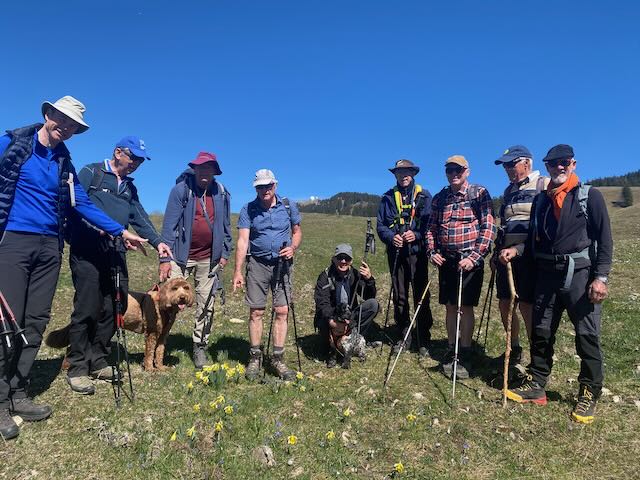
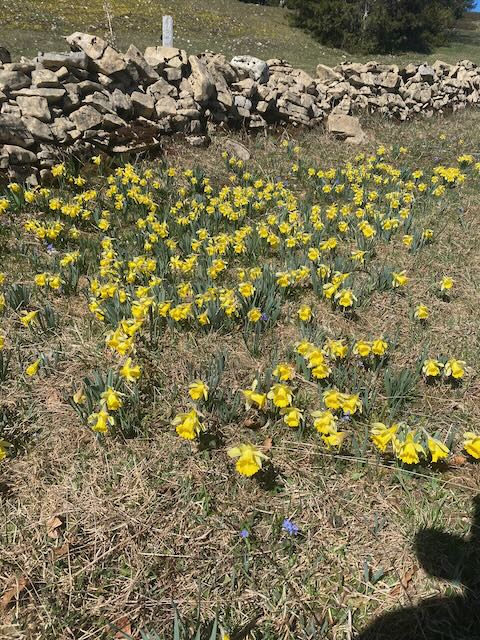
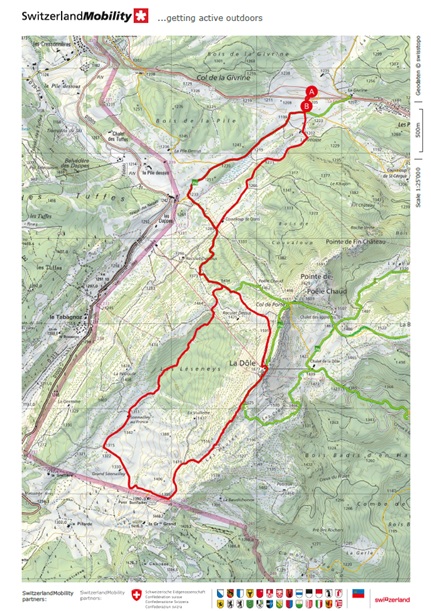
Each year for the last 4 years we have had a hike early in the season to Sonnailley to see the fields of daffodils. A couple of times we arrived just after they’d finished and this time we arrived slightly too early. Still there were some daffodils on display and it was a very enjoyable first hike of the season.
Five of us: David C, Mervyn, Nathan and 2 Marks met at the parking in Divonne and drove up together to meet Peter, Steven, Ross, 2 Mikes: Hempstead and Mathews, and 2 dogs: Kobie and Rocko, at La Givrine.
It was a clear day with no prospect of rain but a strong, cold wind so we were all well wrapped up. After the usual fuss with the parking we were off. We walked up to Couvaloup de Crans, sadly closed midweek, and on to the top of the Dôle. Here we stopped, slightly sheltered from the strong wind, for refreshments. It being close to the birthday of one of the members a glass of crémant d’Alsace seemed appropriate.
Sheltering from the wind
On the way up we had seen about 6 daffodils so the prospect of seeing a field full of them seemed remote. On the other hand there were masses of crocuses.
The view from the Dôle was magnificent, we could see the whole lake and Mt Blanc in the distance. Sadly this is never properly captured in a photo.
Duly fortified we ventured out into the wind and began the descent to Sonnailley.
We’d got through the difficult bit of the descent and almost reached the plain when we realised we were semi dogless – Kobie was not with us. After much blowing on whistles there was still no sign so Peter went off on a hound hunt. The rest of us were on a gentle grass covered slope, in the sun and out of the wind, and it was already 1 o’clock so we decided to have lunch while waiting for the absent dog and master. This had been promoted as a daffodil hike and there was one solitary bunch in view with 5 flowers, somebody counted.
Peter and Kobie soon returned and we were treated to a selection of red wines courtesy of Peter, Stephen and Mervyn, followed by the inevitable black coffee from Mark. Some trouser legs were removed to reveal very white legs and all seemed well with the world as several layed out in the sunshine and maybe even had a sleep. Unfortunately our mean leader could not get comfortable so we all had to set off again towards Sonnailley.
So there actually were some daffodilsAnd even more
We then started the return via Sonnailley au Prince and a lovely path through the forest to arrive back at Couvaloup de Crans, sadly still closed, and on to la Givrine.
All agreed it was a great walk to start the season. 14 km and about 690 m.
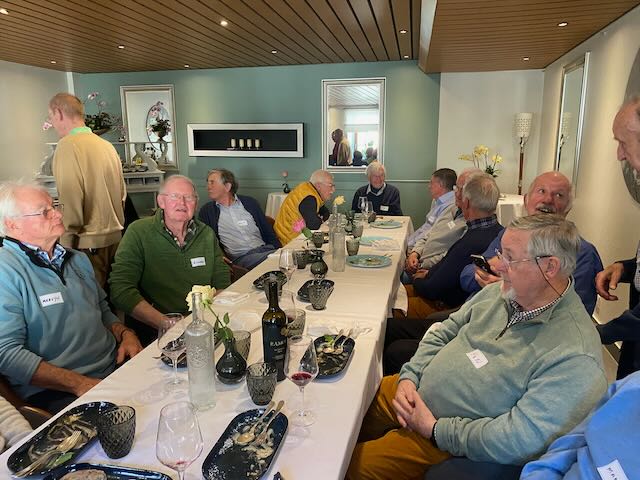
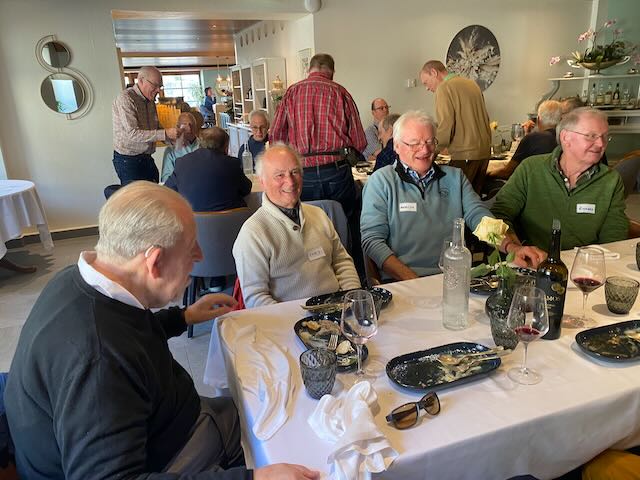
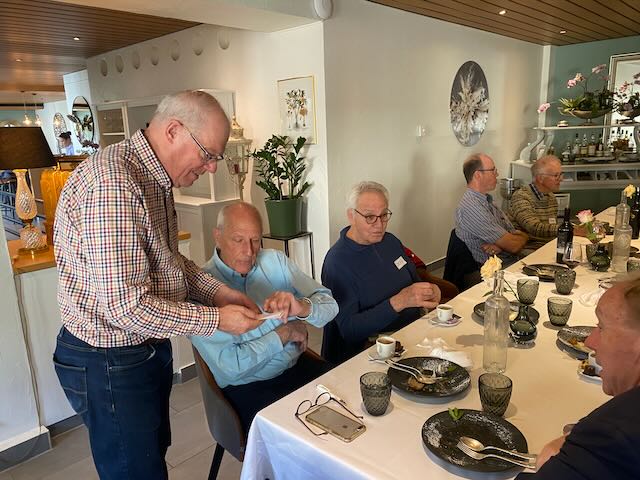
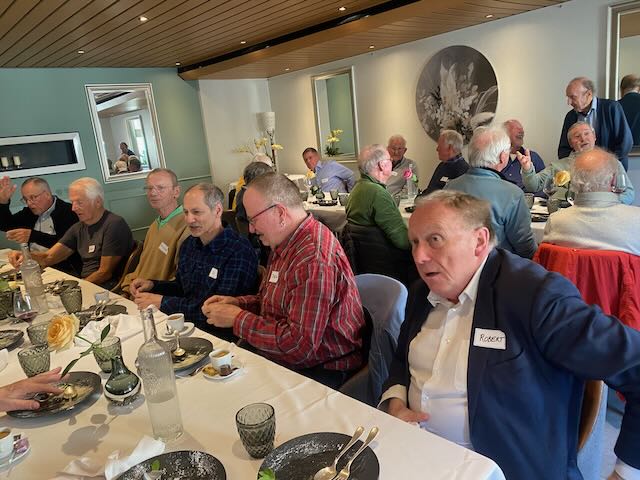
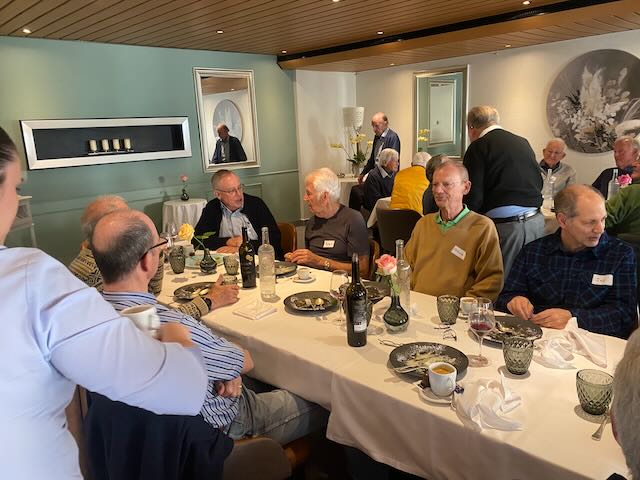
We were 26 “Gintlemen” for our lunch at the Auberge des Trois Tilleuls in Genolier village on Thursday 3rd April:
Norman Eatough
Peter Taylor
Chris Morris
Gary Van Natter
Mark Watts
Kent Forrester
Robert O’Riordan
Rudolph Staehelin (new member)
Trevor Davies
Stephen Long
John Burley
Peter Drew
Joe Kutzin
Drew Meek
Terry Gale
David Colledge
Mark Warren
Philip Jenkins
Mike Clayton
Richard Saynor
Reinier Tervooren
Mervyn Powell
Mike Price
Brian Allardyce
Jeff Shane
Jeffrey Crudgington
🍽🍷
Jeff
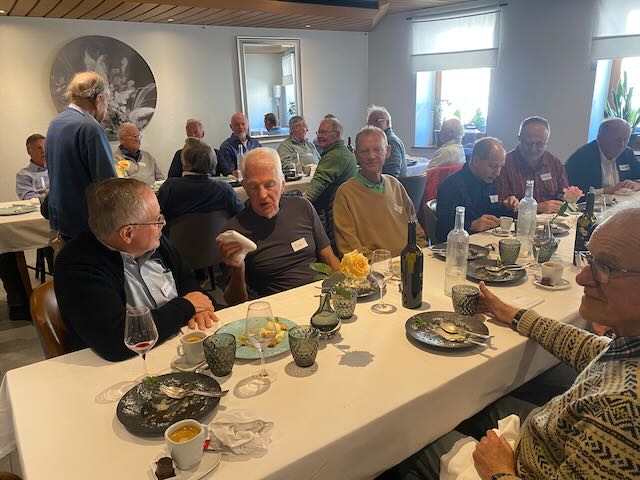
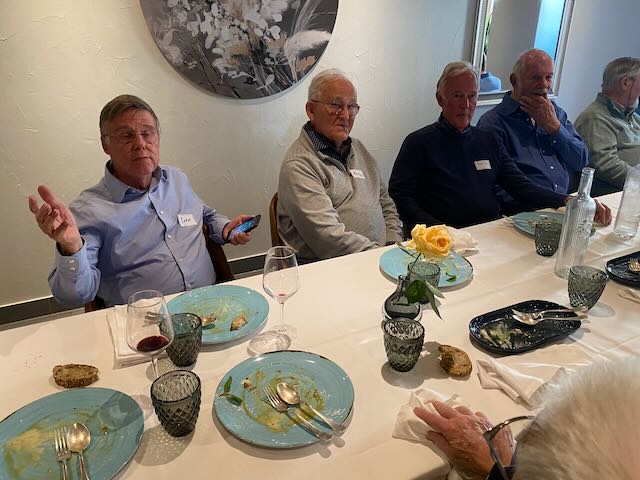
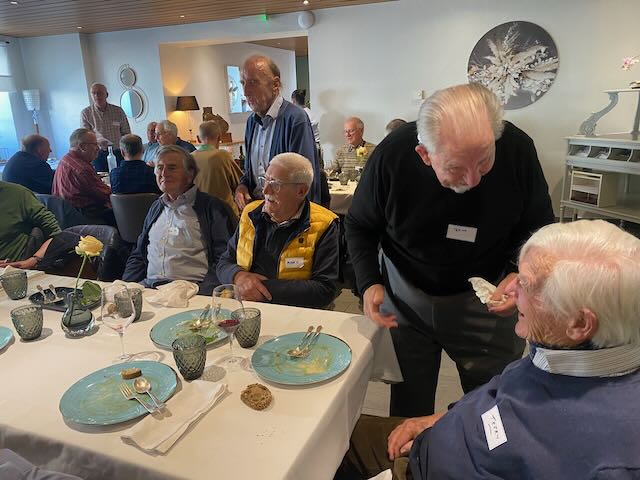
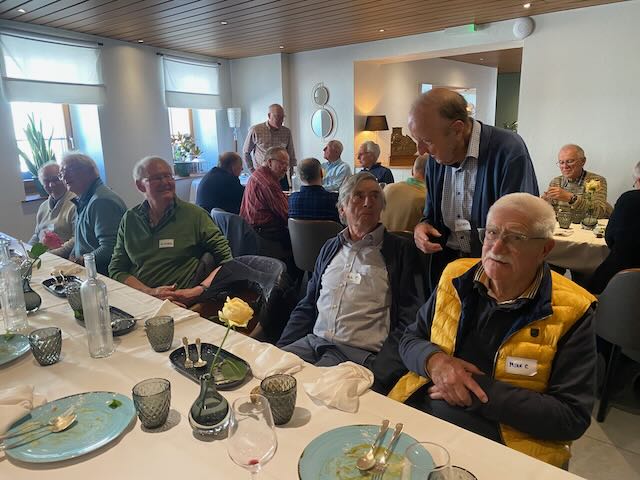
It was a fine lunch with excellent food, wine and service all at a good value price, in wonderful spring sunshine. Many thanks to new member Rudolf for sponsoring extra wine. We had the whole of the back room to ourselves. Jeff introduced the staff to us at the beginnng and again thanked them on our behalf at the end. This is a restaurant well worth revisiting.
Photos below taken at/after coffee. All self-explanatory.
Six participants (Peter T, Mike H, Nathan, Richard, Ross, and Peter S) with 2 dogs (Kobie and Rocco) met at the Col du Mollendruz for the last snowshoe of the 2024-2025 season. Cloudy skies, the cool temperature (3°C) and a brisk bise wind called for extra jackets, beanies and gloves. There was no sign of any snow and definitely no snowshoes or crampons required.
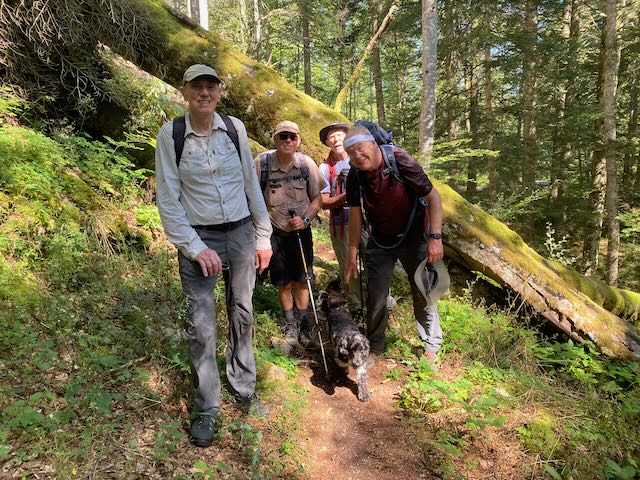
The trail started on the left side of the Nordic sport cabin and headed down the gravel road to the Grand Chardeve (1097m) where it met the path up from L’Isle. After a gentle climb up through the forest we reached the fallen tree for a photo reminder of a previous hike done in Aug 2024.
This time RichardS is with us, as well ats PeterS and Ross.Aug 2024 Hike. We met RichardS at the Chatel Restaurant on the top.
A little further along the contour, a quaint chalet (Chalet des Italiens) with 2 benches prompted a water break. While Peter T and Ross settled in on the benches, Mike tucked into his sandwich thinking it was picnic time.
At the apèro stop with only nuts for apèro
After a short inspection of the inside of the chalet, the group continued up to the junction with the path from Montricher and then onwards to explore the archaeological site of the Chatel d’Arruffens. The panel describes its origins as a fortified refuge which was used between 1500 BC up to 150 AD by ancient Celts during “troubled times” on the plains below. Little remains of the fortifications except a small cluster of “sacred rocks” which resulted in another photo opportunity.
Richard leans on and PeterS inspects the sacred rock – in the SUN !!
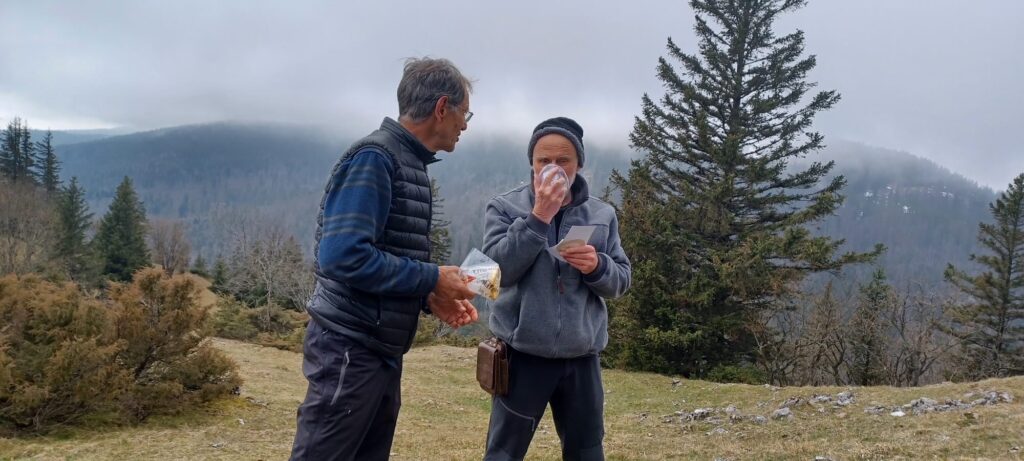
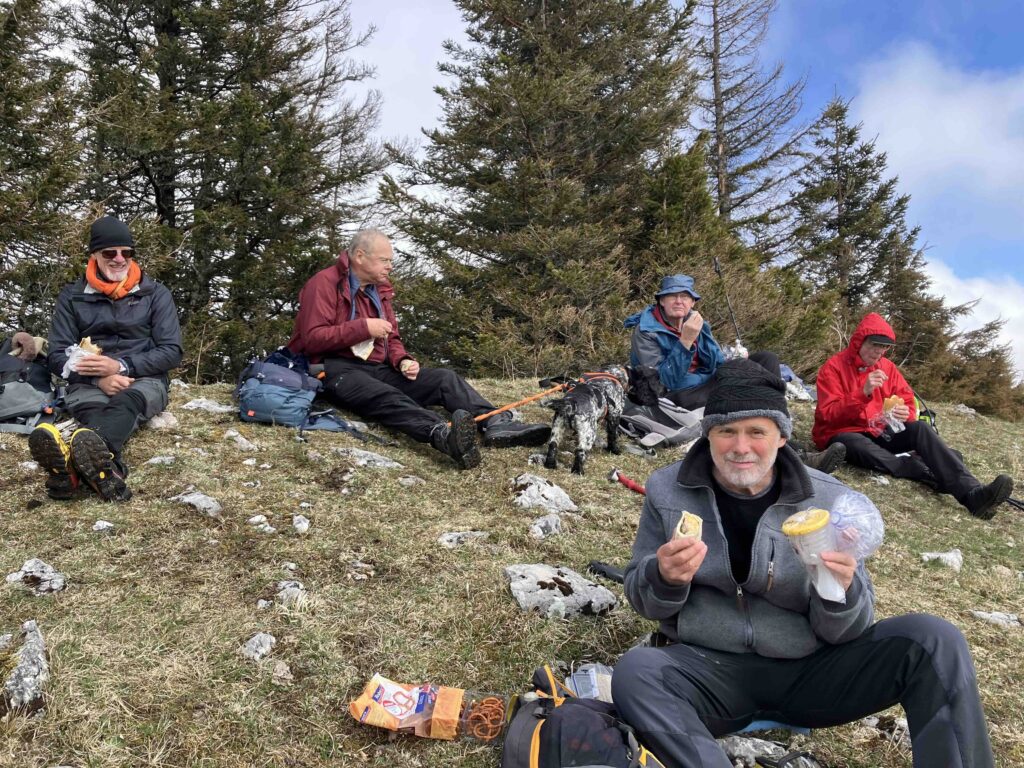
After some indecision, a sheltered mound was chosen for the picnic. Before tucking into his ham and cheese wrap from the Volg, Peter T demonstrated use of the new suction device (LifeVac) he had acquired in case of a choking attack. This was quickly followed by the opening of a fine bottle of Cote du Rhone which served to, as it were, wash it all down.
The LifeVac SeminarLunch Spot – PeterT and his ham and cheese sandwich (The Volg Choker) – and his LifeVac
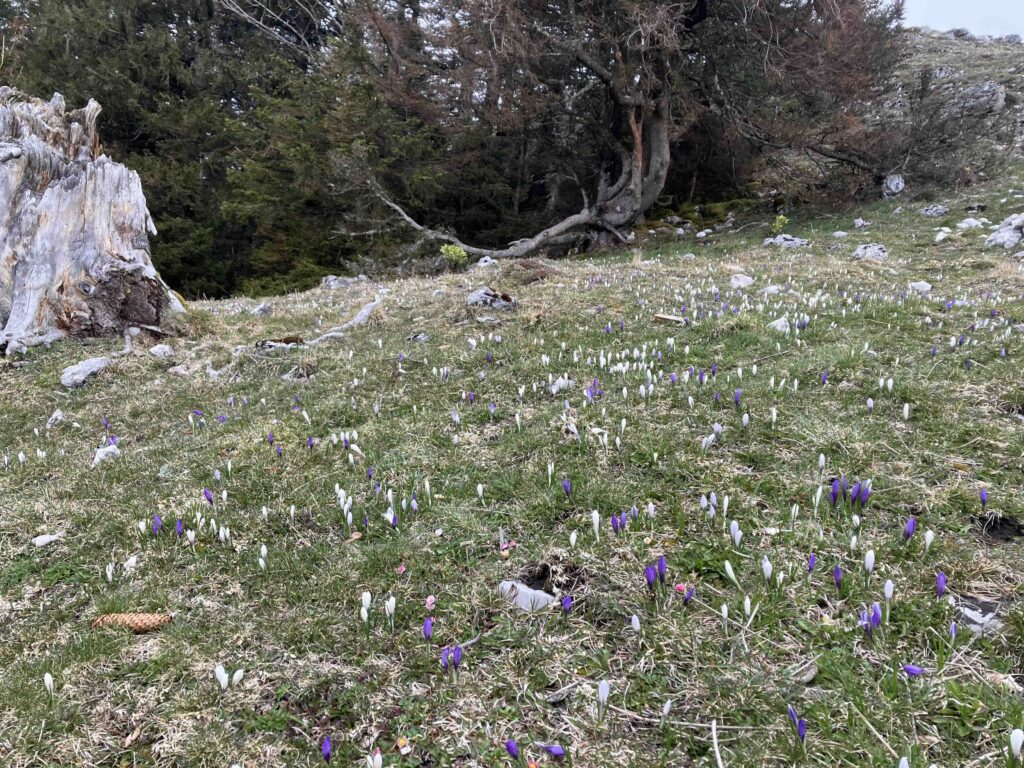
After leaving the picnic mound, the path led up through fields of early white and purple crocuses waiting for the sun to burst into bloom.
Croci
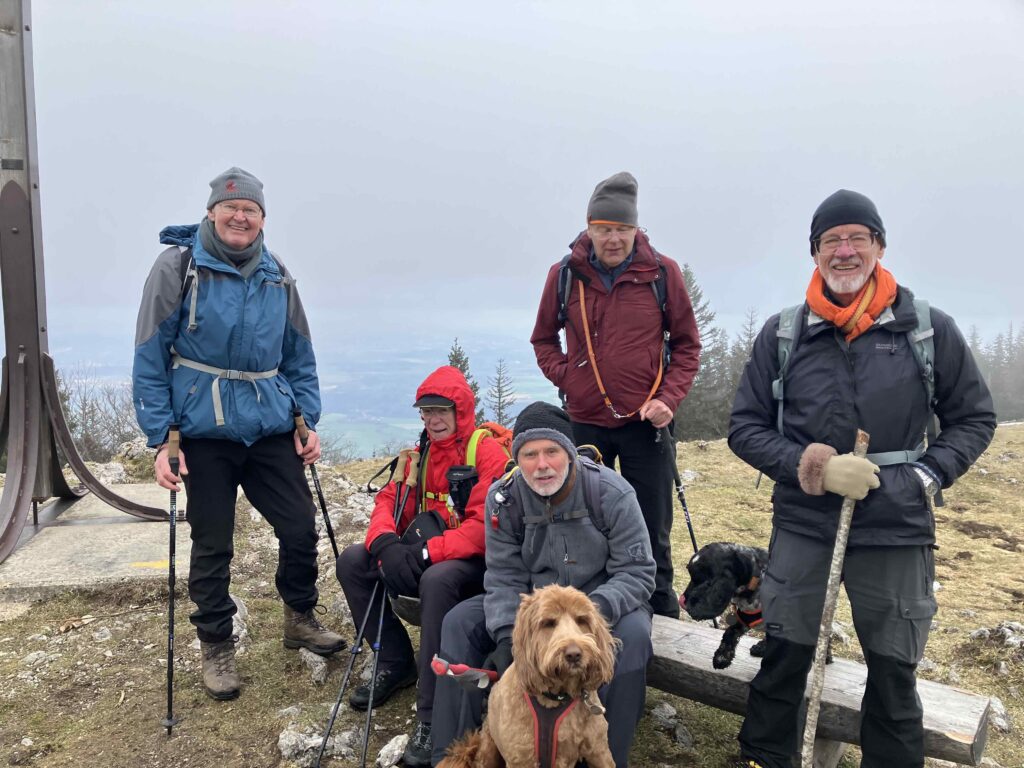
With the bise picking up, there was a brief stop at the cross marking the summit of Chatel 1404m) before descending down into the valley below the Buvette d’Chatel (closed in winter).
Summit photoWe passed this way on 16 Sept 2021
A short uphill led to the Jura Club of Cossonay where the sheltered porch allowed savouring the Corsican cedar brew from Richard’s renowned bottle.
Coffee stop and Richard offers his Corsican Cedras libation (quite nice)
The final stretch tracked down the road to emerge from the forest above the Chalet du Mollendruz (recently closed at the end of the winter season). The group returned to the Mollendruz parking to complete a 4.5 hour tour of 11 km, and ~500m dénivelé.
This is a short record of a necessarily limited group visit to CERN on 22.2.2025.
On 4 Jan 2025 a few selected folk received this email from Mervyn.
“Firstly, Happy New Year to one and all.
Secondly, here is your exclusive invitation to join a private group visit to CERN.
We will have the services of a qualified guide, an ex-CERN employee, friend and neighbour, Dr. Gunnar Fernqvist on
Date: Saturday 22 February 2025
Draft Programme:
09:00 Rendezvous at CERN Gateway (Parking available)
Introductory film
Selfguided tour of the exhibition area
10:15 Depart (by car) for underground visit of the LHC
11:00 Visit the CMS
12:00 Return by car to CERN
12:30 Lunch at CERN
14:00 Walking tour of other CERN exhibitions and sites
16:00 End of visit
IMPORTANT
Please confirm your interest to participate by return email as capacity is limited to 12 (adult, able-bodied, non-pregnant!). Please state your name, nationality and date of birth.
Joining instructions will follow once group participation is established.
Brush up on your physics!
Mervyn”
The day 22 Feb 2025 finally came around, grey and a bit cold. Rob picked me up and then Ross before we drove to the CERN parking near the Gateway. The Science Gateway is a much improved visitor centre (from the original that I had experienced 25 years or so earlier).
To plan a visit – see
https://visit.cern
CERN Science Gateway
CERN Science Gateway is a place to explore CERN and science through authentic, innovative and inspirational experiences. It is CERN’s new education and outreach center, where we take visitors on a unique journey building on the physical proximity to CERN, its accelerators, detectors, facilities and people.
Through immersive multimedia exhibits, hands-on lab workshops, science shows, events that blend science and culture, innovation-prototyping workshops and tours of authentic CERN places – all guided by CERN people – visitors of all ages and backgrounds can engage in the discoveries, the science and the technologies of CERN.
Our vision is for a world where science and learning are part and parcel of everyone’s life. Our younger visitors may leave inspired to explore a career in science and technology. We hope that all visitors will feel empowered to make sense of the science that shapes their lives.
This vision is housed in an iconic building designed by the world-renowned Renzo Piano Building Workshop, with support from Brodbeck-Roulet architectes associés.
An iconic building
Inspired by the diversity and curiosity that are intrinsic to CERN, the building encompasses multiple elements, embedded in a green forest.
Five different spaces host three exhibitions, two hands-on labs, an auditorium, a shop and a restaurant, all connected by a 6-metre-high bridge that spans the main road in front of CERN. Two suspended tubes mirror the cutting-edge technology of the CERN accelerator complex. Raw shapes and forms, and exposed concrete celebrate CERN’s industrial character.
The building symbolises the inseparable link between science and society, with sustainability at its core. Almost 4000 square metres of solar panels provide energy to the Science Gateway and other CERN buildings. A forest of over 400 trees and 13 000 shrubs provides a habitat for animals and plants. When in operation, the building is carbon-neutral.
We reinforced ourselves on quantum coffee as 12 of us assembled, a leader and 11 bosons, not all GIN members but all with an inquisitive bent.
Gunnar Fernqvist (Leader)
Mark Watts
Lynda Watts
Henry Watts
Richard Saynor
Paul Sochaczweski
Mervyn Powell (Organiser)
Peter Taylor
Robert Pashley
Ivan Rykov
Ross Linsley
Philip Jenkins
We had a strict timetable to adhere to as CERN receives thousands of visitors per week and parties are guided on timed visits. During our visit we noted parties bumping up behind us when we asked too many questions or lingered a little too long, but this was not a serious hindrance and we did not collide.
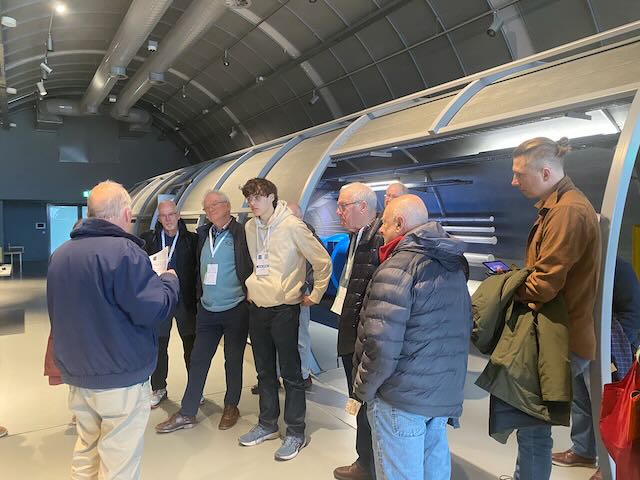
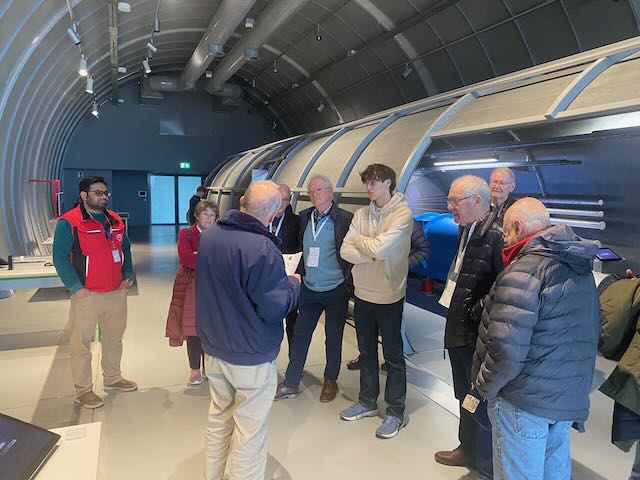
We started up in the Gateway to watch the introductory film, but a large group of Italians visitors (in 3 coaches) were in the mix so the whole film was to be in Italian. We decamped instead to the Gateway exhibitions where Gunnar explained the basic working of the LHC and its related experiments (ATLAS and CMS (Compact Muon Solenoid which we were to visit) being the hi power ones).
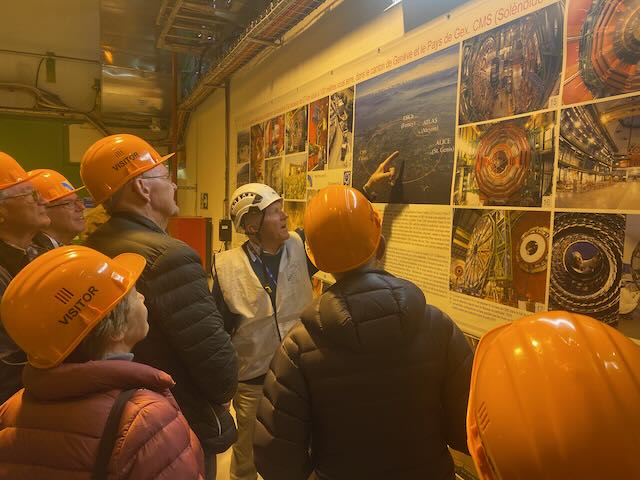
Gunnar gives us an outline of CERN in the visitor Centre.
Here is the basic outline of what CERN seems to be all about :-
The European Organization for Nuclear Research – known by its French acronym, CERN – is the largest particle physics laboratory in the world. Located just outside of Geneva, Switzerland, it was established in 1954, as one of post-war Europe’s first joint ventures, with the express aim of halting the ‘brain drain’ of talented scientists leaving the continent for America.
Today, more than 10,000 scientists hailing from more than 100 countries find themselves at CERN each year to use its facilities, which include some of the biggest and most complex scientific instruments ever created. Their goal: figure out what the Universe is made of and the laws of physics that dictate its behaviour.
What does CERN do exactly?
At CERN, the European Organization for Nuclear Research, physicists and engineers are probing the fundamental structure of the universe. They use the world’s largest and most complex scientific instruments to study the basic constituents of matter – the fundamental particles.
Why was CERN built in Switzerland?
Switzerland was chosen to host CERN to a large extent because of its neutrality and its safeguards against the misappropriation of scientific research results for military purposes. This was especially important when the organisation was established in 1954 because the world was just entering the Cold War.
What has CERN done for humanity?
Crystals developed for CERN experiments in the 1980s are now ubiquitous in PET scanners. Today, CERN’s unique expertise and technologies are being used in areas related to medical diagnostics and imaging, therapy as well as computing and simulations for health applications.
CERN’s work, including attempts to create tiny black holes for studying antimatter, is conducted under strict safety protocols, with the organization and the scientific community affirming the research poses no threat to the planet.
Who funds CERN?
CERN is publicly funded by its 23 Member States and Associate Member States. Find out below about how this investment creates a positive impact on society.
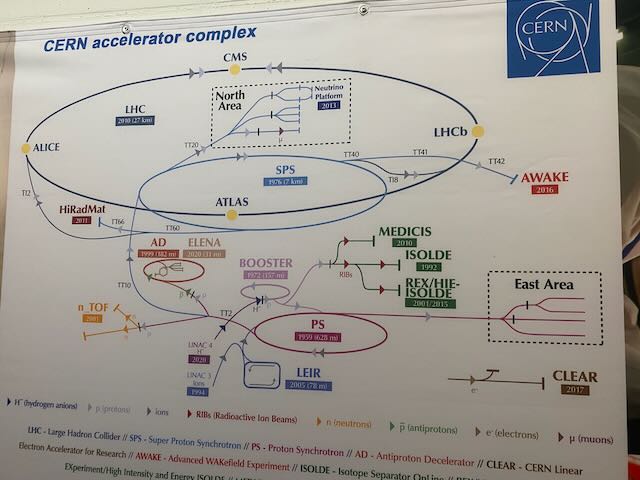
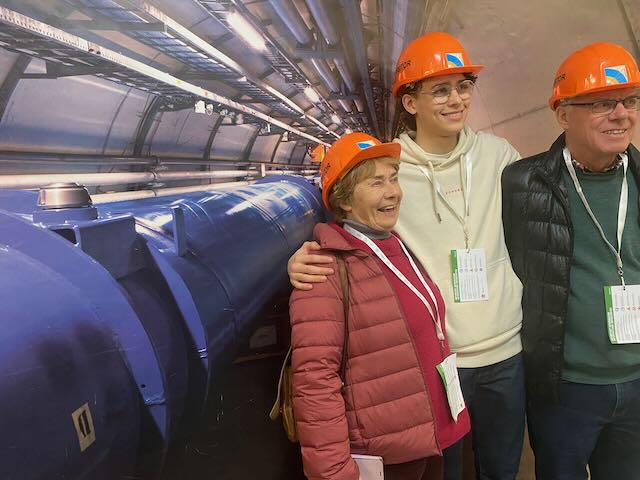
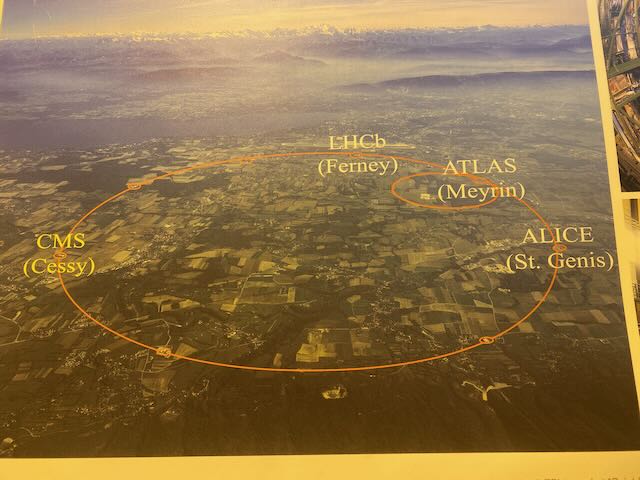
The Large Hadron Collider (LHC) is the world’s largest and most powerful particle accelerator. It consists of a 27-kilometre ring (100 metres underground) of superconducting magnets (cooled by liquid helium) with a number of accelerating structures to boost the energy of the particles along the way.
The CERN accelerator complex accelerates protons, but also nuclei of ionized atoms (ions), such as the nuclei of lead, argon or xenon atoms. Some LHC runs are thus dedicated to lead-ion collisions. The ISOLDE facility accelerates beams of exotic nuclei for nuclear physics studies.
Complex being the operative word
The particle collisions recreate, for a fraction of a second, the conditions that existed moments after the Big Bang, when the Universe was born. By studying the debris of these collisions, physicists try to settle mysteries such as what matter is made of and how particles get their mass.
The LHC, which was completed in 2008, was built primarily to put the Standard Model of particle physics to the test. This wildly successful theory from the 1970s describes the interactions between the 17 elementary particles and three of the four fundamental forces of the Universe: electromagnetism, the strong nuclear force and the weak nuclear force (gravity is the fourth).
What happened at CERN in the fall of 2008?
On 19 September 2008, a magnet quench occurred in about 100 bending magnets in sectors 3 and 4, where an electrical fault vented about six tonnes of liquid helium (the magnets’ cryogenic coolant) into the tunnel.
What discoveries have been made at CERN?
Highlights include the 1983 discovery of a pair of elementary particles called the W and Z bosons, which was later awarded the Nobel Prize for Physics. British computer scientist Tim Berners-Lee helped invent the World Wide Web at CERN in 1989 by developing a way for computers to talk to each other, called hypertext transfer protocol (HTTP).
In 1995, CERN scientists were the first to create atoms of hydrogen’s antimatter counterpart, antihydrogen. In 2000, they discovered a new state of matter: a hot, dense, particle soup called quark-gluon plasma. And the Higgs boson, predicted by the Standard Model of particle physics, was observed for the first time in 2012 at CERN’s Large Hadron Collider (LHC), scooping its discoverers a Nobel Prize. This discovery confirmed a crucial part of our understanding of how particles acquire mass.
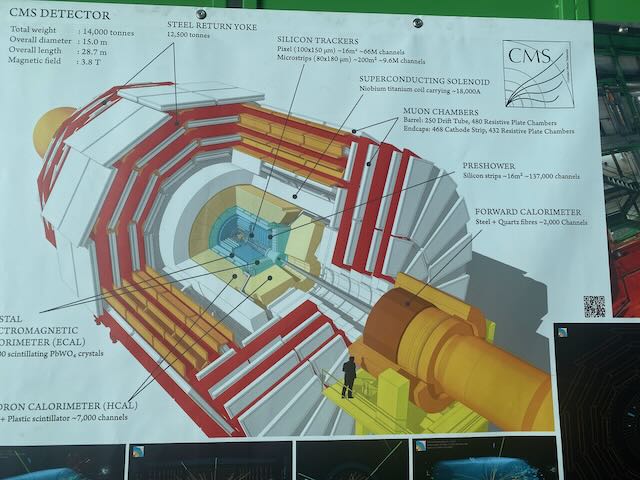
One CMS photo showed (apparently) that the Higgs boson is produced in the collision of two protons at 14 TeV and quickly decays into four muons, a type of heavy electron which is not absorbed by the central part of the detector – but in the outer muon detectors.
The discovery was a big win for fans of the Standard Model, but the theory is incomplete. It leaves many questions open, such as: what is dark matter? Why does the Universe contain more matter than antimatter? The LHC may help answer these questions.
Things could really start to get exciting after the next long shutdown, currently slated for 2026-2028. During that time, the LHC will be upgraded so heavily that it warrants a new name: the High-Luminosity LHC (HL-LHC). Over 20-plus years of operating, the machine will work up to generating luminosities nearly 30 times greater than those produced to date, allowing physicists push the Standard Model to its limits.
And the search for new physics doesn’t end there. A proposed new collider – theFuture Circular Collider (FCC) – would dwarf the LHC. “It’s really just a concept right now, but ultimately this would be an even more powerful collider that would be 100 kilometres around. The LHC ring would basically just be the booster ring for the FCC!”.
Gunnar, being an electrical expert, sparkled with energy, especially when describing magnets and the power supply aspects of the LHC. In particular in his time, his team were challenged to get a firm control on the current such that it provided for a finely controlled and powerfull magnetic field to bend the accelerated particales around the ring, focussing them in the centre of the vacuum tube such that they never touched the sides (which would have given rise to the magnets becoming non-superconducting and exploding as in 2008). The power in the circulating paricles is so high (of the order of a jumbo jet) that in order to quench it (every few hours or so), the particles are brought offline and sprayed into a 300 m long carbon dump – which becomes radioactive for a while.
Gunnar was keen to show us that while we did not have personal radiation detctor devices for our safety, he did, and he demonstrated that his read zero radiation before and after (hence during) our visit. Safety is a big part of the CERN operation.
We did get back to see the initial part of the introductory film before time beat us and we were required to whisk ourselves away in a quantum leap across the ring (in our cars) to the CMS Experiment at Cessy across the border in France.
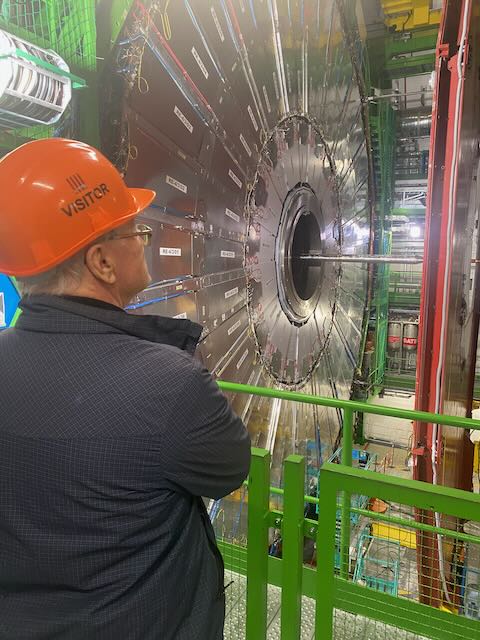
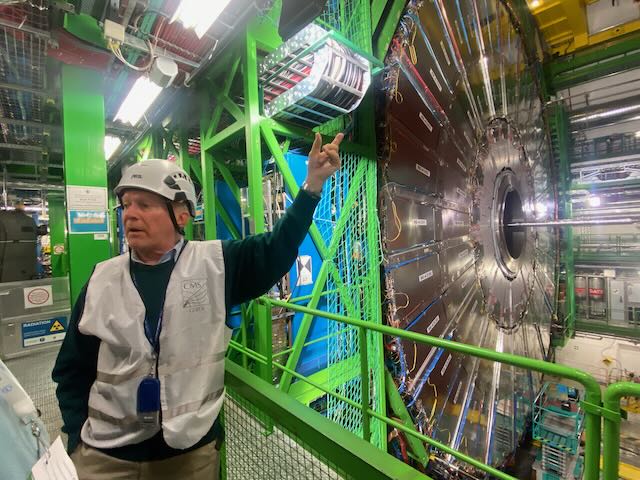
We descended 100m underground in a large lift, after a safety lecture, down to the airlocks and tunnels into the vast CMS chamber. The huge cylindrical detector lies on its side surrounding the thin beam pipe (somehow the two pipes form one in the detectors).
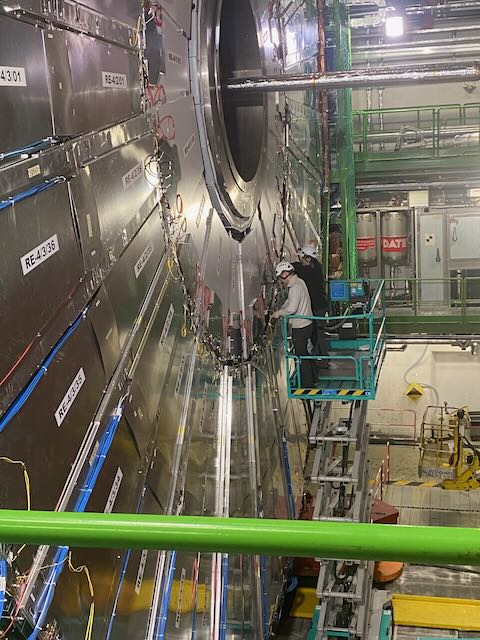
It was partially disassembled in that the final disc detector had ben slid forward, and workers were paying it some attention. When the beam is running this chamber is filled with radiation and personnel are kept well away.
Gunnar in CMSEngineers fiddling aboutMany Watts go through this tunnel
All too soon we were required to return to the surface as another party was coming in. The drive back to CERN centre for lunch led us to the chosen restaurant in a far corner of the CERN site, but sadly being Saturday it was closed. No worries we decamped to the main restaurant. This science stuff can bring on a good appetite.
After Lunch
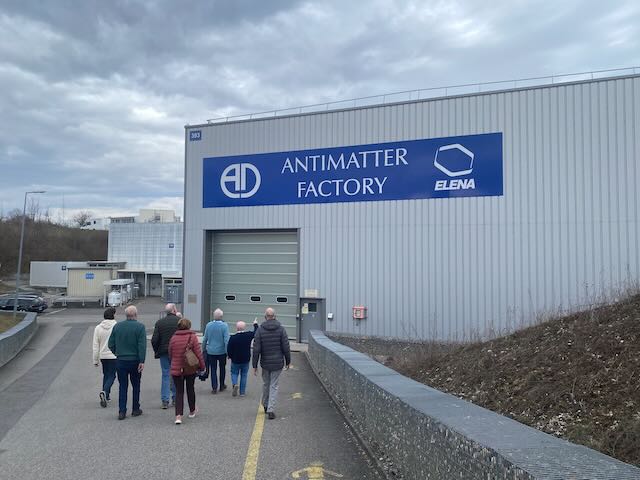
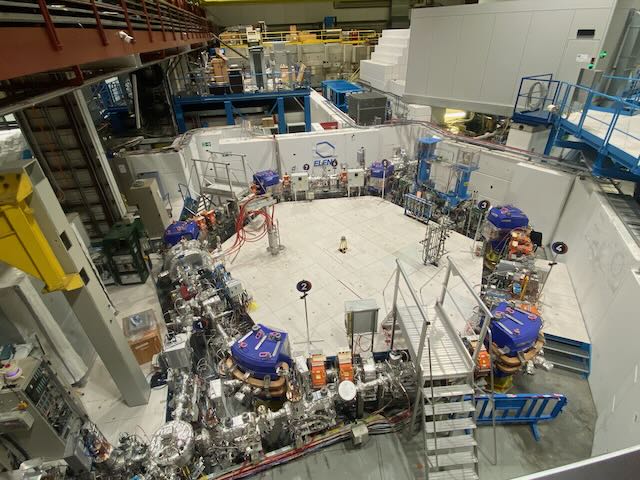
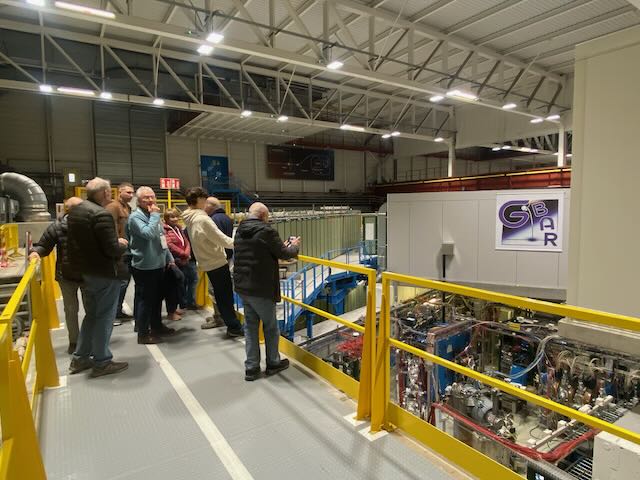
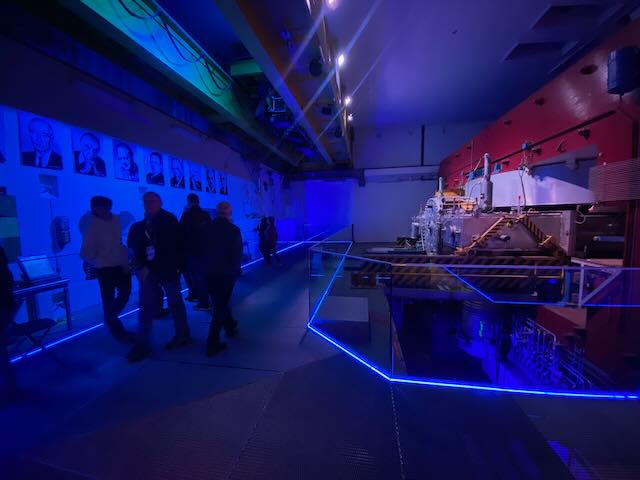
The afternoon was spent at the Anti-Matter Factory, the old original Proton Synchrotron, and the Atlas Control room. Each were fascinating and we plied Gunnar with plenty of questions which he ably asnwered.
A very odd state of matter – apparently it is quite normal in nature :-
Natural antiparticles
• A person weighting 80 kg produces 180 anti-electrons (positrons e+) per hour from the desintegration of Potassium-40, anatural isotope
• A banana produces 10 e+ per second
A key experiment going on seemed to be seeing if anti-particles are affected by gravitiy in the same way as particles, and it seems they are: attracted by the earth and not repelled.
Antimatter decelleration ringInside the Anti-Matter factory. Does it do anti-aging too?
The Proton Synchrotron history is explained in this film.
As the beam was down, no actual personnel were present and nothing was happening but again Gunnar brought it back to life for us.
All in all an amazing day – a visit to CERN, even without the special visit that we were given, would be a wonderful day out for anyone with a fascination of life, the universe and everything.
Final drinks
Many thanks to Mervyn for organising and to Gunnar for being our guide into this mind bending place. I’m off to eat a banana…
As the leader for the day pointed out, snowshoes were not needed for this hike on Mont Mourex and Mont Mussy. The spring-like weather of the week before had reduced snow levels on the Jura and, despite some new coverage, the decision was taken to reduce altitude level to try and stay on relative firm ground. As it turned out the weather forecast for the day was unsettled and as we gathered in the car park next to the old station in Divonne it was indeed trying to rain as well as blowing a cold wind.
Eight intrepid GIN Snowshoers turned up on time (well almost) with two canine friends (Kobi and Rocco) happy to see each other and join in the circuit. Stephen (leader for the day) Mike H, Nathan, Richard S, Mark 2Ts, Peter T, Peter S and Ross made up the starting group. We set off through the Divonne housing in the direction of Les Crottes and onto the Chemin de Tir where the road melted into a track leading along the base of Mont Mussy to Mourex. Helpful “Deviation” signs showed us the way….intended for traffic but somehow seemed suitable for this group. Happily, any deviating individual had been properly admonished on the last snowshoe outing, consequently solidarity with the leader’s directions was unflinching.
Along the way, we experienced some unexpected hail and an attempt at snow but also some sunshine. Arriving at the road leading up through Mourex, several of the group, who are also members of the Biking Group, recalled the hard slog in the saddle up this hill from the old train track below. This forms part of the famous 3 hills circuit pioneered by Peter D. We followed the road up through the village until we reached the parking for Mont Mourex. At this point, our canine presence was swollen by a dog walking group of at least 8 dogs of various sizes and breeds. Extracting Kobi and Rocco took a little time.
We completed the hike up to the highest point (755m) where the vantage point and circular tableau offered not only a superb view but also a useful bar and table, albeit a little wet and slippery. The cold wind didn’t allow the Puglian Primativo to be enjoyed at it’s best and even the spirit bottle of many names was untouched in favour of Mark’s warm coffee. (That could also be due to the fact that it’s contents were unchanged from the previous outing and our memories of that tasting experience are still fresh). However, the increasing number of snacks that appear on these outings were happily consumed in an attempt to provide insulating fat and ballast.
Highest point – Mont Mourex
The “bar” in action
A happier Mike………amazing what abstinence can do
At this point the leader suggested retracing our steps to the car park to enable joining the track leading around the far side of the hill. Despite seasoned voices suggesting that there was indeed an alternative route to achieving this aim, not requiring backtracking, solidarity and compliance with the leader’s pre-determined route prevailed. As it transpired, this allowed a second encounter with the dog walkers and their canine posse, much to the delight of our two dogs.
With only occasional stops to ensure that we were taking the correct forks in the track, we arrived at the parking by the Ferme de Mussy. At this point Peter T, Ross and Peter S took the direct route back to the cars, foregoing the pleasures of L’Accord Parfait. In Peter T’s case this was probably due to concern that Kobi would ensure that he didn’t need a doggy bag as he would have benefitted from a tour of the restaurant and kitchen, sampling from any plate left unattended.
The five lunch-goers took the small meandering path to the back of the restaurant and arrived after a Tayloresque off-piste steep descent. Why there is no formal path down is a mystery. We joined Mark 2Rs who had arrived separately, recovering from a flu/fever but well enough to have ordered and consumed a kir prior to our appearance.
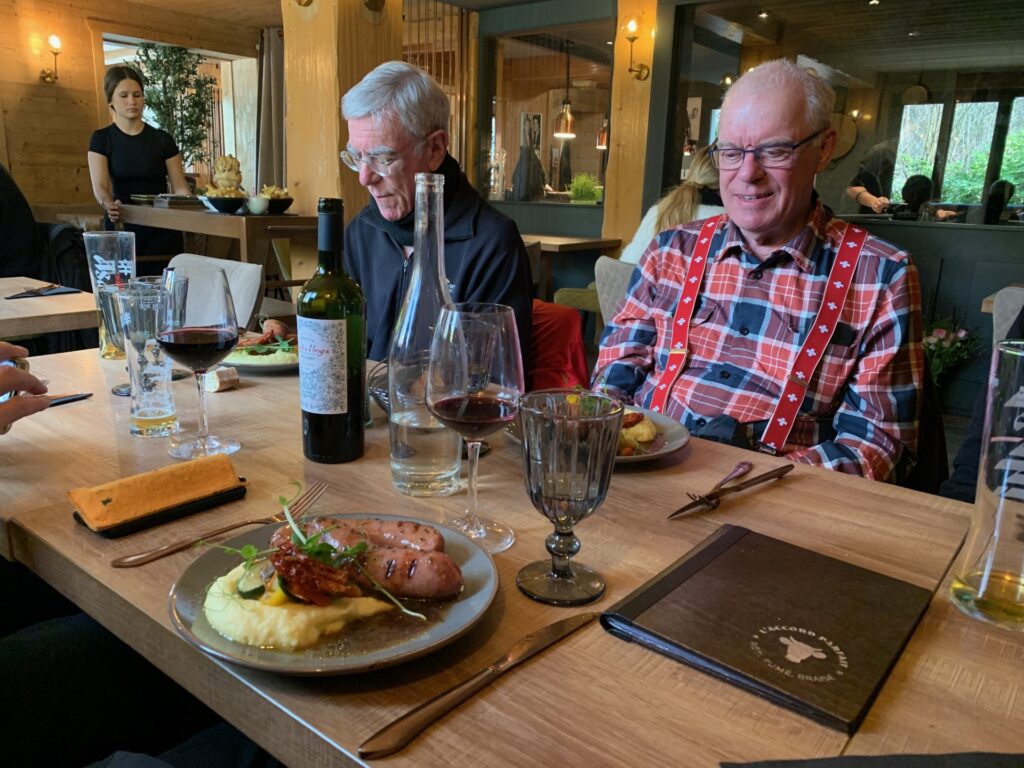
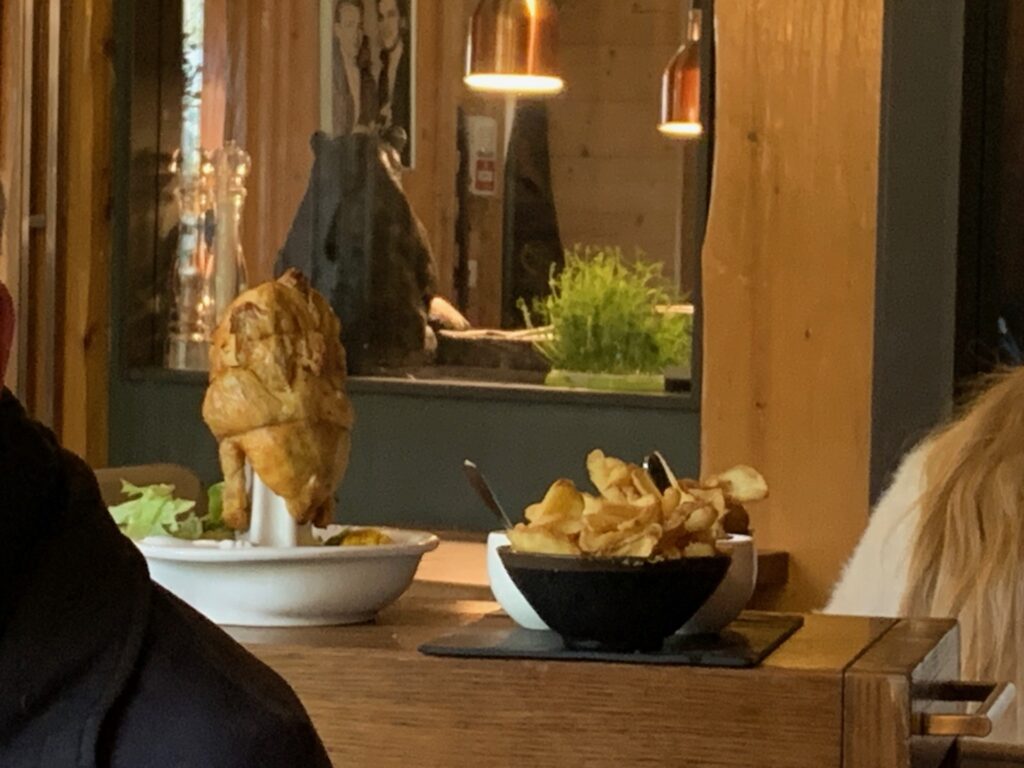
Beers were ordered and a bottle of Argentinian Malbec (at the correct temperature). All but Richard and Stephen opted for the menu du jour. This comprised of a salad and meat croute starter, sausage and mash, and an ice-cream dessert all for an amazing 19Euro. Richard and Stephen went for the more modest coquelet with fries, “modest” being relative only to the set menu lunch as Richard took half of his lunch away with him for later and Mike managed to find room for excess fries. Rocco behaved almost impeccably under the table apart from his penchant for destroying serviettes. He won over the waitress who ensured that he had adequate water. Conversation was varied and interesting, as usual, but don’t expect me to remember the details…..I was struggling with eating all that chicken meat.
Contemplation of the sizeable main course of the menu du jour…..the coquelet is arriving in the background
Lunch anddinner for one
The walk from the restaurant back to the parking by the old station was uneventful. It was a shame that the first part had to be along the main road but there was no appetite for a rescaling of the off-piste to the woodland path. Mark 2Rs took us on a shortcut alongside the chateau to enable not only seeing property in an unknown part of Divonne but also ensuring that siestas were not delayed further.
Consensus was that we covered ca. 12kms and climbed 365m.