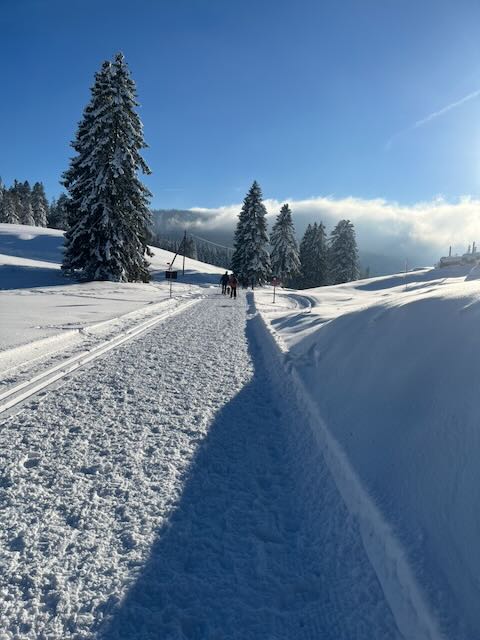
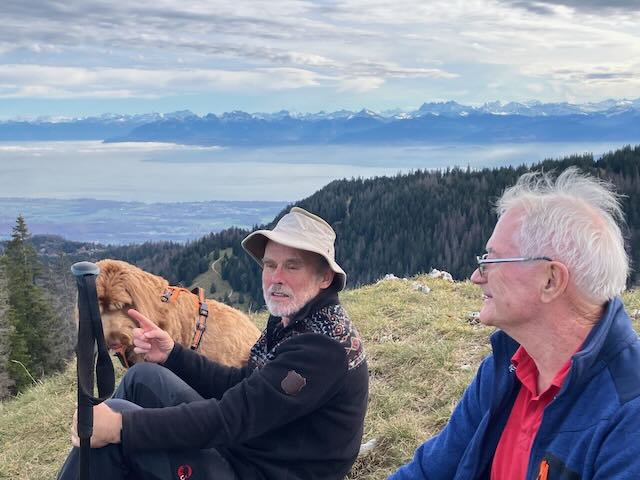
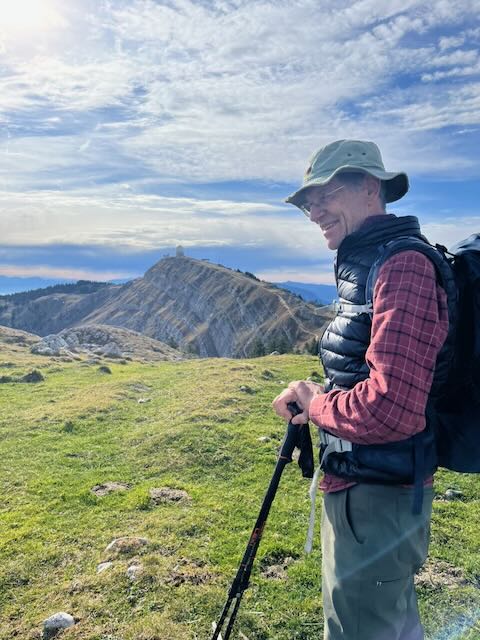
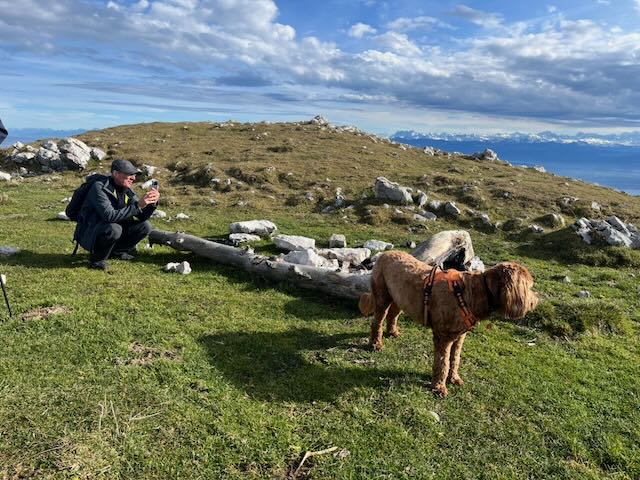
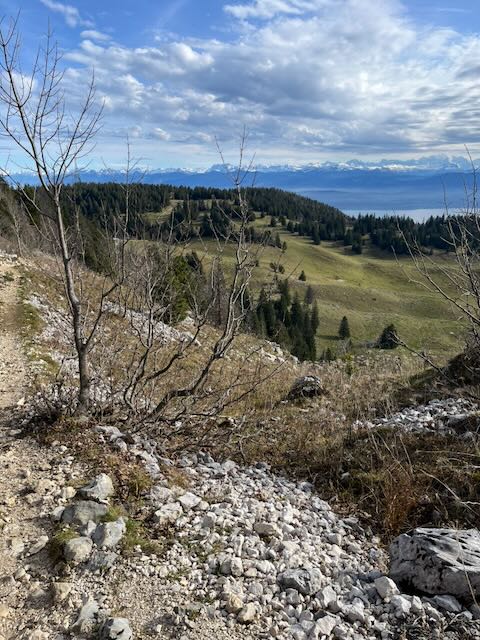
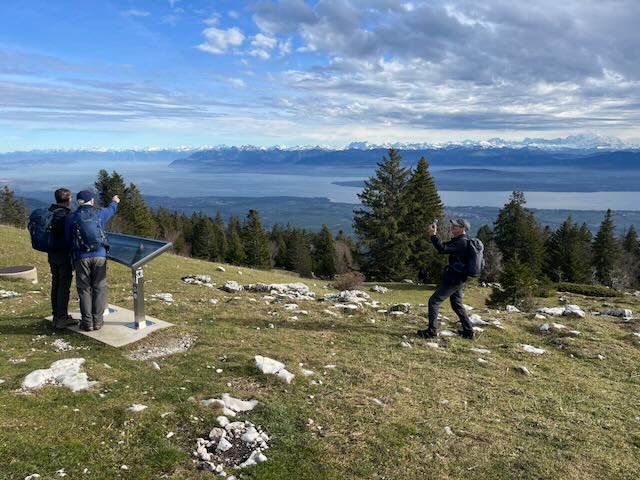
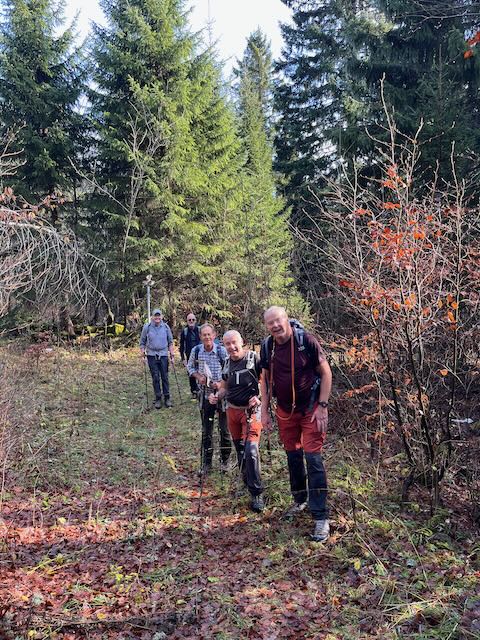
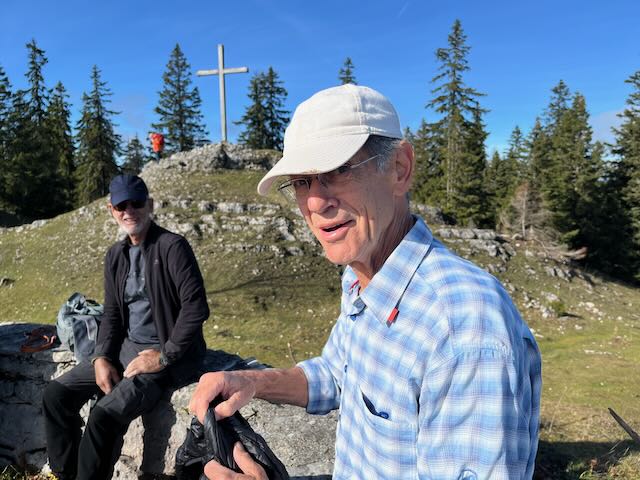
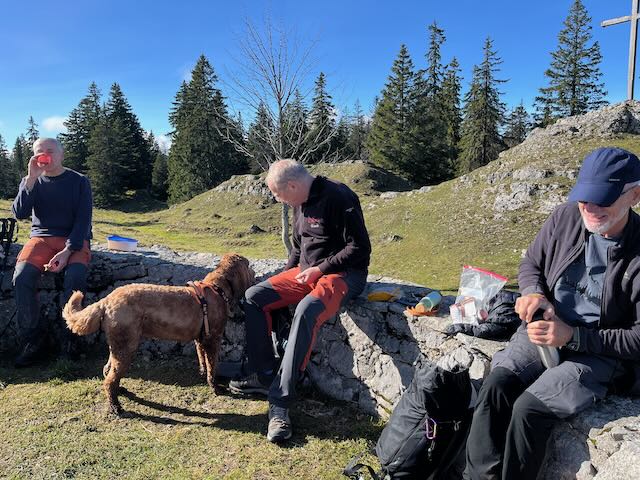
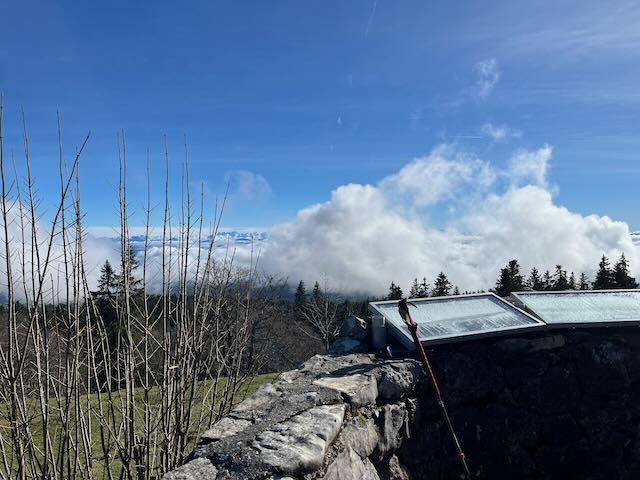
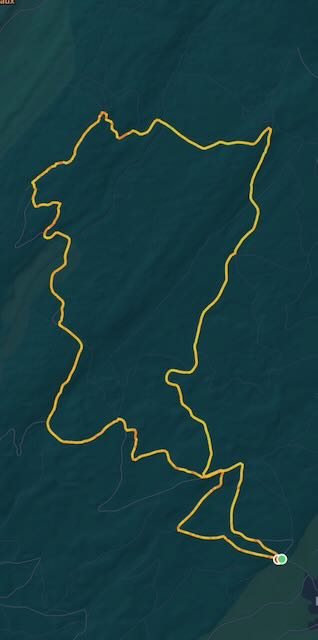
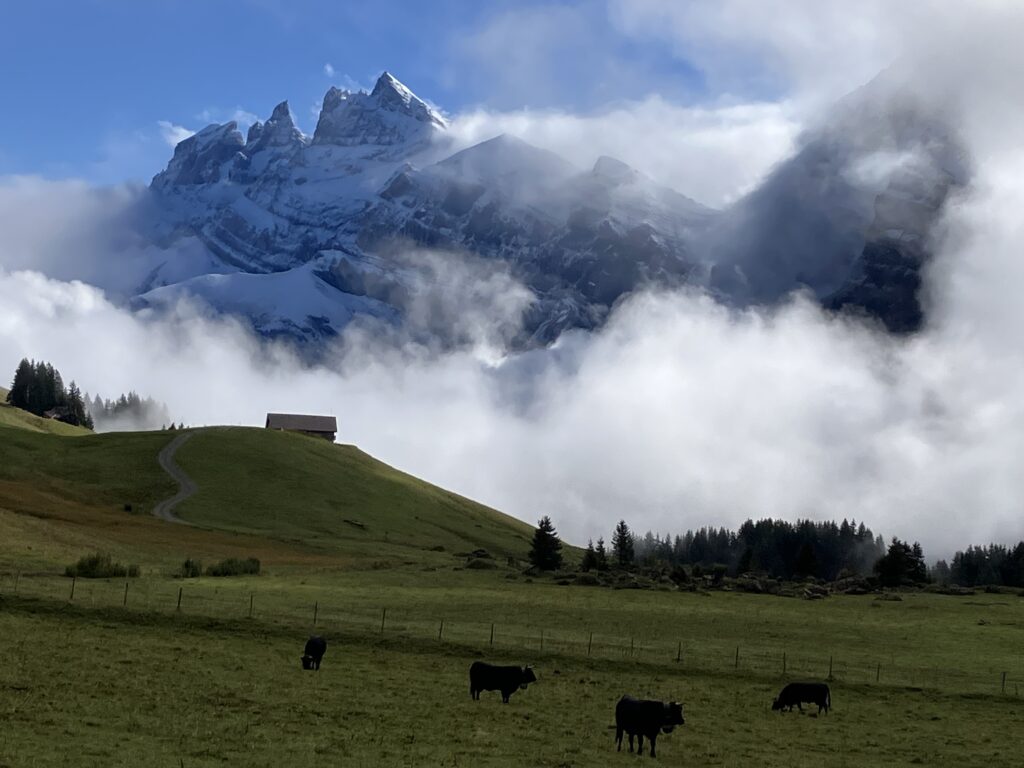
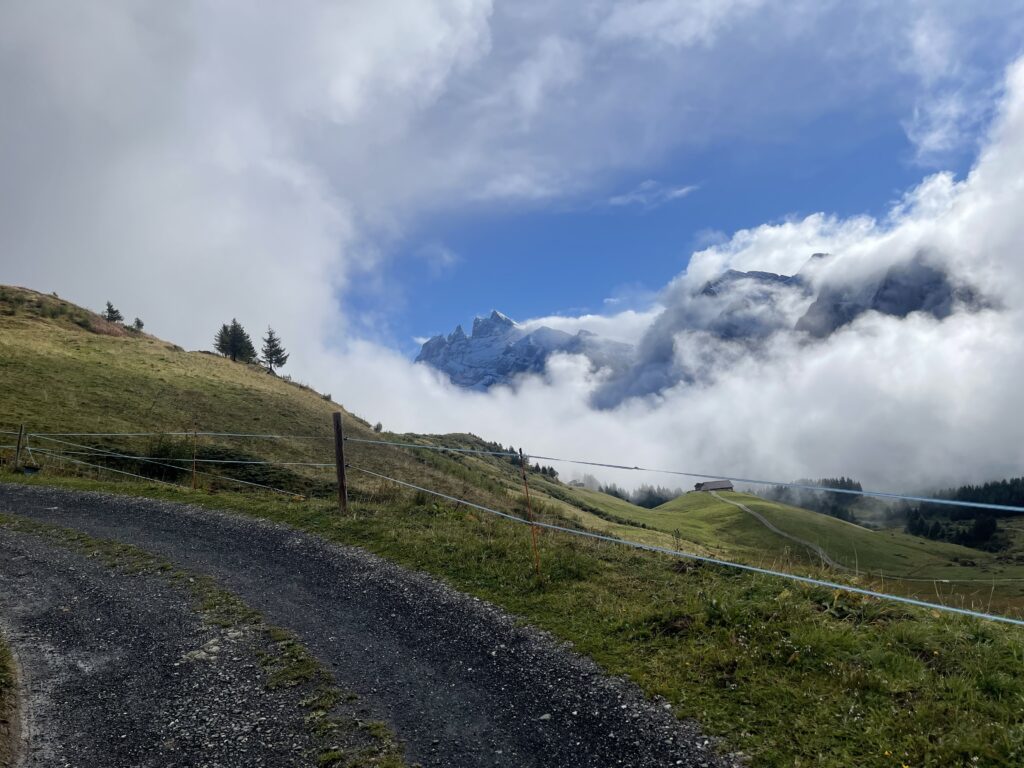
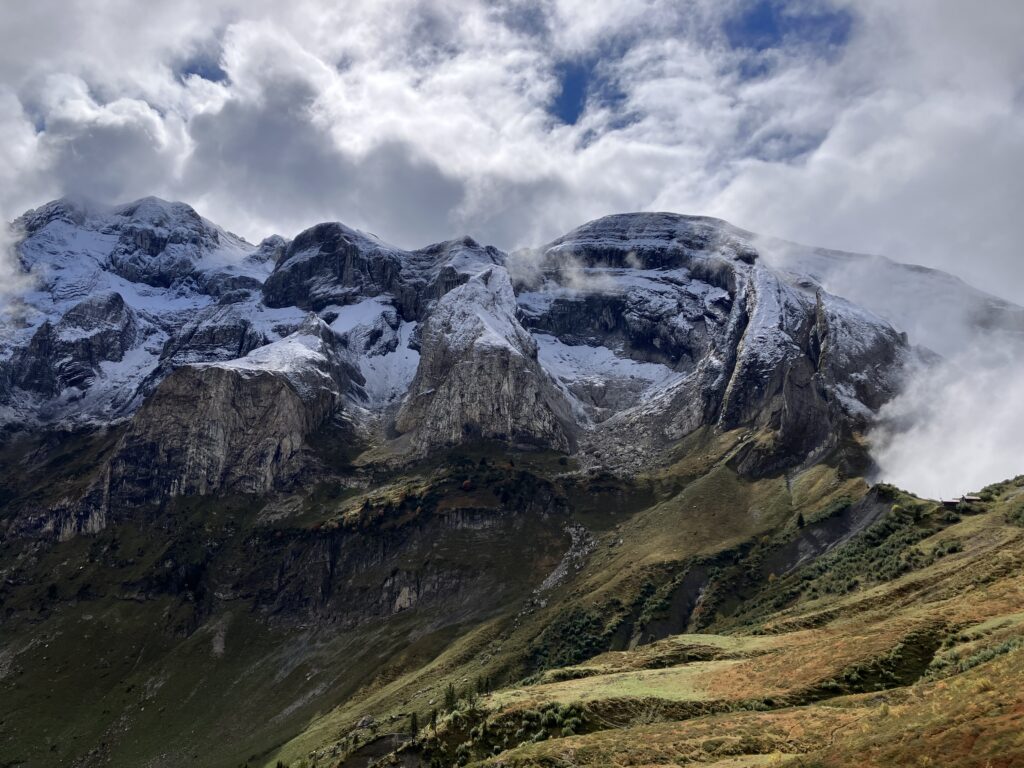
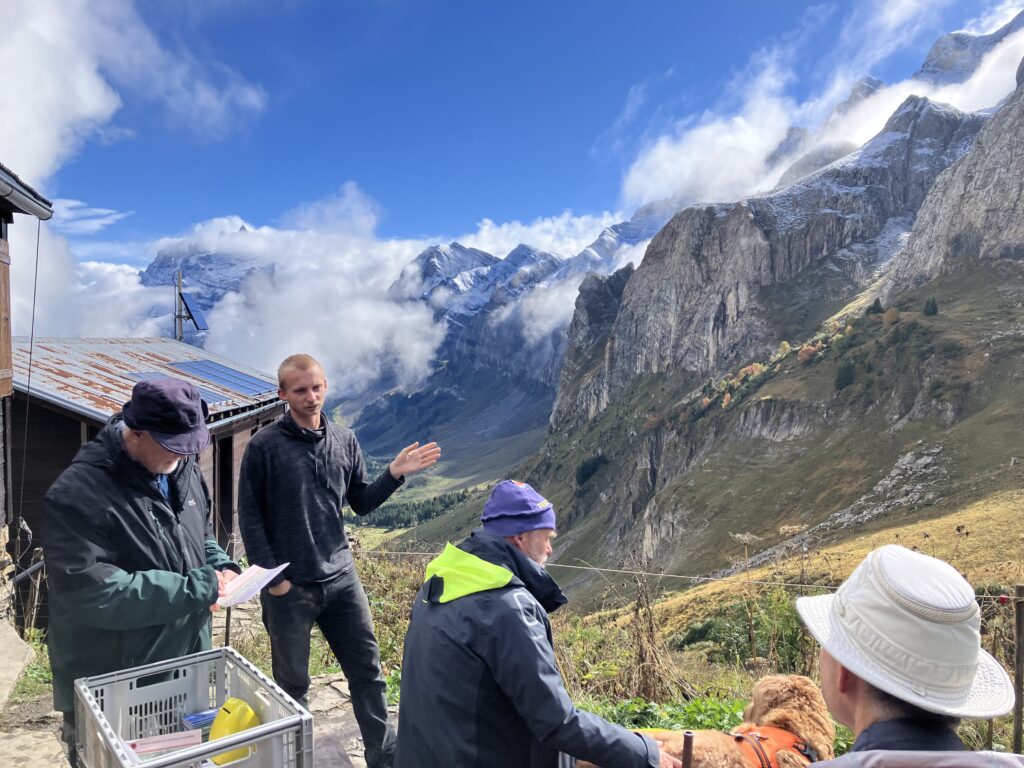
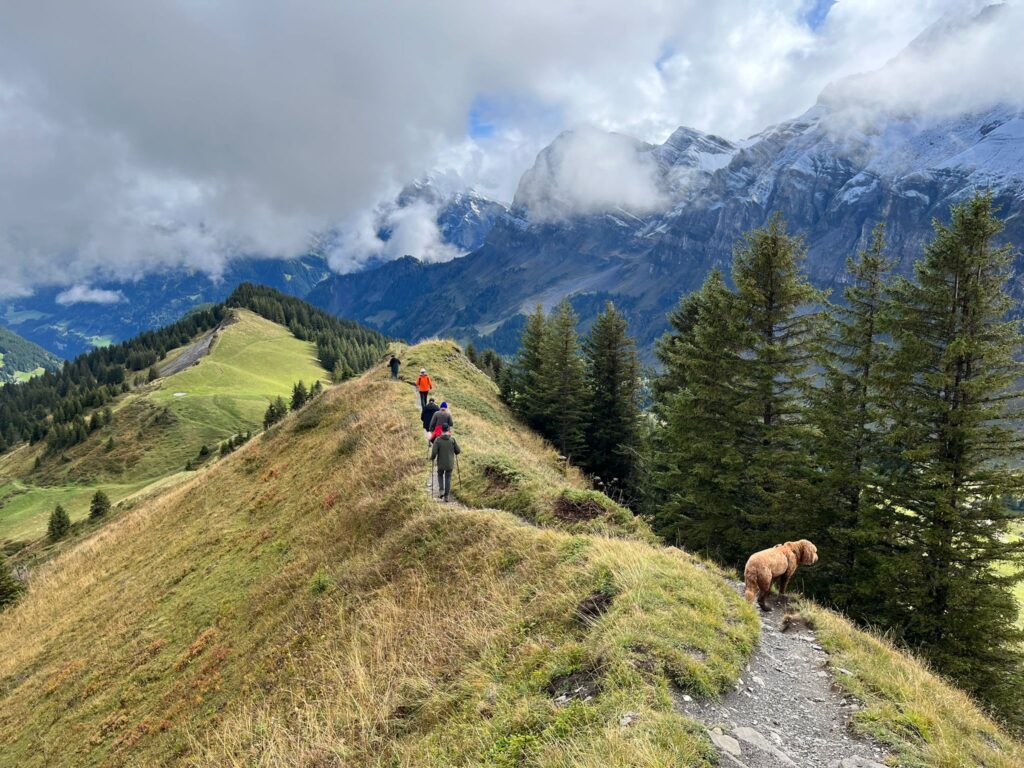
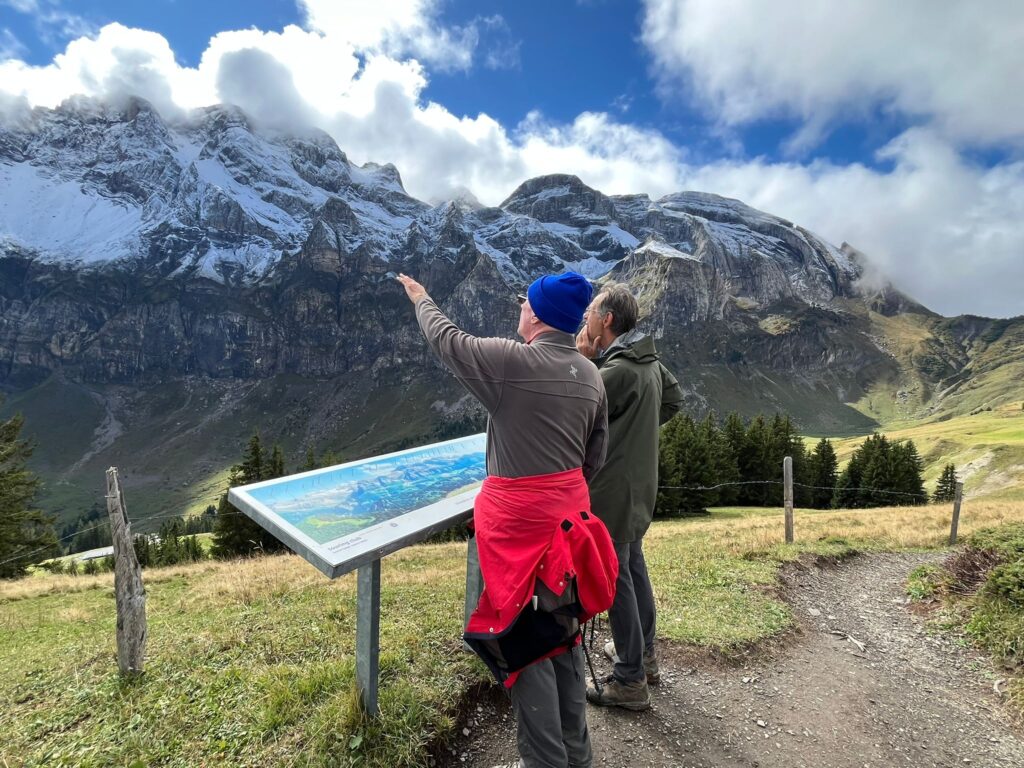
A journey through a winter wonderland. La Givrine to Cabane Rochefort and La Genolière. 10Km and 300m denivellation.
Billed as a hike it became clear that this was going to be a snow-shoe affair, filling the first of Rob’s calendar for the 25/26 winter season.
Rob had still not recovered so I ended the hiking season with this fairly easy snow-shoe. It looked like the weather was going to be good and perhaps the snow too, but we were (at least I was) astonished at the 35cm or more of powder lying on the Jura top, while our gardens were still green. Ross had been pounding the powder for the past few days and posting photos so he knew about it.
Apologies were received from several, simply to record that they were missed, and they missed a good one. It was uplifting to hear from Larry but we were sorry to read that he is still in Canada struggling with some health issues. Get well soon Larry!
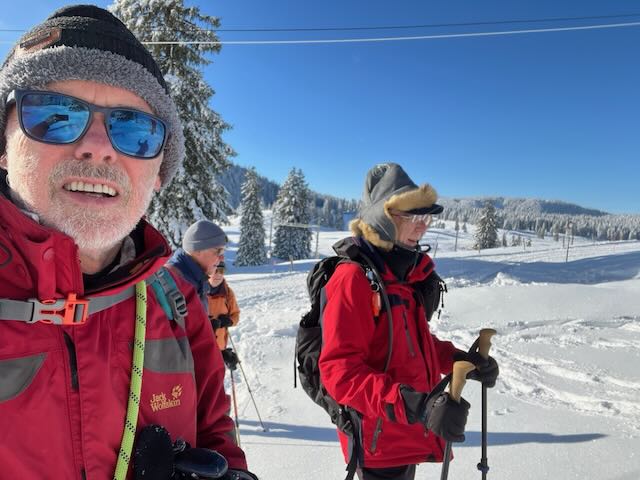
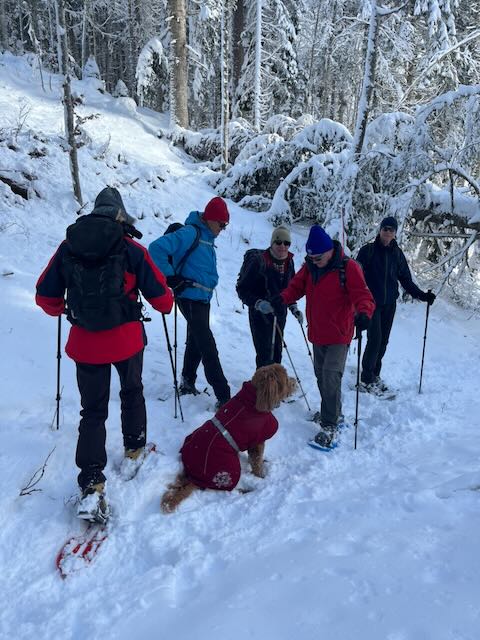
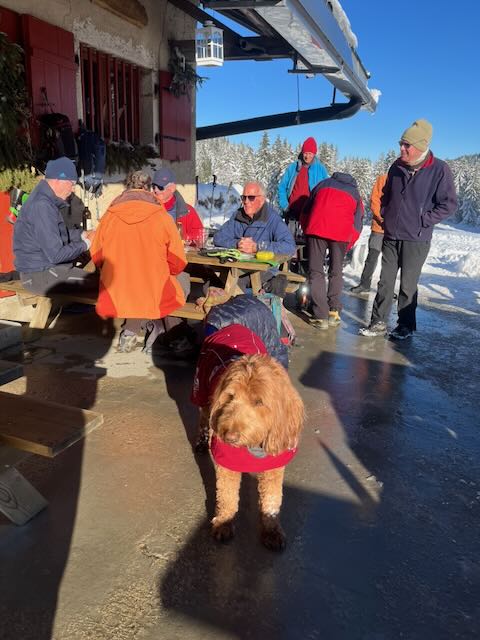
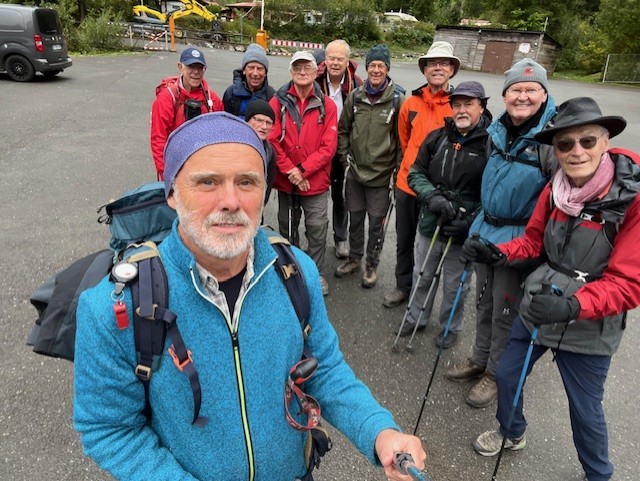
In the event 9 and a dog turned out at La Givrine (1207m). Nathan, Mervyn, PeterS, Mark, Mark, Stephen, David, Ross and me with Kobie. Conditions looked perfect with bright sun, cold, and no wind. I had booked a table at La Genolière for 12.30pm, but had to revise this by phone with a delay to 1.30pm – we were slowed by raquettes, age and deep snow and by the apèro stop.
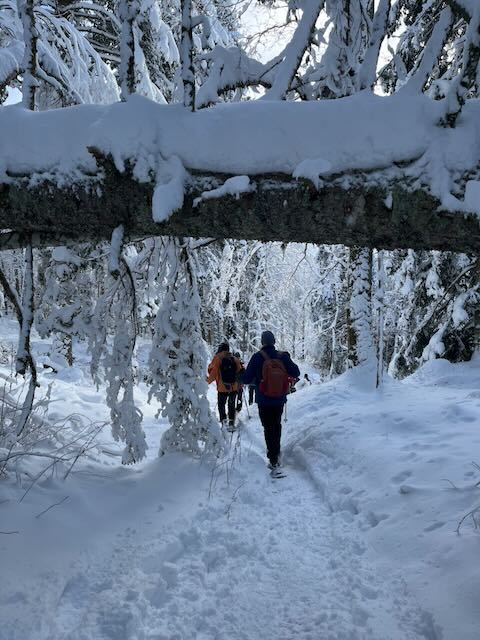
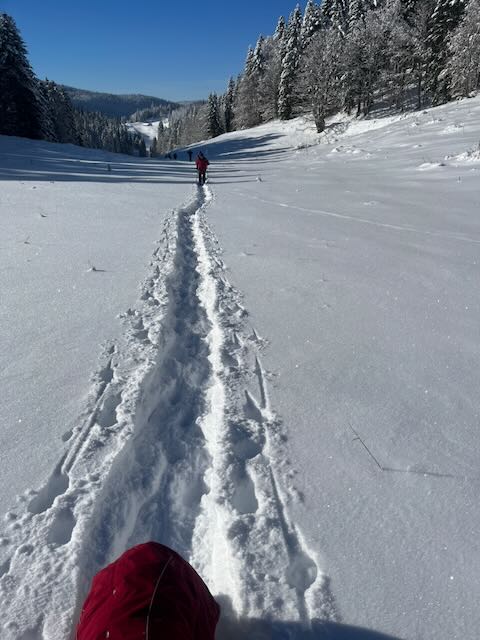
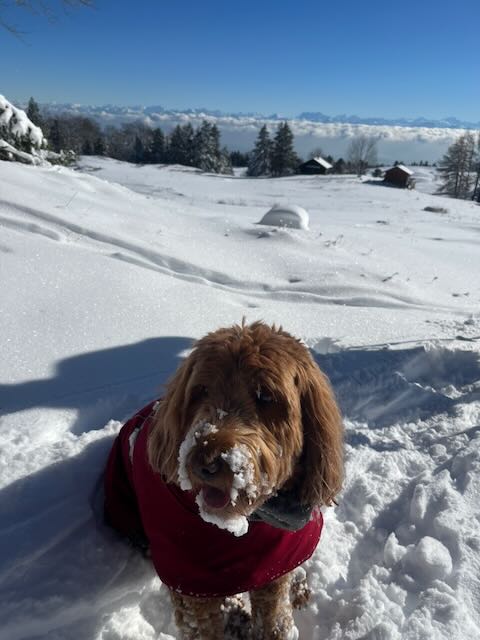
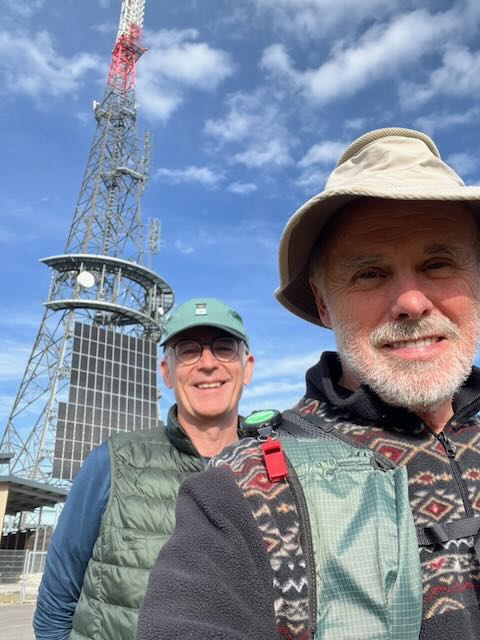
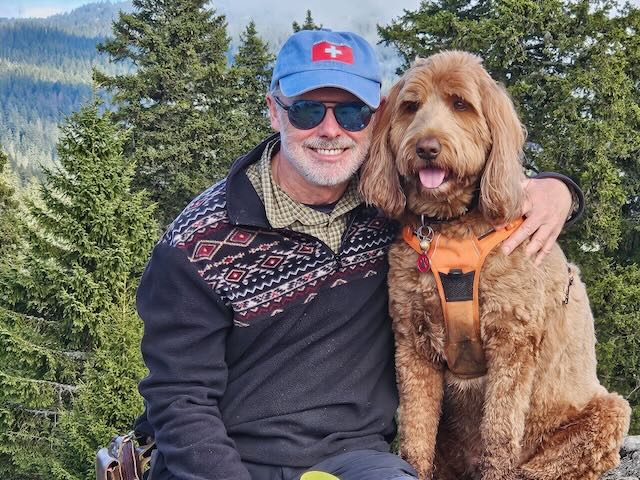
Mervyn and Kobie – who found the snow depth troubling at times The author, David, Mark2rs, Nathan starting out Into the woods
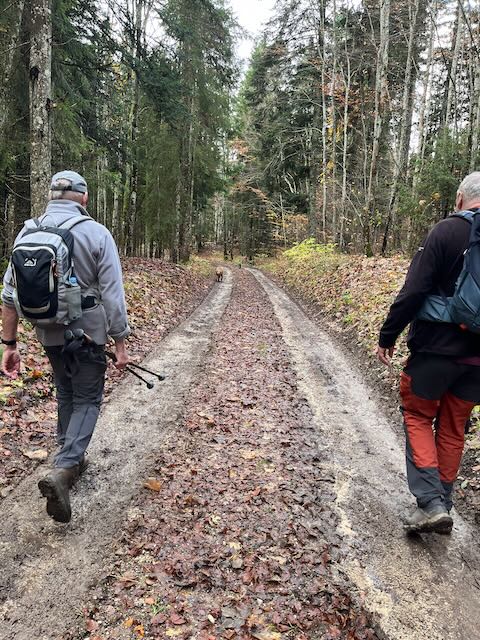
We set off on the ski du fond piste but branched off on the snow-shoe trail to Les Pralies, followed by the Route de Combe Grasse
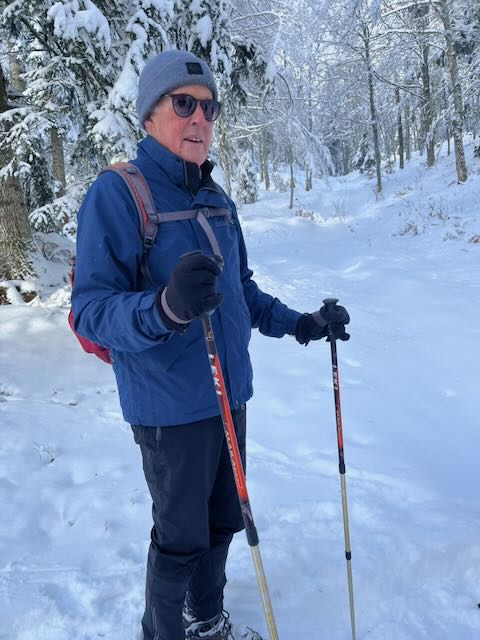
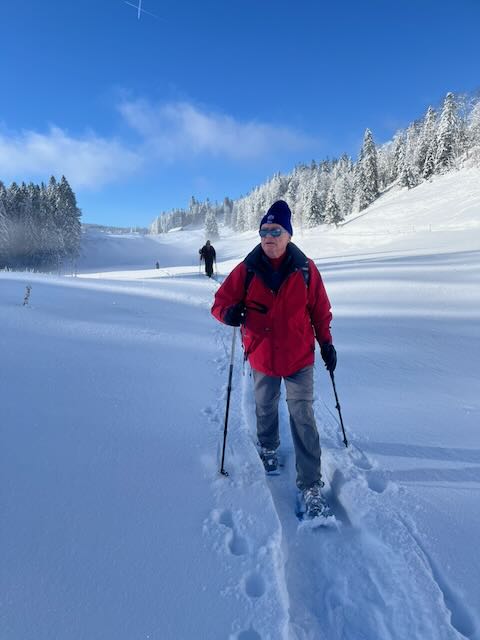
David enjoying the conditions, and his condition was good tooThe trees were loaded with snow – perhaps better than at Schilligers
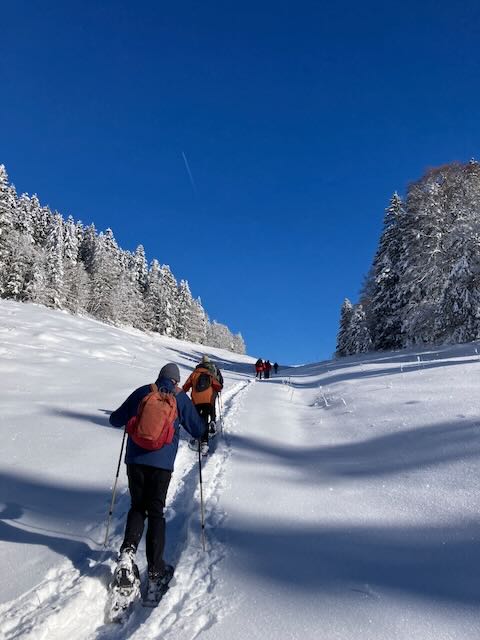
This route was straightforward as a vehicle had passed by earlier. Stephen set a steady pace through Combe Grasse with Kobie following in his wake. Ross was pleased – this was a new route for him – and he seemed surprised as if he thought that he had traversed all the trails above La Givrine.
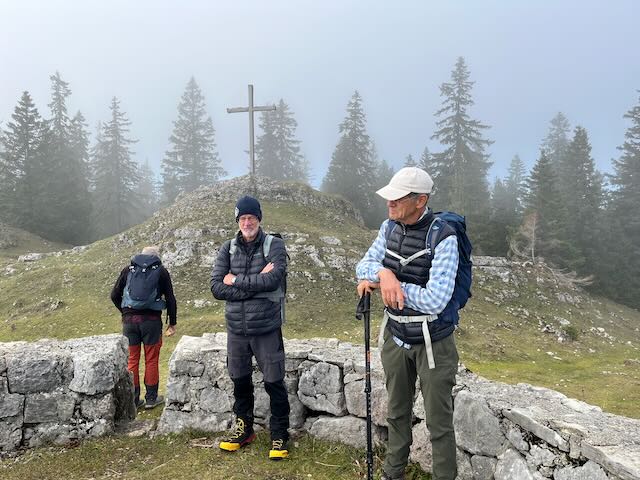
At 1271m exiting the forest into Combe Grasse.
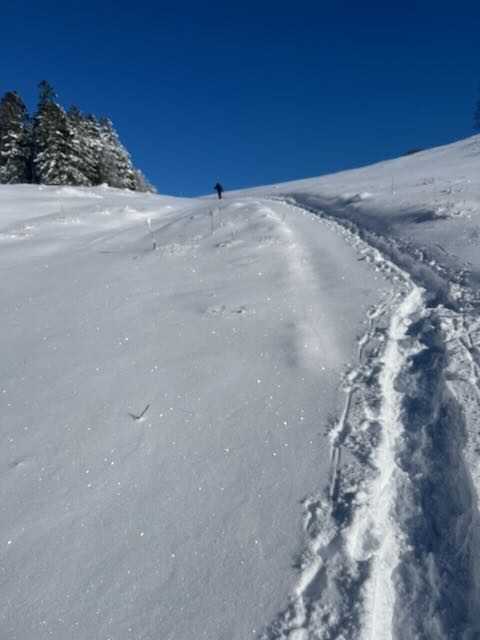
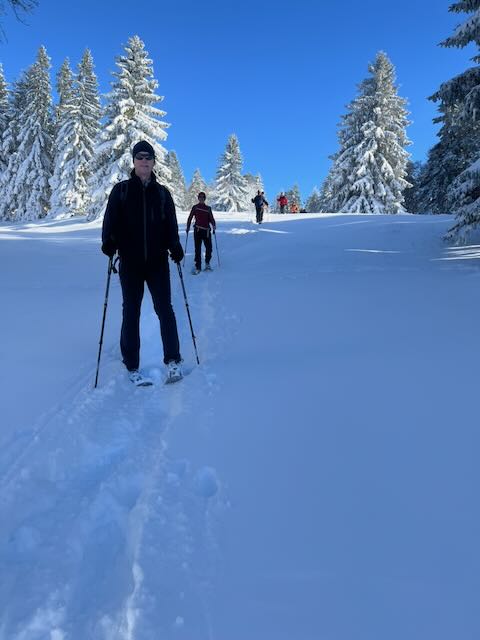
The Combe itself is a depression which acts as a fridge, cold misty air hung in its bowl as we ploughed through the deep powder, aided only by a trail laid by four snow-shoers we could see ahead. I was lost in my thoughts, amazed to be out in such conditions – albeit we have been here before in similar…
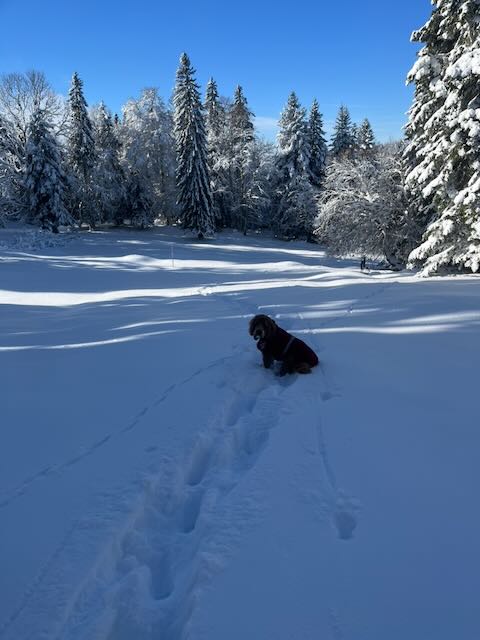
Through the Frigid CombeCrystal fields on either side – magical conditionsMervyn pulling up from Combe GrasseStephen up ahead – he was trying to lose the 5 kg that he put on during his Antartic cruise.Looking back, Kobie right behind me
We turned sharp left at 1316m just before the right turn to Chalet Devant at the Fruitières de Nyon and then sharp right on up to the Cabane Rochefort 1385m.
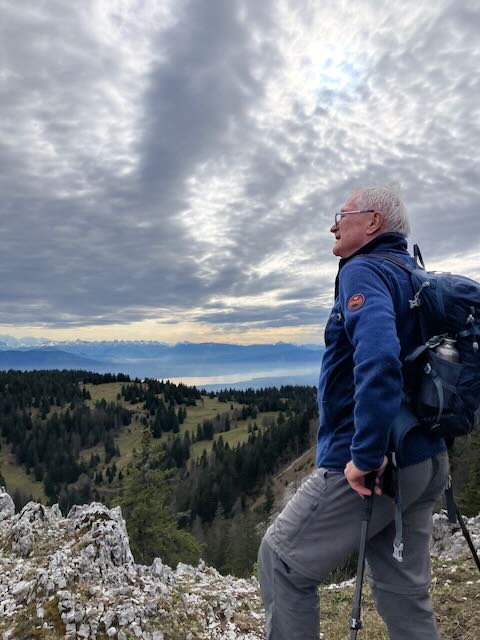
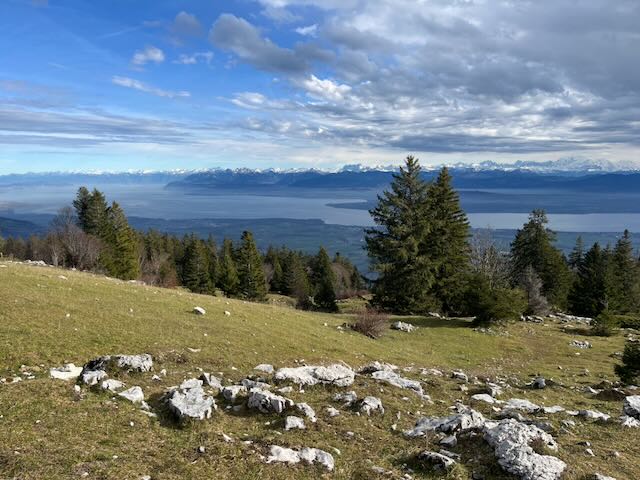
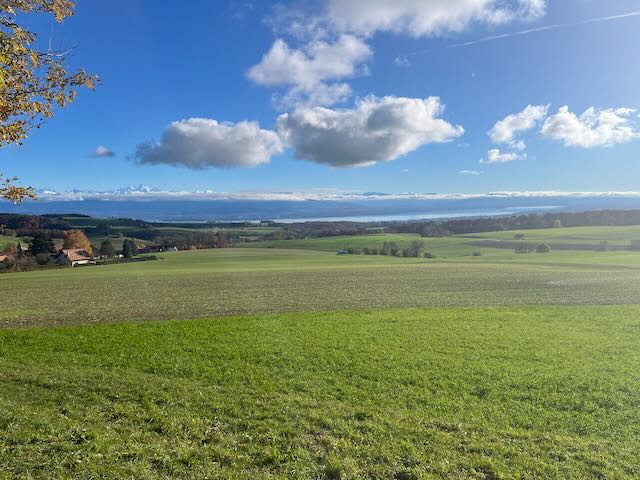
Looking back towards the Barillette on the way up to Cabane RochefortBig views to Mt Blanc and the whole alpine chain
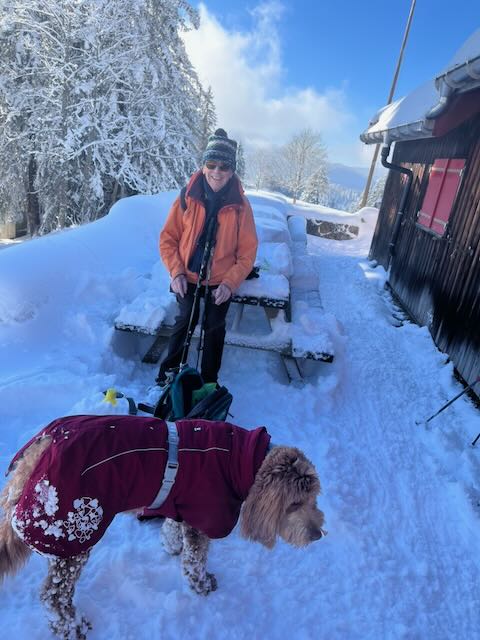
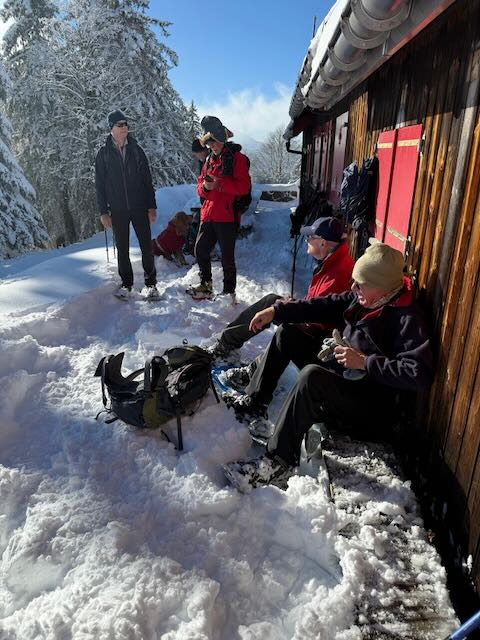
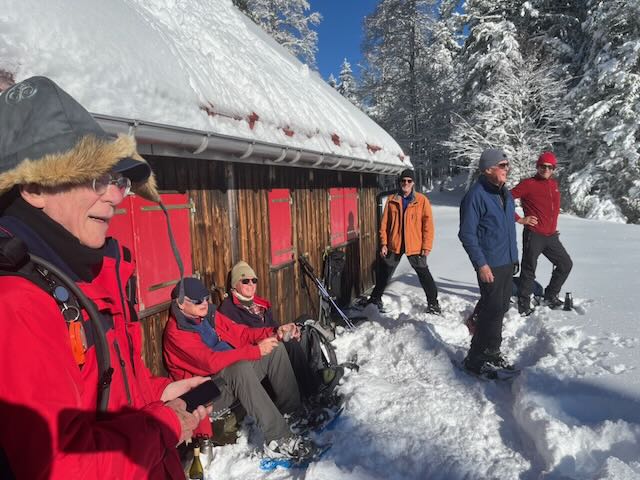
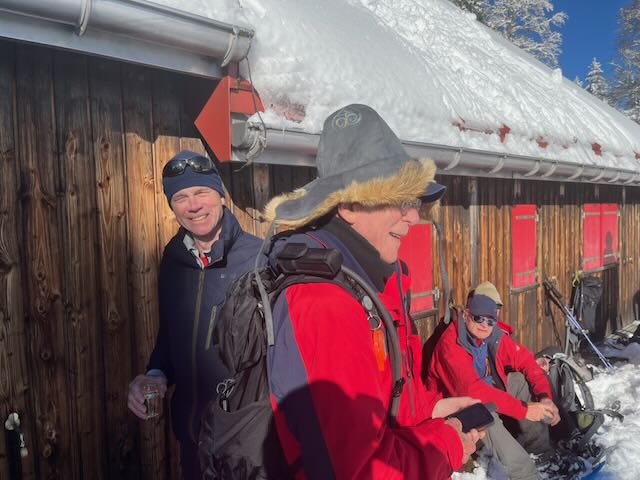
It was time to reward ourselves with some apèro at Cabane Rochefort where we found the seating in the shade still and cover in 30 cm of powder.
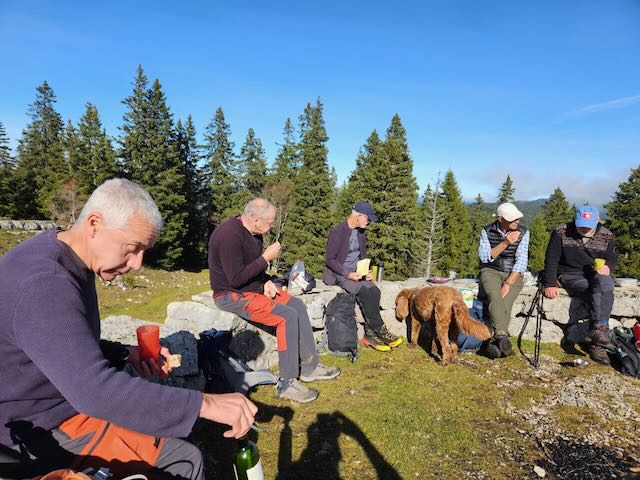
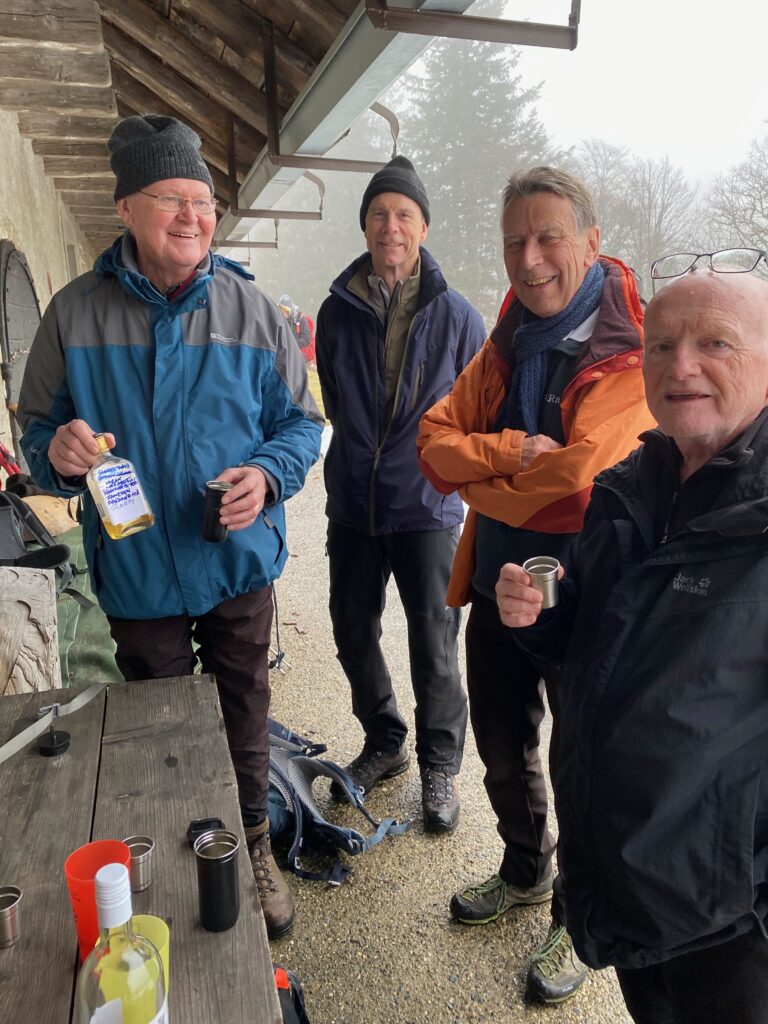
Stacks of snow at C RochefortA fine spot despite minimal seatingMervyn supplied a welcome bottle of chilled white wine. While we took in the view, over the F de Nyon, Lac Leman and the big alpsThere was a lot to smile about
Just as Mark2ts was about to offer us all some black coffee the leader (me) decided that we had better press on; we were now trying to keep to a 1.30 lunch schedule. My offer of a straightforward route or scenic route was met with short shrift, and the easier route was decided.
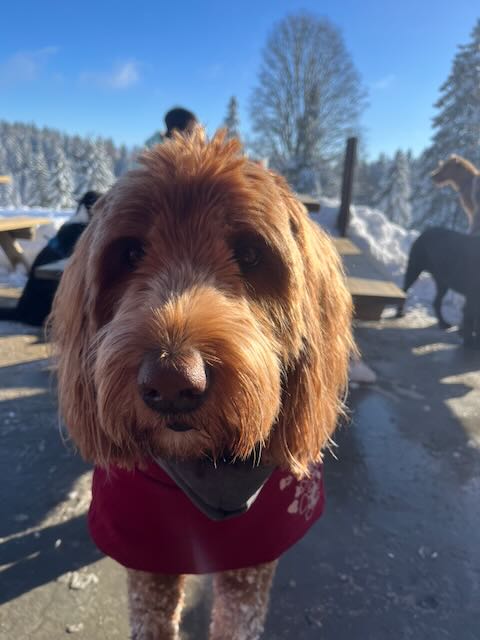
Descending into the Grande Combe towards the ski trail and SS routeKobie revelling in the powder and forging the trail ahead
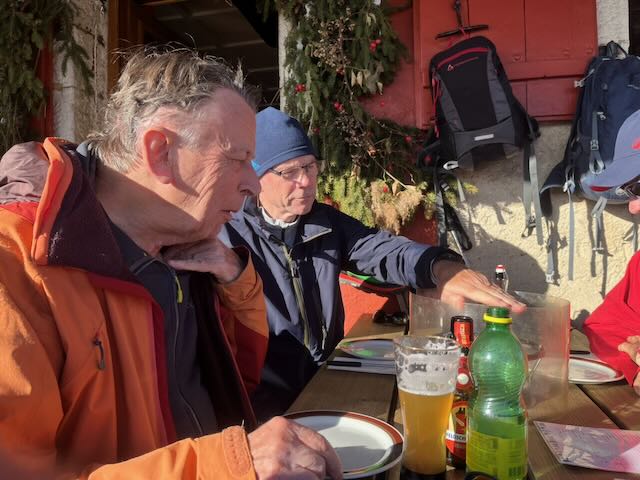
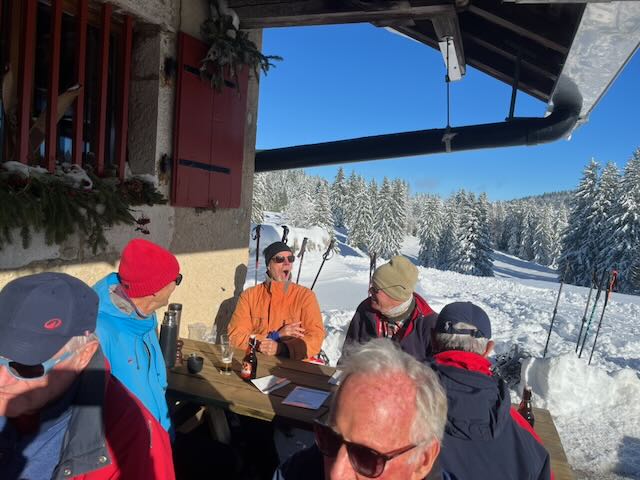
It was not long before we were ensconced outside at our reserved table(s) and drinking some excellent beer – I thought I had reserved inside but we were all happy to be in the sun.
Mark’s panachet was a beer and a bottle of lemonadeRoss reckoned this was one of his better photos, so I have included it…
Ross had decided to eat his own provisions and it was not a problem for him to sit with us.
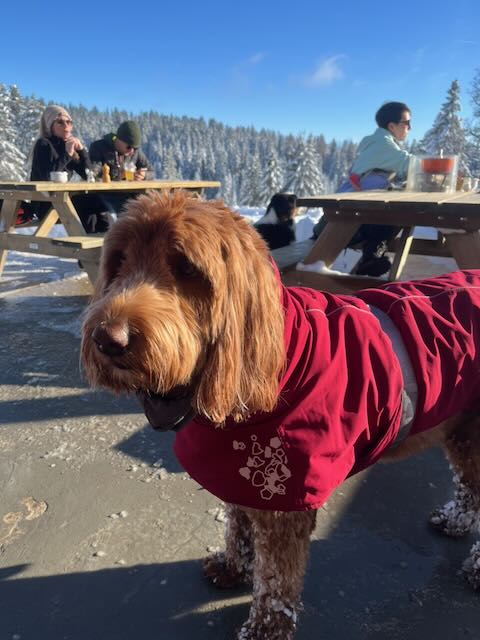
There were quite a number of other visitors, luckily not annoyed by KobieAnd many other dogs too, including MoosThe dog in the suit was Una (see story) with Moos
A nice lady introduced herself to me and said that she had met me and Kobie in Divonne in 2022. She so much liked Kobie, and the Cobberdog breed that she and her partner got one from Denmark in 2023. Una sported a full length-legging suit. They were very pleased with their choice, so seemed Una!
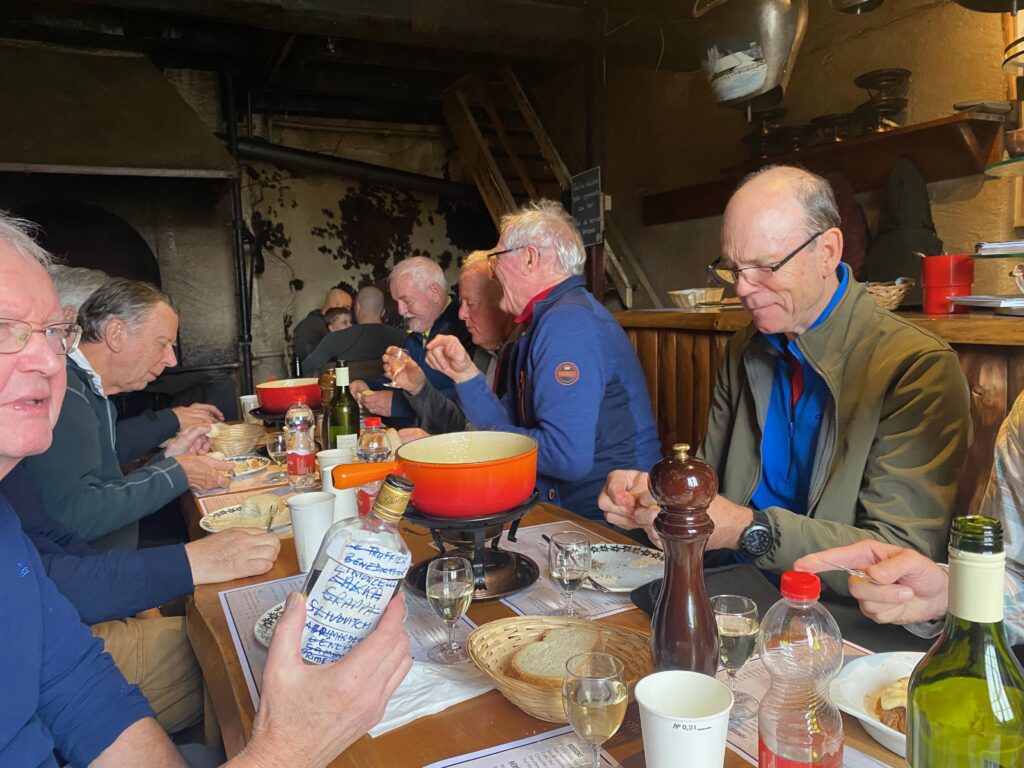
Enough dog talk. A rather good fondu for 4 was ordered as were röestis and croutes, helped down with a bottle of house white. We drank to absent friends, Larry in particular, also our leader Rob, but also Richard who was missed for his bottle.. Surplus to requirements, I donated my bottle of Chilean Cab Sauvignon to Maria, the proprietress and Moos owner.
Over lunch Mark2rs and I reflected on the fact that this is perhaps as good as it gets. Perfect snow conditions, no wind, sun, fine views to the alps (we could see Mt Blanc), hot cheese, cold wine, great company and only downhill to come (in life perhaps too, even if not always with our ski leader). Given that we were still only on 27 November when rain and wind is more the norm, we were very thankful for our luck.
We finished with apple and cream tarts and coffees.
Girding to go.
We donned snow shoes again for the easy stroll back down to La Givrine and the cars.
Follow the sun downRarely this good snow in November
I reckoned 10km and 304m denivellation. A truly magical walk in the Jura at its very best. Thanks for the company everyone. Kobie slept well that night.
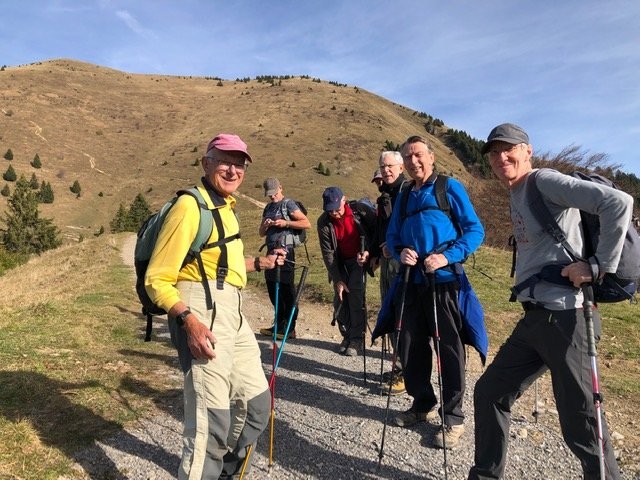
This one was organised at short notice to capitalise on the unseasonably warm and clement weather. In the event eight of us were seduced by the idea of the annual amble up Le Môle, some old faithfuls and some for the first time.
Those participating: Bill, David, Mervyn, Mark 2Rs, Michael Ma, Nathan, Philip, & Ross.
Apologies for absence received from ten more, including the hiking team leader and several of his deputies. You were all missed.
The day dawned bright and we assembled at our usual muster station, the Divonne Lake parking, at 9am, all except the honorable member from Arzier who was waiting at the parking on the other side of the lake. (Note to the organiser: spell it out more clearly).
We loaded into two cars to travel the one hour journey to the start of the hike at Chez Béroud 1160m, a few kilometres beyond St Jean de Tholomé. Le Môle had been visible, a lone peak, for almost the entire journey, but from the car park was now obscured by thick forest,
Setting off from Chez Béraud
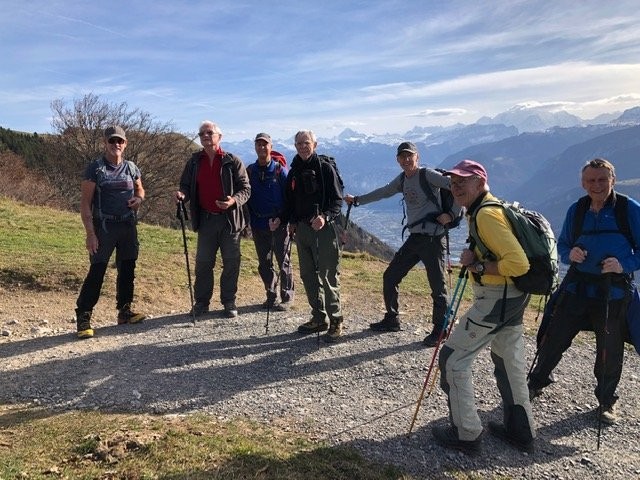
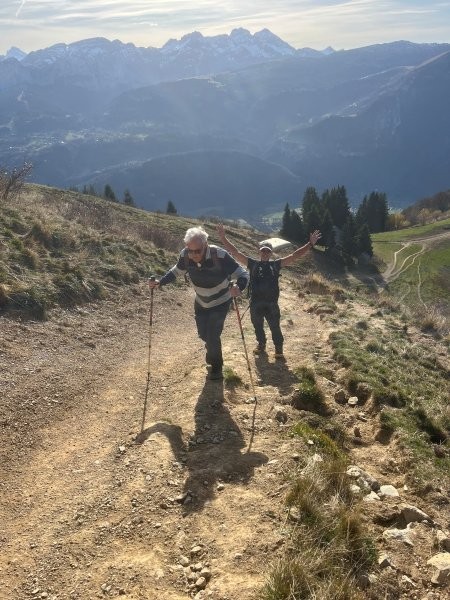
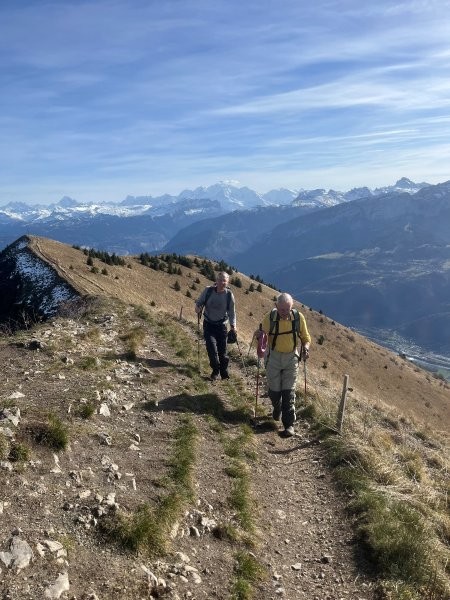
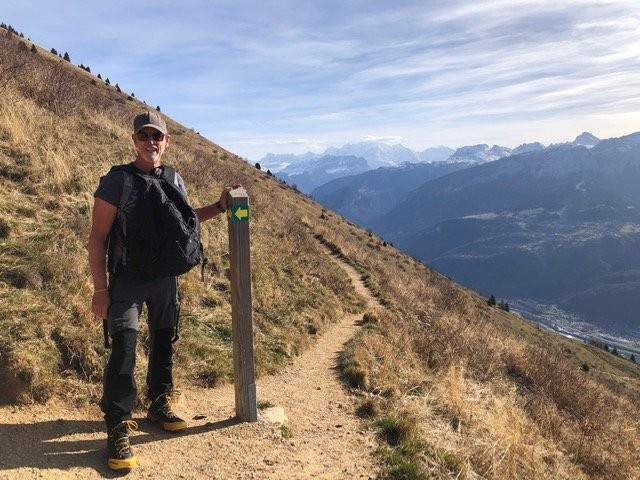
The path up starts wide and stoney and with a moderately steep and steady gradient. This warmed everyone up and we were soon shedding excess layers. At a junction we wrestled with the choice between steep and very steep. Being without the “A team” members we opted for the former and in less than an hour later we reached the isolated farm at Le Petit Môle 1534m for a photo stop. We had got tantalising glimpses on the way up through the forest of the Vallée de l’Arve far below us, but now we had reached open pastures with a clear vista of the distant alpine peaks from Mt Blanc and stretching west.
Halfway up
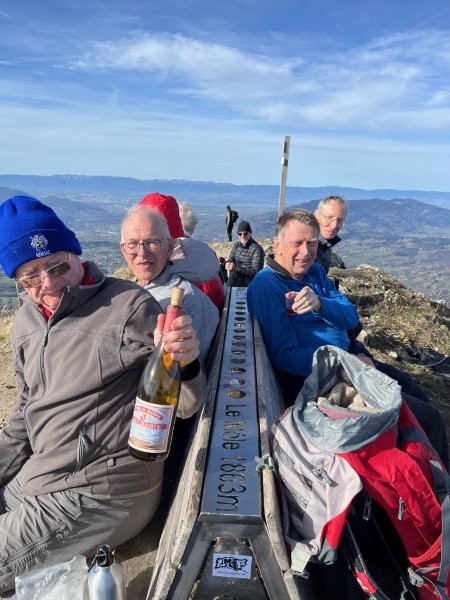
The broad south facing grass covered mass Le Môle now stood before us with several path options leading to the summit. They all looked steep but the ground was dry so we headed up the middle at various pace. The breakaway group reached the top, 1863m, at 12:30 and set up camp for lunch at our usual spot – the Wine Bar (see photo). Only one bottle of Côtes du Rhône between eight this time and no sign of the GIN bottle of Many Spirits; almost a temperance hike! It was quite windy but the visibility was superb and the anticipated 360° panorama did not disappoint. This really is an exceptional vantage point and banished memories of our ascent in the fog a year earlier.
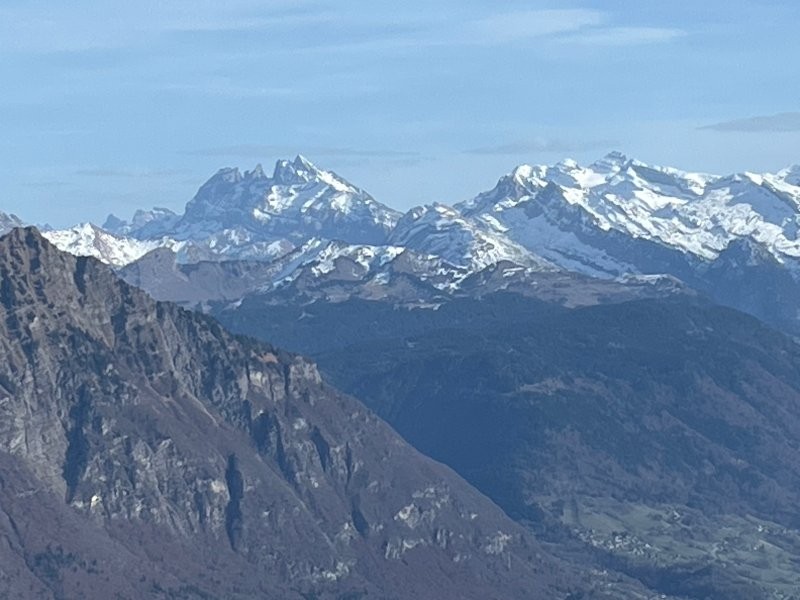
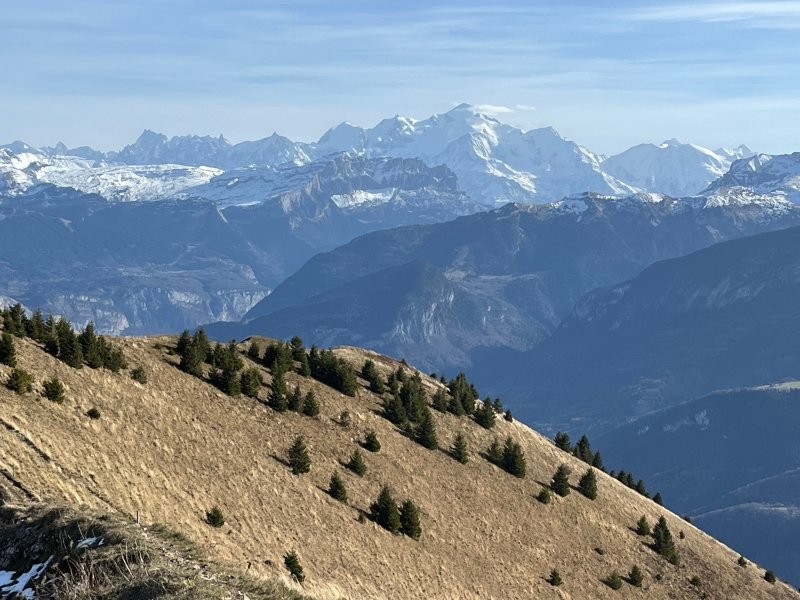
The final pushBill about to catch DavidLate arrivals for lunchRoss on Le MoleView from the top … Dents du MidiView from the top … Mt BlancWine bar at the summit
The descent took us by way of the lower summit cross, along a narrow ridge and then down a steep and rocky path. There were vestiges of snow clinging to the north facing flank, which seemed incongruous in the prevailing warm conditions, but perhaps a reminder that winter is not far off. Upon reaching the Petit Môle we retraced our, by now weary, steps to Chez Béroud. We had noticed at the start a café which one of our number with sharp eyes and an optimistic outlook thought might open at noon.
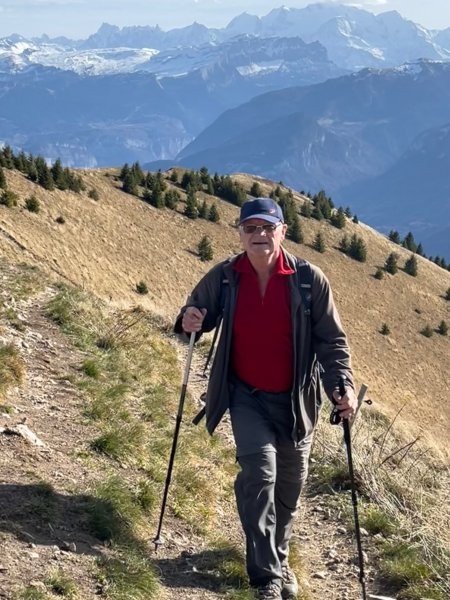
Leader leaving Mt Blanc behindThe steep way down
It was by now 4pm but, perhaps……….?
Yes! It was. Beers and panachés were ordered and quickly downed by us thirsty hikers as we sat outside watching the late afternoon sun set behind the trees and reflecting on a grand day out – perhaps the last of the excellent 2025 season?
We had hiked last week but as I had planned to be absent on 13 Nov, I chose to organise an impromptu (tonic) hike up the two peaks north of La Dôle.
A large number of excuses and apologies with varying levels of credibility were proferred, all were accepted – I’m a generous soul (I think). Six of us turned out, eventually at the starting point.
This is not a place for a dispute as to the location of the start of this hike. I will simply relate the following.
My Flyer stated :-
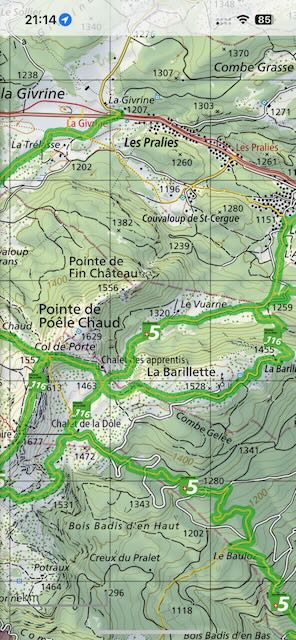
“Meet just after 10 at the parking above St Cergue at Couvaloup de St Cergue (W3W ///piglets.decency.duke), for an ascent of the Pointe de Fin Chateau and the Poêle Chaud.
Ross has done this with me earlier this year but I believe no one else has ever been up the path which goes directly up to the P de Fin Chateau. It’s not much above 400m of up but as it is steep I would rate it as moderate-hard.”
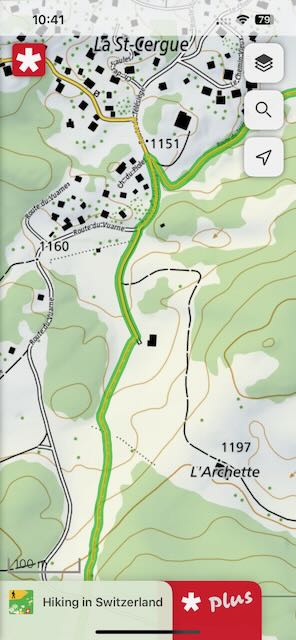
In the event one of our vehicles struggled a little to find the parking – and first tried the “Couvaloup de Crans” – a totally different place. We were indeed starting at W3w ///piglets.decency.duke (Michael found that piglet.decency.duke is in a Moscow suburb).
Why I also referred to the start as CoutzetAnd not L’Archette which is up a track.
The parking is actually at 1151m at the “Refuge de la Barillette” the large black building in the photo above. I would own that there is a board at the parking which indicates that one is at L’Archette, but that does not tie with the maps, L’Archette is up the hill.
We finally got sorted though. Michael Mathews came on his e-bike, and by car came Nathan, Mervyn, Peter Strebel, new initiate Chris Newton, and me and Kobie.
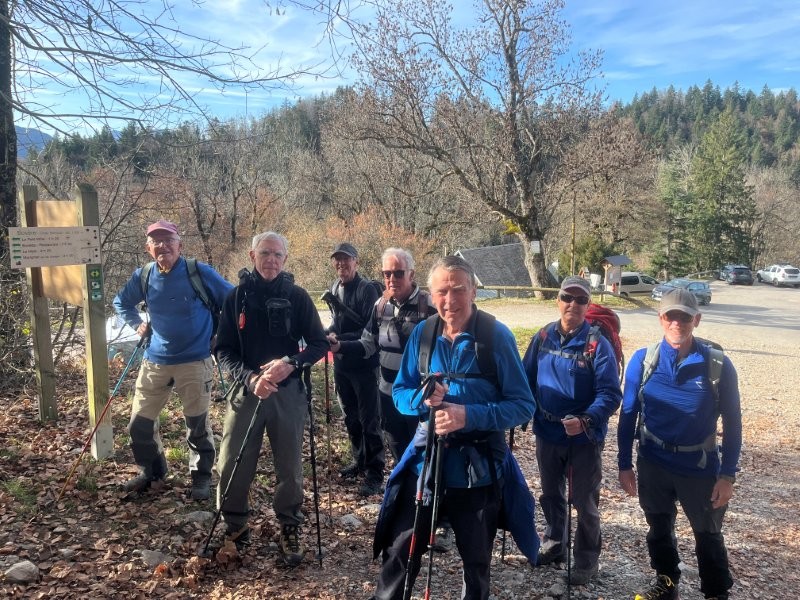
Mervyn, PeterSt, Nathan, Chris, Michael with Kobie and keen for the trail
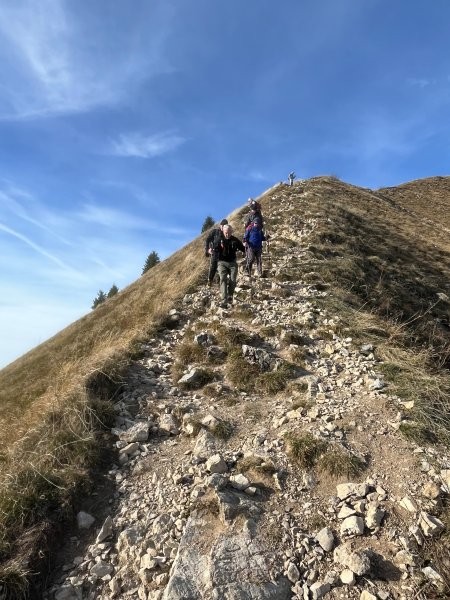
We were swiftly underway, the vibe was good, the weather set fair with a bit of high cloud and intermittent sun expected later, temperature reasonable, little wind. The team were guided onto path Code-Red. Large splodges of red paint signalled the narrow path upward through pine and deciduous forest at a persistently steepening angle. We stopped a couple of times for short breathers but the trail relentlessly led upwards until finally one emerges into the open pretty much at the top of the Pointe de Fin-Château, 1556m. We had made the 400m in not much over an hour.
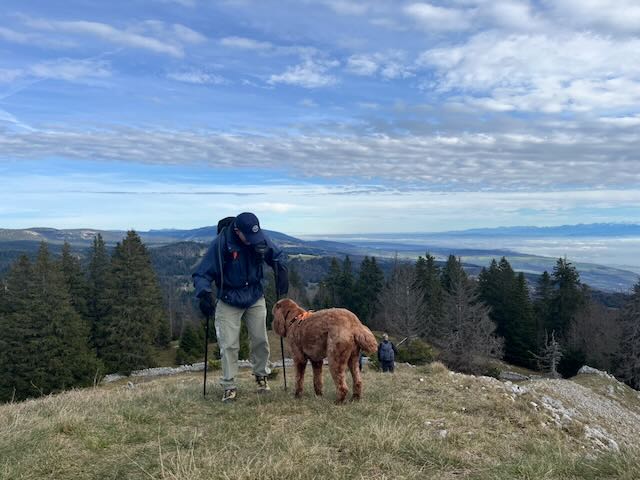
Arriving at the PdFC 1556m Time for some revitallisationKobie welcomes Nathan, view to the NW. Time for rest and recoveryVIew to the SW with the Poêle Chaud and La Dôle in the backgroundFabulous views across to the Alps, and we could also see far into France profondeIt was good to be up on the heights again
Once we all had recovered our breaths and rested it was time to leave, wandering down then on up the grassy ridge in still air to the Pointe de Poêle Chaud 1629m.
Lunch spot on the summit of the PdPCThe Leader with his owner – you choose (see previous photo too)
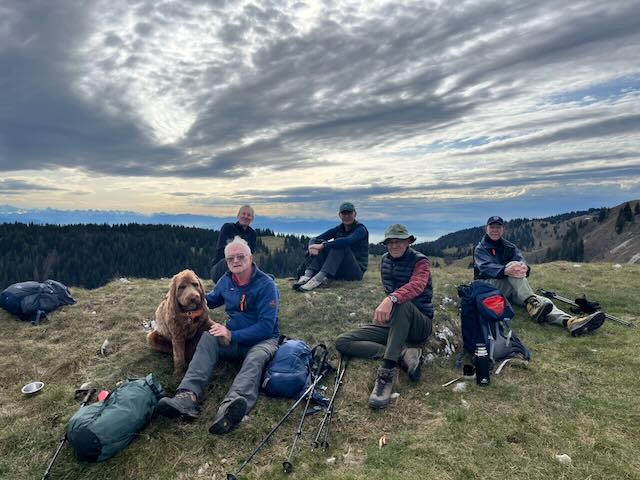
We enjoyed a very pleasant 45 minutes or so, sheltered from the slight breeze below a summit mound. Côtes du Rhone oiled the sluices and I did not have a choking incident. We drank to absent friends, one very far away, one with health issues. I was pleased that newly-retired Chris fitted in so well with our hike culture of reasonable effort and Last of the Summer Wine. I was also pleased that Kobie did not succeed in nicking anyone’s lunch. It seemed a very convivial affair, as are nearly all of our mountain picnic lunches.
PeterSt admires the spectacular view
It was all too soon time to pack up and return to the parcours. A unanimous decision was taken not to hike up La Dôle, we have all been there many times this year.
Michael trying out his new iPhone17 on an artistic log/dog.Starting the descent of the Col de Porte
Descending to the Col de Porte (1557m) we headed down the trail towards the Chalet des Apprentis. All of a sudden a large herd of chamois appeared ahead up the slope to our left. Kobie decided to make their acquaintance and he scootered off up the hill in pursuit. The herd tracked back across our PdPC skyline and they dislodged a large rock which came tumbling down above me. Happily I could judge that it would miss me by a few metres and I watched it bash noisily into an old tree stump. We watched fascinated as the bulk of the herd traversed the Col de Porte and danced swiftly across the steep ledges underneath La Dôle seeking escape from their lumbering golden pursuer. Kobie soon could be seen returning down the path we were on, sensible lad. He needed a lot of water to quench his chase.
The Leader had decided that the more interesting return leg would be over La Barillette (1528m), albeit one of our party decided on the more direct route to return to the cars – perhaps for a sleep (etc). We were soon there having taken the skirting path to the right avoiding the steep ascent from the Bent Tree.
Barillette – more great views to the AlpsAlways a privilege when we get such conditions Chris and Peter at the Tower of PowerGin Kingdom
From the tower the route tracks down the road to the Barillette restaurant (closed – much to the chagrin of an old couple who had just driven there- they said that the internet indicated that it was open…).
During the descent one gets a view of the morning’s ascent.
We were soon back at the cars, rejoining the member who had taken the easier descent option for a snooze. We were back before 3pm and siestas were the order of the day at home.
I really enjoy this parcours and it was made infinitley better by fine company and really nice November weather. The views were stunning and the whole day will linger in the memory into the dark depths of winter. I think Chris enjoyed himself too, new and younger life for our club.
I had recorded 9.1km and 559m – my watch/iPhone Session said – “Moderate”, albeit I had had 31 minutes above Zone 1 heart rate (112bbm).
Thanks to you all for the company and for putting up with me and my hound. Kobie slept well that night, no doubt with vivid dreams of chasing chamois to no avail.
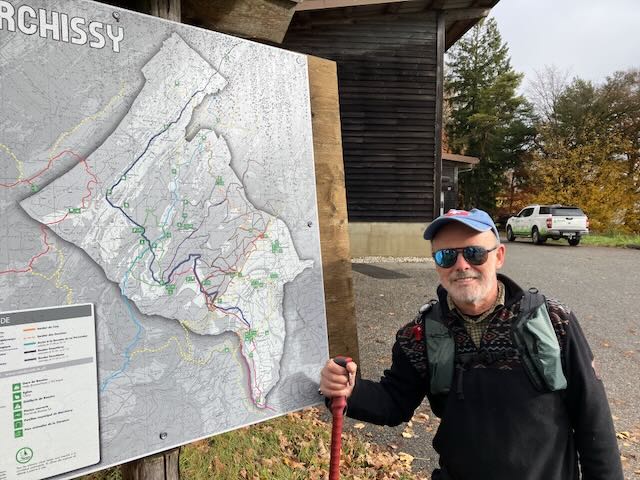
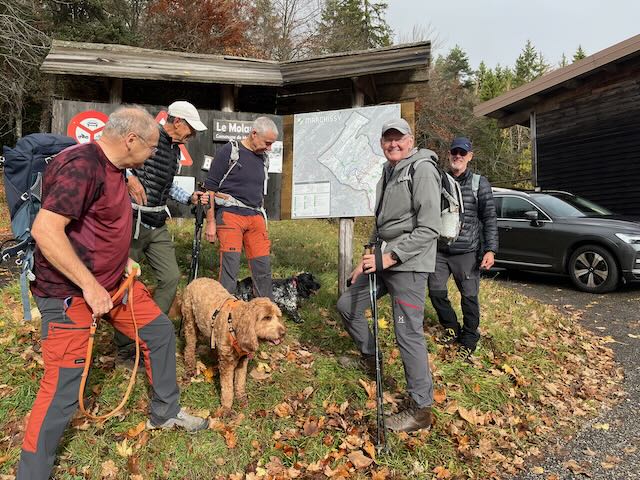
The hike last week was cancelled owing to persistent rain. So this Thursday with the BLeader being in the South Atlantic no biking was arranged and instead a delayed hike was organised. Following Mrs Pashley finding the excellent, recommended and newly made “3 villages path” (above Bassins, Le Vaud and Marchissy) recently, Jill and I hiked it and I spotted a possible new section of forest to explore upward of this. Hence 6 of us with 2 hounds assembled at Marchissy (883m) at 10.15 am ready for an ascent to Cret de La Neuve (1494m). I had reckoned on 611m of up (simple math really).
Attending : 6 :- Peters Strebel, Solomon and Taylor; MikeH; Ross; RichardS; with dogs Kobie and Rocco. I had apologies from many, some ill, some away, some busy, some just chilling.
Our leader (me) selecting the route
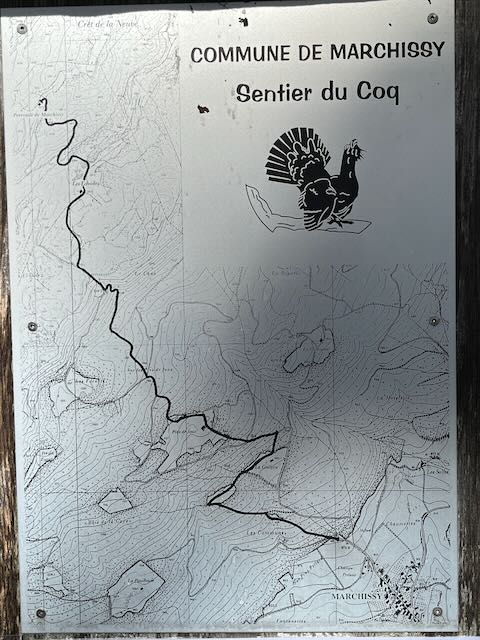
Happily the paths above Marchissy are now well mapped and signposted and it seemed that my target of Cret de la Neuve was reached simply by following the Sentier du Coq, then heading NW up the ridge.
The trail up – gently up in most places with a bit of tarmacSome initial sun somehow evaporated
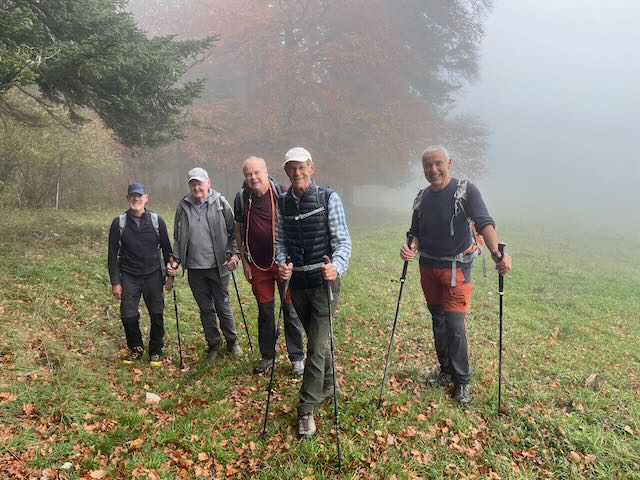
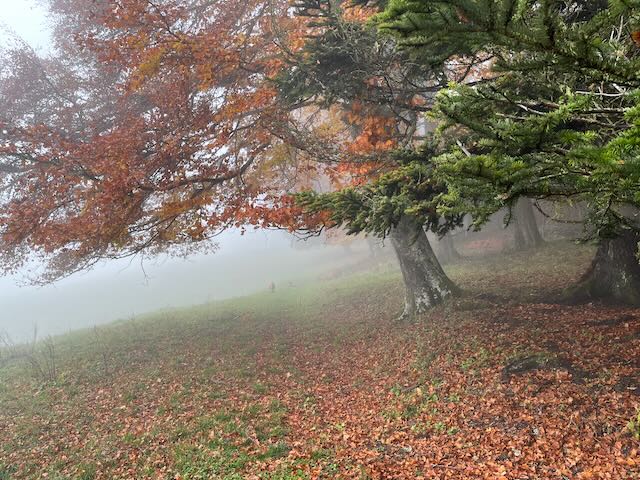
The forecast was good, and so it was a little disconcerting to be starting in the mist, the cloud had yet to lift. We set off in good cheer though following the wooden Coq signs, gently upward through the autumn forest colours.
Traversing an open stretchDogs lead the wayEventually we rose high enough that the sun reappeared
At one point we had to leave the Coq path and take to tarmac as loggers with noisy chain saws had closed the trail. It took about 2 hours to reach the top of the Jura ridge at the Perroude de Marchissy hut, with tell-tale (and very small) signs of the snow that had fallen recently. We turned right and wandered up the sunny slope to our old favourite lunch spot at the Cret de la Neuve.
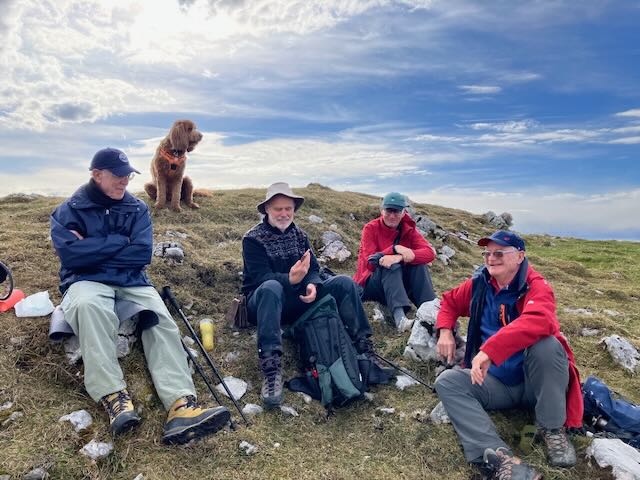
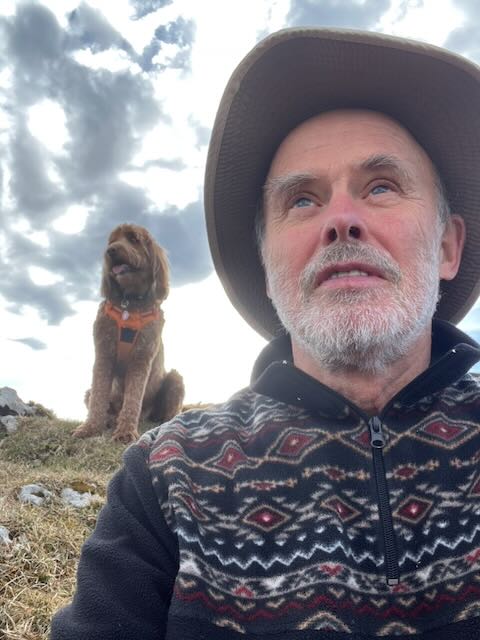
Arriving in the sun – let’s have lunch !Ross and PeterSl with the sign of the crossDogs were given chews but soon tried to explore our sacksRichard in his element. Note – we were just above the cloud levelView to the Alps, sometimes obscured a little, but mostly magnificentHike Leader with his hound (nice pic Richard!)This is a really convivial spot for a glass of vino and a sandwich
A bottle of Bordeaux helped to relax the party and stopped me from choking on my sandwich. One hound perhaps ate too many of my chews too quickly and made an offering to Richard, which he then consumed (again). We met a courageous young lady (from Paris) there who was cooking up her lunch on a stove. Her pack included a tent and she was solo en route from Marchairuz to St Cergue.
Topics at lunch were many and varied. We toasted absent friends and one member told his favourite Margaret Thatcher joke – when visiting a care home she asked an old lady in a wheelchair – “do you know who I am?”. The old lady replied “I don’t know love, but if you ask at that desk over there they will tell you”.
Richard dug out his famous bottle and several of us benefitted from some Russian vodka.
The cloud rose as we moved to go and it suddenly got chilly.
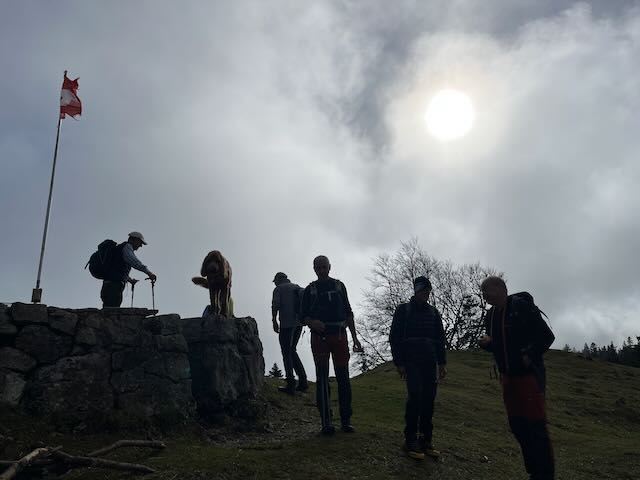
Starting to leaveBeginning to leave under a hazy sun. Notice the Swiss flag.Typical of the way down
The descent, after a first steep section, was long and uneventful, easy angled with much walking on wide trails and some tarmac and the sun came back. At least this enabled plenty of chatting, and we were soon back at the cars, well before 3pm.
Fabulous views at the car park looking over MarchissyA fine view of Mt Blanc courtesey of Peter Strebel
I think we all enjoyed this one, visting an old haunt (for some of us) from a new angle, moderate hiking, in fine autumnal weather. My measurement today was 616m denivellation and 14km. Thanks to attendees and to those supplying photos.
The outline of our parlours with red bits showing higher heart rate. The highest (red) point left is the Cret lunch spot
The forecast showed no precipitation in sight just a little low cloud to mask the sun. Excellent cycling weather….. especially if we could get above the cloud! Seven GIN Bikers signed up for the outing which promised the usual “at least one hill” as well a hearty lunch and the usual comradery.
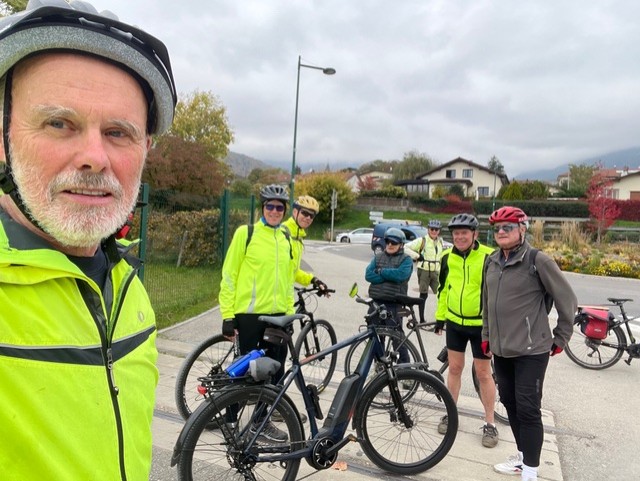
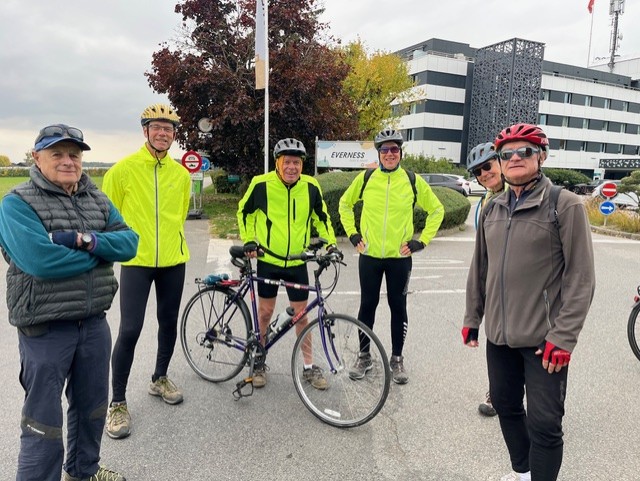
Mark2Ts Mervyn e-Paul PeterD PeterT e-Thatcher Stephen
Six of the group arrived at the Everness Hotel at the planned 10h, only Mark seemed to be absent. Perhaps the change of timing from the usual 09.30h had thrown him or perhaps a little longer mental preparation was necessary. Phone calls failed to contact him. In the event, it seems that he took a novel route which was longer than expected. However, when he did arrive, he arrived in style: he was the only one of the group to be wearing shorts on this fresh autumnal day.
All present and almost correct
We headed towards the Versoix woods, passing a new barrier designed to stop any motorists who thought this path would be an acceptable bye pass of the lengthy road closure on the usual route to Chavanne de Bois. The ride through the woods was delightful: dry, flat and with beautiful autumn colours. We stopped for coffee at the Vielle Batie Golf Club where we received a warm welcome and warm coffee/tea. There were a few golfers trying their hand on the driving range and the 9 hole pitch and putt course. One of Thatcher’s neighbours appeared with grandchildren. Junior clubs sized, they went off to start a potential career in golf (the children that is…..too late for the grandparents!). Paul kindly volunteered the coffee as a recognition that this outing had enabled him to reach 10,000km on his bike this year. Bravo!
The gentle climb up towards Cessy and Gex on paper seems just that but after a relaxing rest it somehow seems more demanding. The peloton spread out with the e-bikers at the front, accompanied by PeterT, who seemed to have a point to prove. The BLeader did his best to keep the group together and encourage the less speedy. By the time we arrived at Gex, the major part of the climb was still ahead of us. We reassembled adjacent to an e-bike hire hub which generated the usual conversation about whom of the non e-bikers would succumb to electronic aid first. There is still a lot of pride attached to pure muscle power riding. Mark thought that the time is approaching but was not prepared to act on the spur of the moment and rent one of the bikes from the stand. So, with the tough hill ahead and Wattage low, he decided to head back home for a comfortable ride and early siesta.
The rest of us gritted our teeth and headed through Gex and up on the road to the Col de la Faucille. The road itself zigs and zags it’s way up the hill and past our lunchtime destination, the restaurant Le Florimont. This has two disadvantages: firstly it is a lot longer and secondly there is a lot of traffic to contend with compared to the back route. Unfortunately, the back route being shorter for the same amount of elevation gain is consequently much steeper. Memories from earlier tackling of this direct ascent some years previously had faded (indeed, the Bikers had cycled to a GIN lunch here) and the level of effort required forgotten, replaced by the warm satisfaction of the well-oiled lunch. The climb rivals any of the other usual GIN Bikers challenges. The group strung out. PeterT determined not to be at the back forged ahead. The e-bikers, Paul and Thatcher, unworried about charge anxiety as they had plenty to spare, could enjoy the colourful seasonal display on the Jura. The rest of us had heads down, concentrating on the tarmac and sweating profusely as each pedal turn challenged the ageing leg muscles and lung capacity.
One by one the restaurant destination was reached. When 5/6ths of us were there the beers were ordered. When the sixth member had not appeared 30 minutes after the first, some concern was expressed. However, we had no doubts that PeterD would appear for beer. Some minutes later, the BLeader thought that a more positive effort should be made and managed to make phone contact and received a reassurance that our party would soon be complete. Definitions of “soon” can differ but eventually the BLeader started walking down the road in search of the lost rider. A further call and an acknowledgement that all was not well and maybe there would be a spare beer at the lunch table. Not a happy outcome and the incidence of a lost GIN biker would not make for a relaxed lunch. Stephen returned to the restaurant to impart this sorry story only to find both Peters sitting at the end of the table and the spare beer being consumed. In his keenness, PeterD had cycled right past Le Florimont and further on up the track before realising that he had expended more energy than necessary.
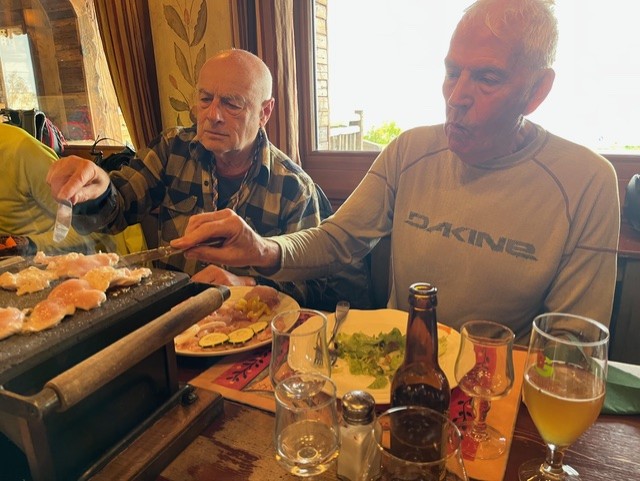
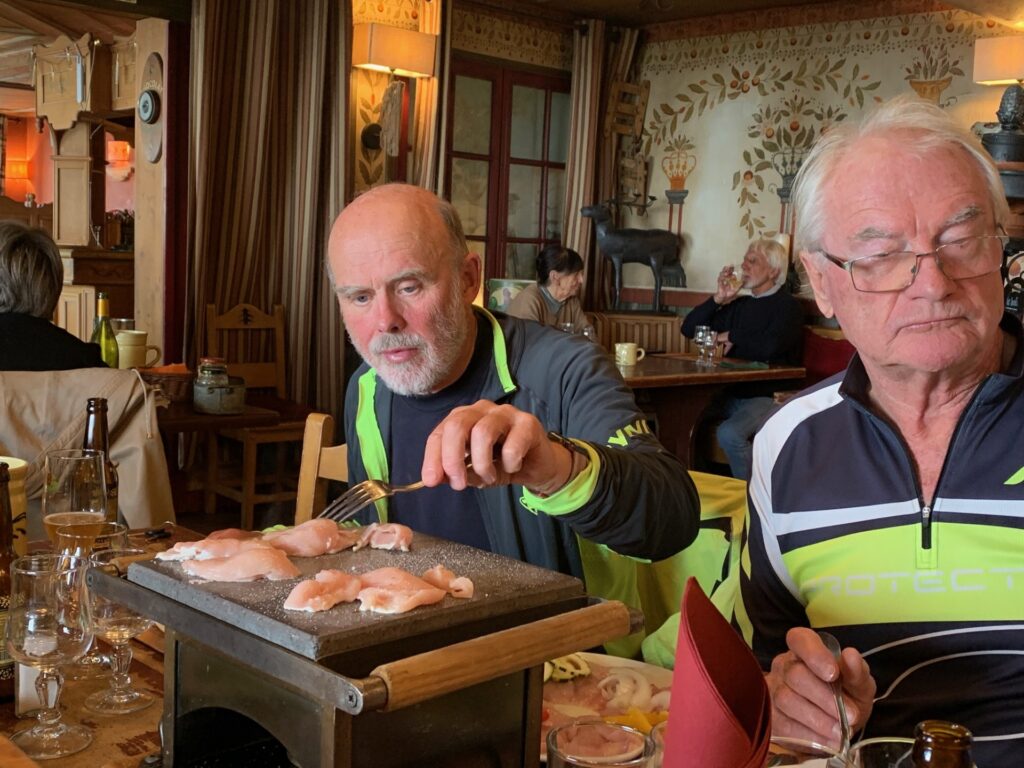
Pierre perdu tucks in
The other Pierre does the same
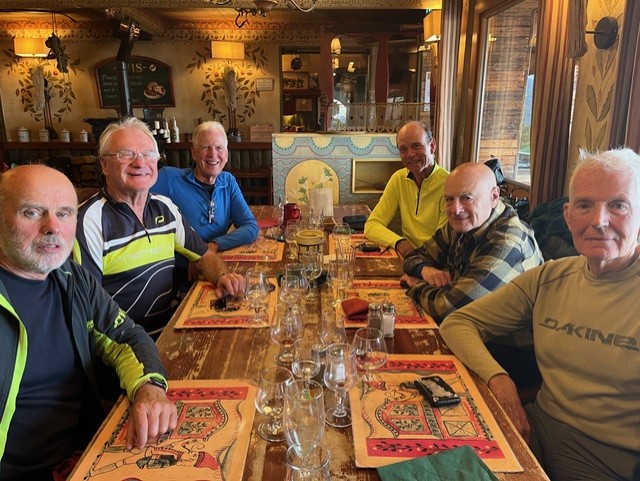
The last time Thatcher had been in this restaurant was 35 years previously. Apparently, little has changed….certainly the place mats were dog-earred. Lunch was excellent and plentiful. The menu du jour was salad, pierrade with chicken and then a café gourmand, all for a modest 25 Euro. Stephen offered drinks in recognition of the last formal ride of the season, Mervyn offered top up drinks including large digestifs (of a much more satisfactory quality than some other recent ones in Barme on the 2 day walk) in celebration of a recent birthday and Thatcher offered lunch as a thank you to the GIN organisers. What comradery!
Replete, relaxed and still a large digestif to round off the meal
Fully relaxed and with that warm glow from good food and drink, we wrapped ourselves up for the chill factor of the descent. It was an enjoyable downhill all the way, retracing our path until the old railway track in Gex, where Paul separated to head directly for home. The rest of us sped along the gravel track towards Divonne with the knowledge that we were not far from a comfortable chair and rest. Unfortunately, the progress was impeded by construction works just before Grilly and we had to descend a steep bank to the alternative road. The first there gingerly slid down the slope whilst Thatcher did an impressive forward roll, happily with only minor damage to his bike and no apparent personal injury.
At Grilly the group divided further with only a couple benefiting from the short new extension to the railway track, which avoids the earlier detour through the town. By the time Divonne was reached everyone was on their individual way home.
This was another exceptional day’s ride and a fitting one to end the formal season. The discussion on e-bikes continues but there is more weight towards the benefits after an ascent of this nature. The capability to go further to new cycling areas also is in favour of e-bikes. PeterT, for one, categorically stated that he would not attempt this route again without electronic assistance but he still is reluctant to set the trend. We’ll see what challenges the Bleader sets next season and what machines are being ridden.
Statistics for the day: +/-42km and ca. 650m ascent
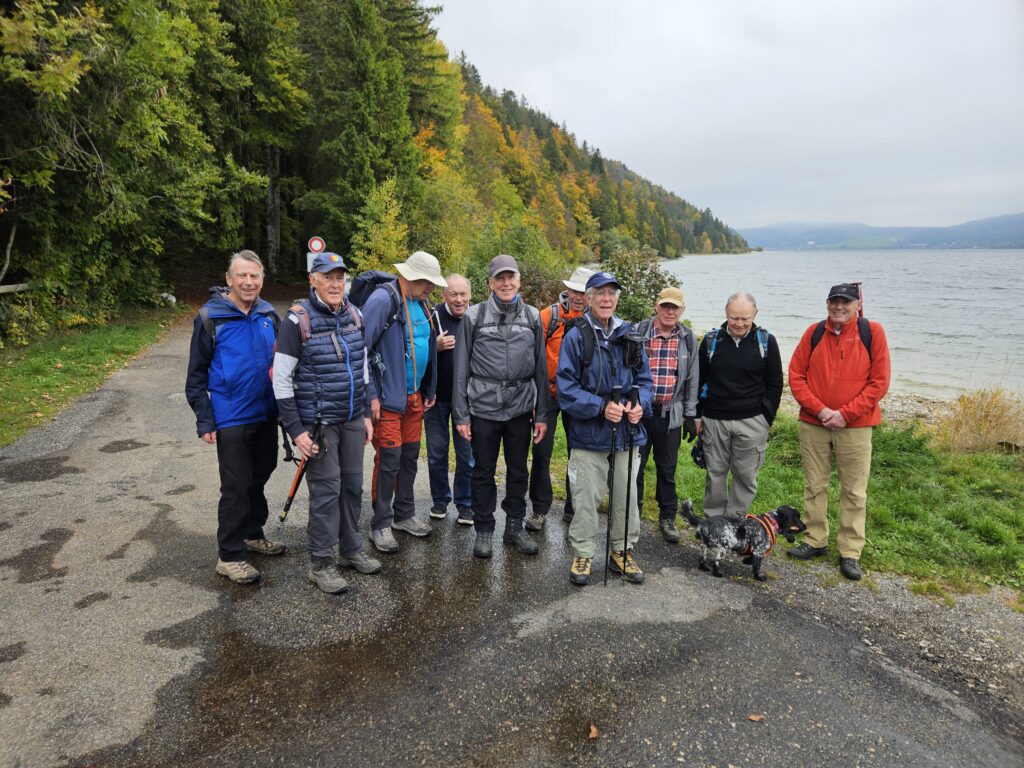
For the sixth time in the modern (GIN) era, the classic hike on the shores of the Lac de Joux was planned for Thursday, 9th October. It was billed as a relatively easy outing which might have attracted a larger response from the hiking community, but in the end just eleven of us embarked on the trip as several “would-have’s” were otherwise occupied, along with some regulars who were either incapacitated or off on their travels. Seven of us (Mark 2rrs, Mark 2tts, Nathan, Stephen, David, Rob O’Riordan and myself) met at the Divonne parking. Rob had just descended from St Cergue by public transport only to be returned by private mode. Our delight in seeing that there were none of the usual queues up to the autoroute was quickly dampened by the slow-moving, sometimes stationary, traffic on the said road. Messages were exchanged advising of possible late arrivals at the L’Orient parking place, where we met up with the four (and a half) remaining members (RichardW, Andrew, Thatcher, MikeH and Rocco). Rocco ran around greeting everyone, but was obviously confused that his mates Kobie and Nessie weren’t present.
The weather had been sunny on the plain but as we had reached the summit of the Col du Marchairuz, we encountered the cloudy conditions which unfortunately persisted for the rest of the day. The leader communicated the bad news that the little red and white train for the return trip was out of service, but the good news that there was a conveniently-situated bus stop which would enable us to be ferried back to the cars. It was also noted at this point that there were three virGIN members who hadn’t participated in earlier hikes in the area.
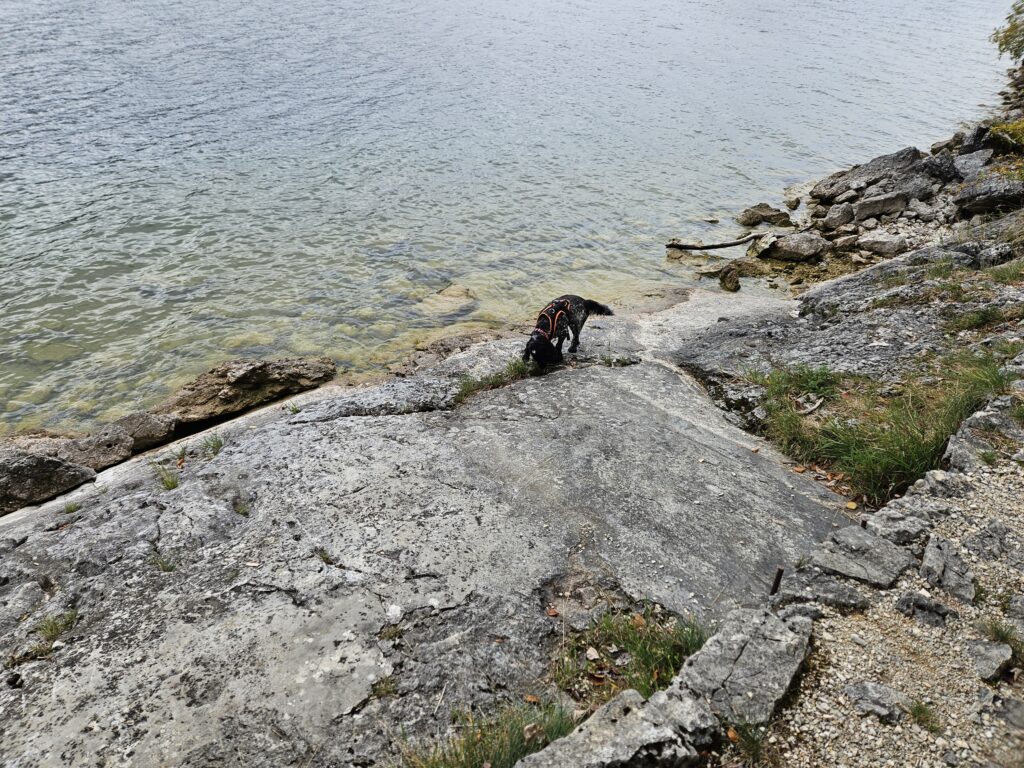
So we set off, somewhat delayed, which may have precipitated the cracking pace set by the first two in the group. However, everyone managed to keep up with the young bucks at the front and there were occasional stops to admire the views across the lake and take in the bird life and Autumnal colours which had been promised. One common topic of conversation which seemed to prevail were the latest exploits of the Orange man and whether his efforts to bring peace would prevail, and if he would be subsequently rewarded by the Peace Prize. Nobody fancied a swim except the brave Rocco who didn’t stay in for long!
Rocco after his swim
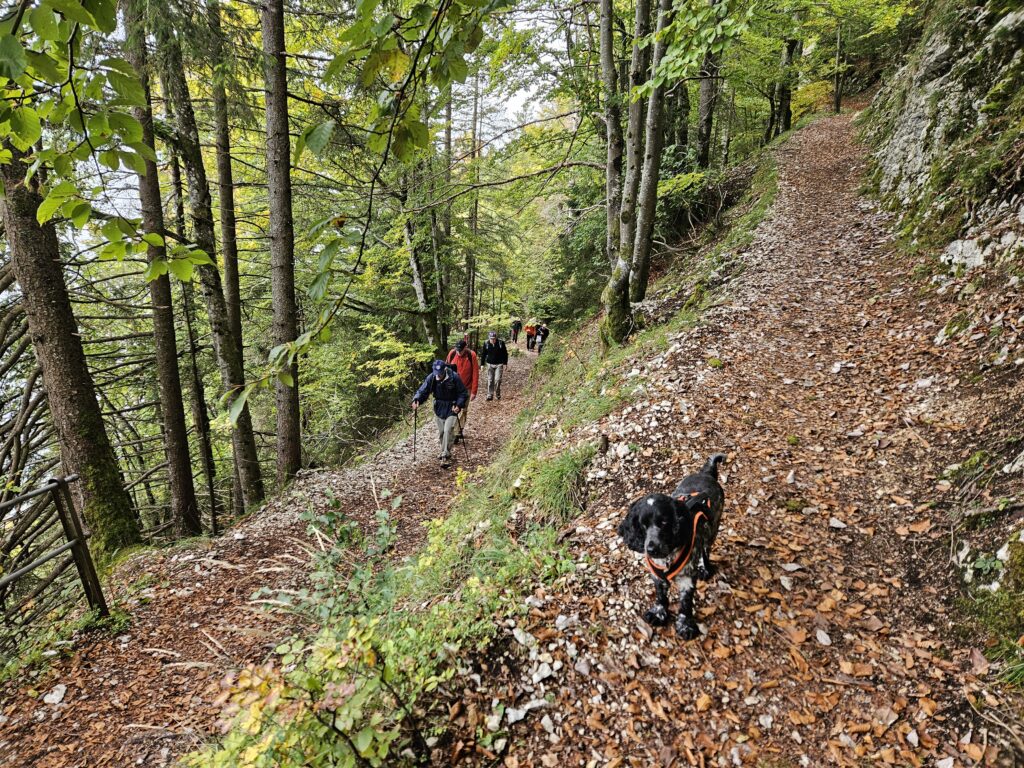
The trail, which varies between grass, road, wooden boardwalk, pavement, soft woodland soil and rocky paths, follows the edge of the lake until there is a steep uphill section rising about 80 metres in a series of switchbacks to a welcoming seat which served a very useful purpose.
Upwards and onwards
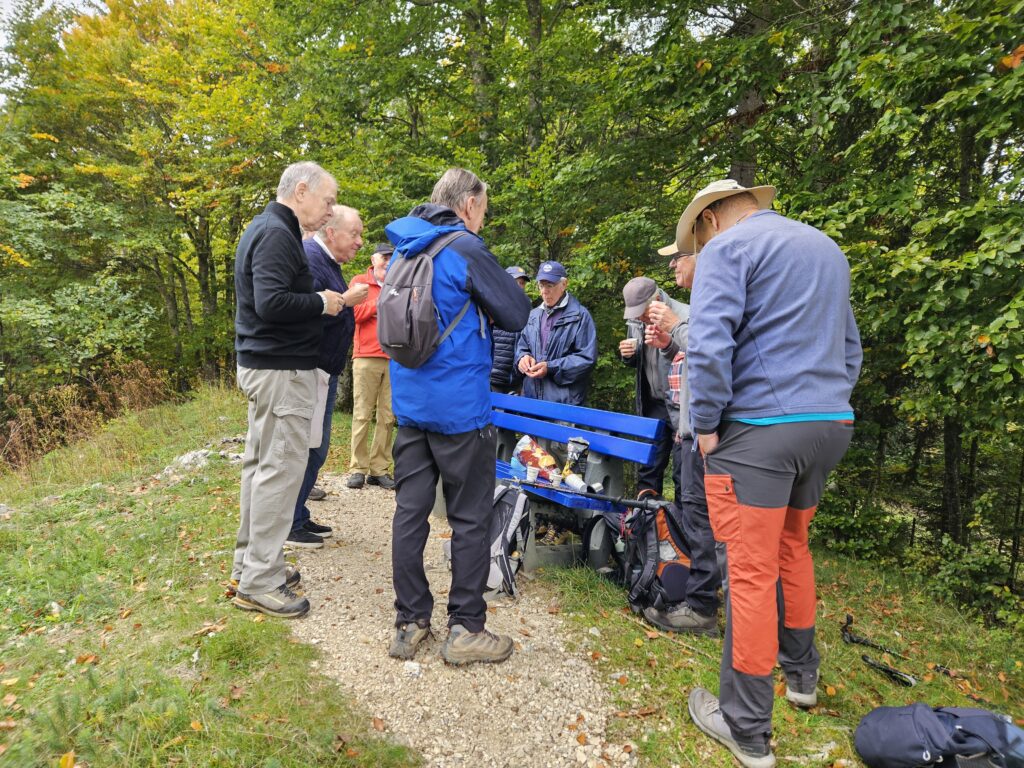
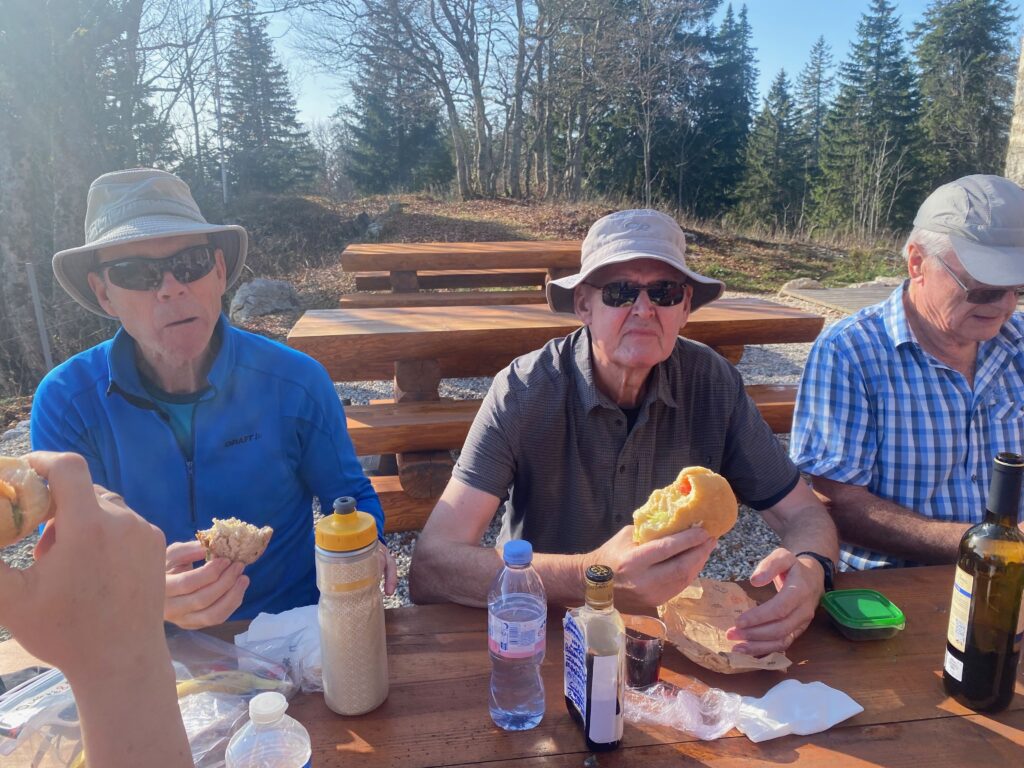
Tucking in
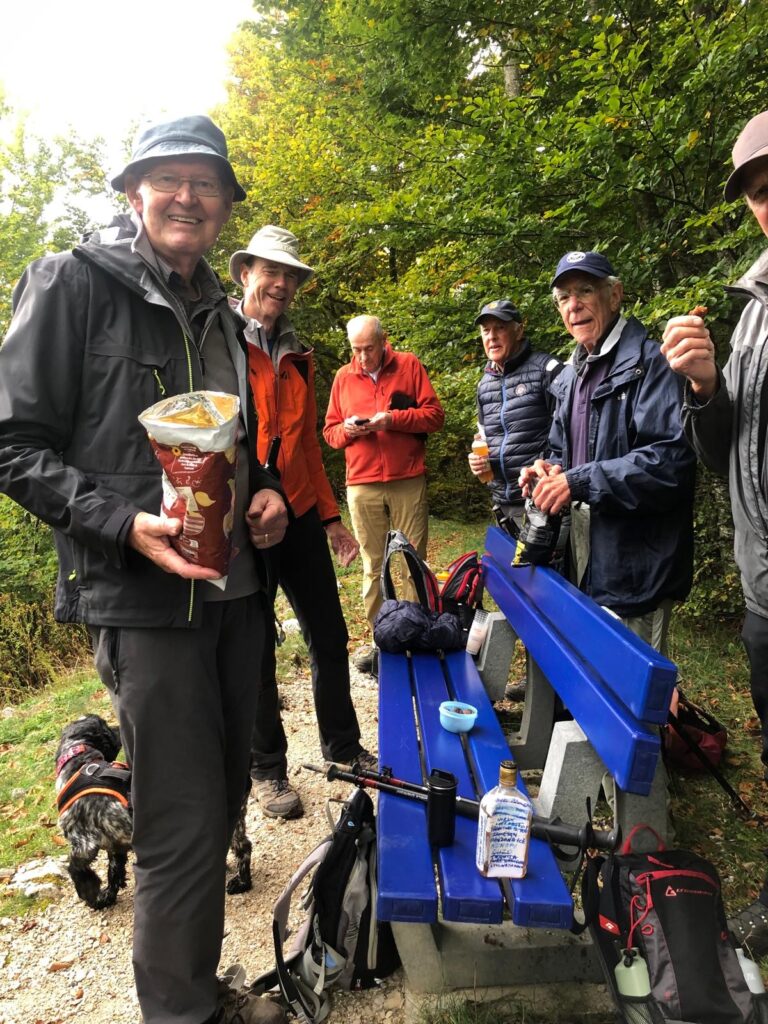
A bottle of excellent red from Puglia was produced (many thanks, Stephen) as well as a variety of snacks, which were gratefully consumed. Sitting forlornly on the bench was the GIN bottle who would remain untouched until much later in the day
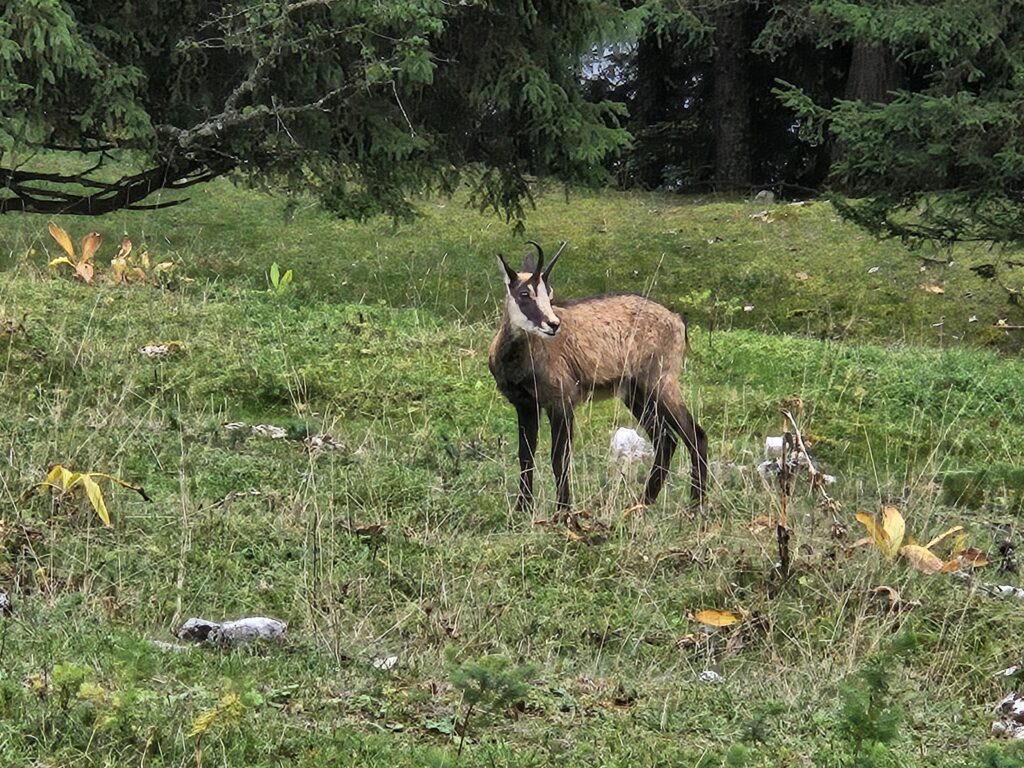
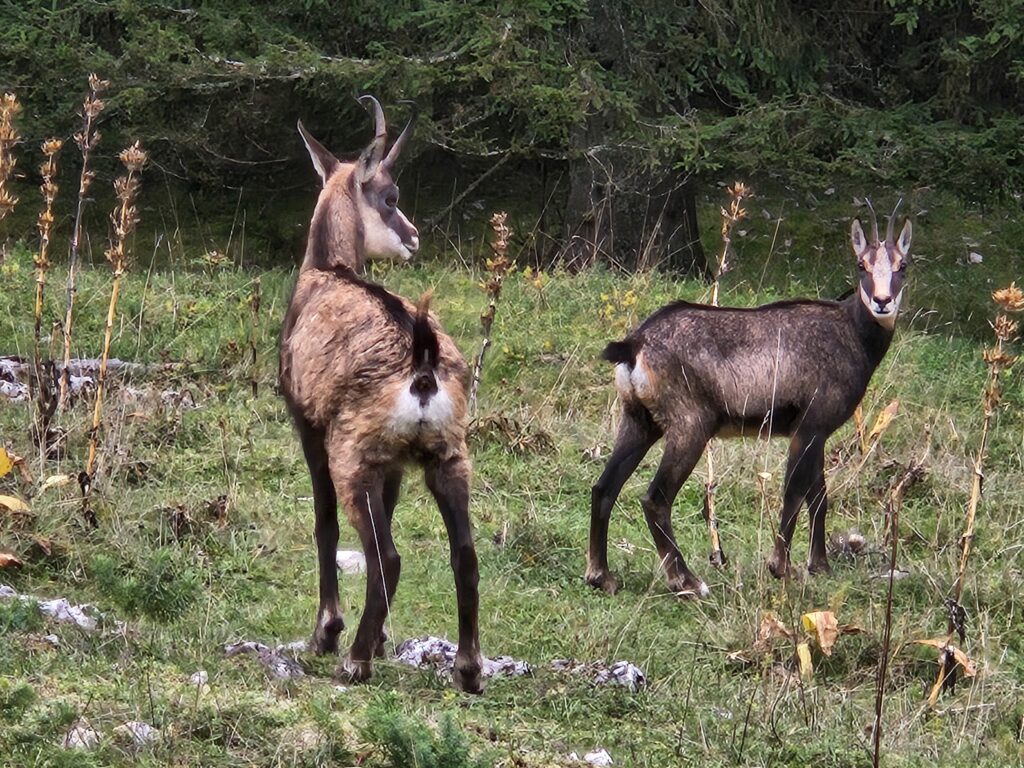
Conscious of our tardy start, we continued into the woodland section hoping to see large herds of chamois, but were somewhat perturbed to see several groups of fellow hikers in both directions which may have scared off the wild animals. However, the leading members of our group, including an excited Rocco, did soon espy a small group of chamois disappearing off to the right. Although we didn’t encounter the 70-odd herd that we saw last year, we did eventually come across a gathering of 10 individuals who seemed quite happy to munch away even though we got quite close.
I’m watching you
The path down to the lake level is quite steep with rocks and roots, which is slippery even in dry conditions, so the team became a bit strung out with the leaders obviously thirsty and hungry, probably in that order, marching off along the Le Pont promenade towards the Brasserie des Combières, our lunch spot.
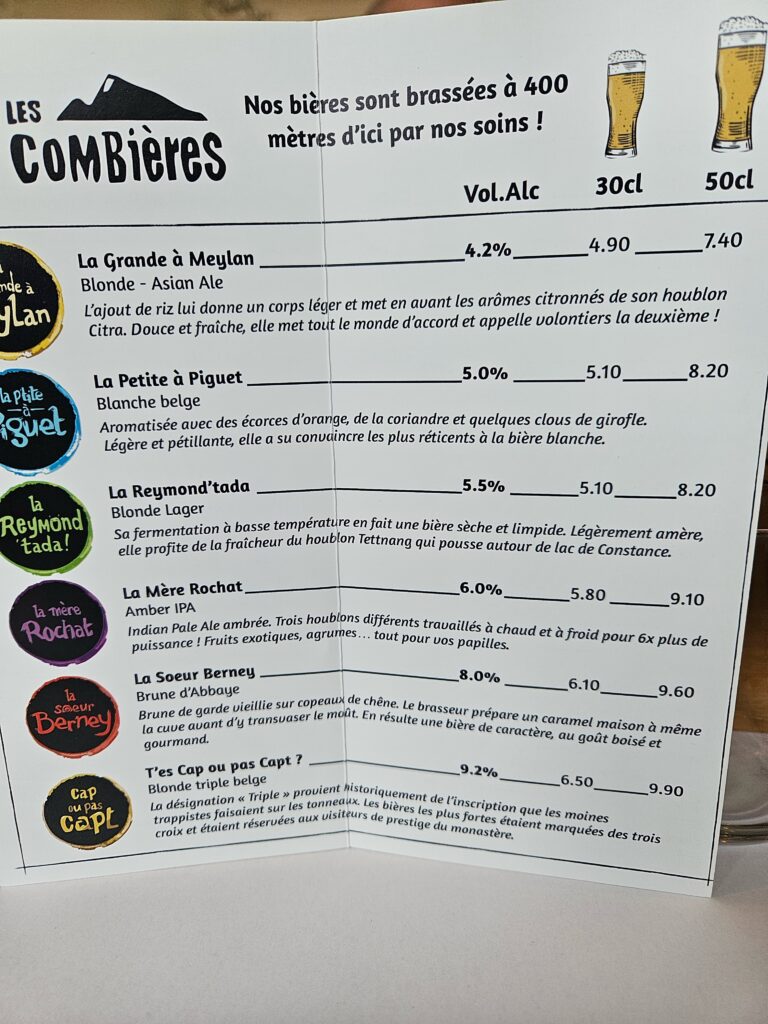
Beers brewed less than half a kilometre away were quickly ordered and sampled and we were pleased to see that a selection of “chasse” was on the blackboard.
Difficult choices
About half our number opted for one or other of the game options and a couple of bottles of red were consumed, although we agreed that the quality was not up to Stephen’s earlier offering. Our twelfth honorary member, the GIN bottle, was passed around and several partook of it’s contents of Stolnaya vodka.
When’s the food coming?
The buses back to the cars run hourly and with the 14.30 departure not being an option, 10 of us bought tickets online or from the driver at inexplicably different prices for the 12 minute trip leaving at 15.30. Rob took his chances that trains would at least be running northwards to Lausanne so headed off to the station.
Our total hike was 12.5 kms, somewhat less than last year, but hopefully just as enjoyable. Total ascent was 180 metres.
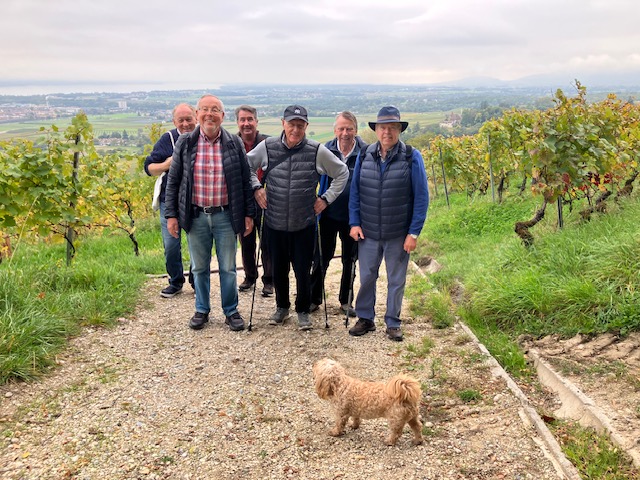
A small group of Ginners enjoyed an excellent lunch at the Café du Raisin in Begnins on Wednesday 8 October, preceded by a walk through the charming vineyards surrounding the village. The view of the Vaud countryside and the lake was very good; unfortunately, the Alps were covered.
From left to right in the photo – Robert (O’Riordan), Rudolf (Staehelin accompanied by Daisy in the foreground), Bob Rankin (on his first outing as a new member), Jeff (Crudgington), Mark (Warren) and Gerry (Swart).
Local boy Al (Peters) and Norman (Eatough: he made it all the way from Thoiry) joined the group for lunch.
Into October and still the weather forecast was indicating a sunny day. However, we hadn’t prepared ourselves fully for the chill of the morning which carried on throughout the day. Seven GIN Bikers met at the Everness at 09.30h, some wearing shorts and some having changed to their winter wardrobe ith long leggings. The starting team were:
Mervyn Mark2Ts (back after many absences) PeterD (back after some absences) PeterT (back) e-Paul e-Philip Stephen (Bike Leader)
Paul arrived last having been contemplating the wasted fruit on the ground in the neighbouring orchards…..seemingly good fruit but for some reason left to recycle into the ground. His panier basket seemed fuller than usual.
At this stage in the biking season, muscles should be fully formed and lungs ready for the more strenuous rides. E-bikers circumnavigate this need and can perform at all times but the purists can be caught short if they haven’t been active on a regular basis. The BL had chosen a route to test physical condition… the famous 3 hills circuit of Bonmont, Mourex and Vesancy.
“Cycle gently towards the Bonmont climb. Warm up with the climb up to 727m. Down to Crassier and a coffee. Along the old train track, through Divonne and onto the Mourex hill test. Down and then up to Vesancy. Down to the Accor Parfait for lunch. Home after lunch.” Compromise was made in the shape of a coffee break after the Bonmont hill and serious calorific restocking at lunch.
We set off in the now usual circuitous route towards the first hill, passing a fellow GIN member, Martin Vaughan, walking his dog, Terence. Martin declined the offer of joining the group blaming an ageing bike with a puncture in his shed.
PeterD commented at one stage that the route to the base of the Jura was a little too wayward….but he hadn’t been on the previous outing to make a balanced judgement. The group spread out considerably even in this warm up period and it became obvious who had not been exercising regularly and/or had older equipment. The potential to switch to e-bikes was discussed again but there are some stubborn classical cyclist in the group and they do not want to be seen to crack first. PeterT set off at pace up the Bonmont hill, anxious to dispel the demons of the previous ride. The rest followed with the e-bikers looking decidedly more relaxed and the BL doing somewhat of a corralling role to ensure no-one was left behind. At the 727m junction, the wait for the usual photo seemed prolonged as the backMarker was running on low Wattage. The photo was taken with the potential opportunity to photoshop in any missing member later and then the congregated group departed downhill, eager to get a warming coffee in Crassier.
Time and tide wait for no backmarker
The BL, feeling the responsibility associated with his position, backtracked to ensure that the missing biker was still pedalling uphill…which he was only a couple of hundred metres down the road. The summit attained Mark and Stephen sped down appreciating anew the chill of the day and the impact of wind chill. They arrived at the coffee stop in time to add their order to the open bill, which PeterT kindly settled, adding in some patisserie as well as a bar of house made chocolate.
Happy BL but doubtful GIN Bikers….where are we going next?
At this stage it became apparent that the group was going to fracture. PeterT was called away due an unwell Jill and Kobie, who was in need of his daily part-Everest ascent. Philip had earlier mentioned that he would not be able to complete the circuit as he had to get home for other commitments. Mark part-accompanied Philip on his way before finding an easier route to lunch, avoiding two thirds of the hills on the planned itinerary. The remaining 4 of us manfully adhered to the predetermined route and enjoyed (?) the challenge of the Mourex uphill slog followed by the lesser Vesancy climb. Even e-Paul found that he had to work hard….maybe a case of too many apples in his bag? However, we all made it, age and fitness levels deferring to sheer will-power.
The downhill from Vesancy in the direction of Divonne, via the hamlet of Saint Gix, was a joy apart from that persistent chill factor and we got to the Accord Parfait in good time to have a round of drinks before Mark joined us. Except Mervyn, who decided on the excellent maigret de canard, the rest of us opted for the three course 19 Euro menu, although Paul would have had the copious spare ribs had they not been out of stock. As indicated earlier, the three menu courses were plentiful: pâté en croute with salade, cheeseburger and fries, and an interesting desert of chocolate sauce with mint ice-cream and a thick layer of whipped cream (for those who could manage this). Paul’s often fruitless request for “super croustillant” fries was met on the second attempt as a fresh bowl of indeed crispy chips was supplied without argument by our friendly waiter.
Refreshed, vitalled and warmed we wrapped up again for the quick descent through Divonne and to our respective homes. Such was the eagerness to get to that siesta that the farewell formalities were dispensed with and we peeled off at our individual appropriate points. Overall ca. 50km and 750m ascent with quite large variations depending upon the individual.
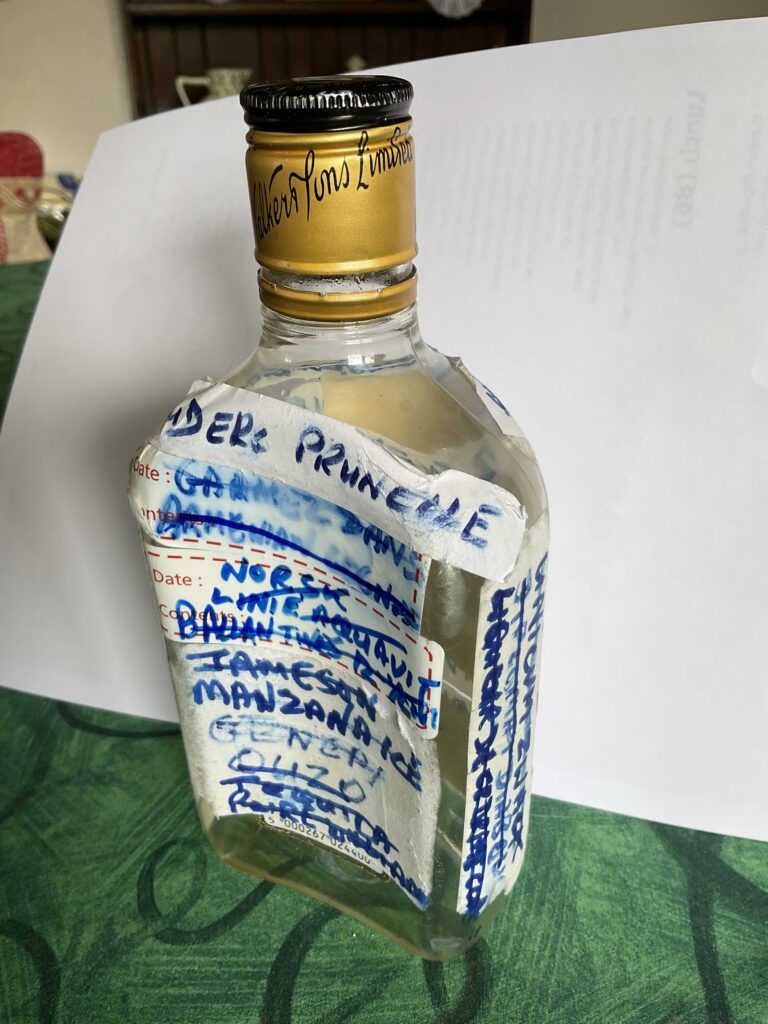
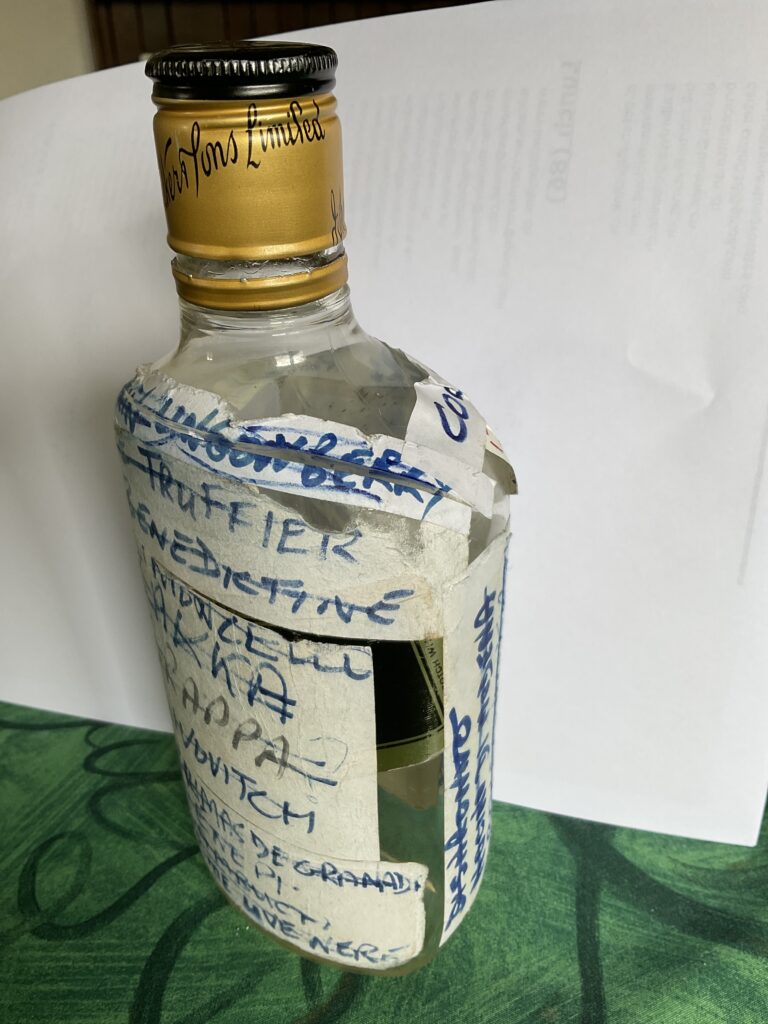
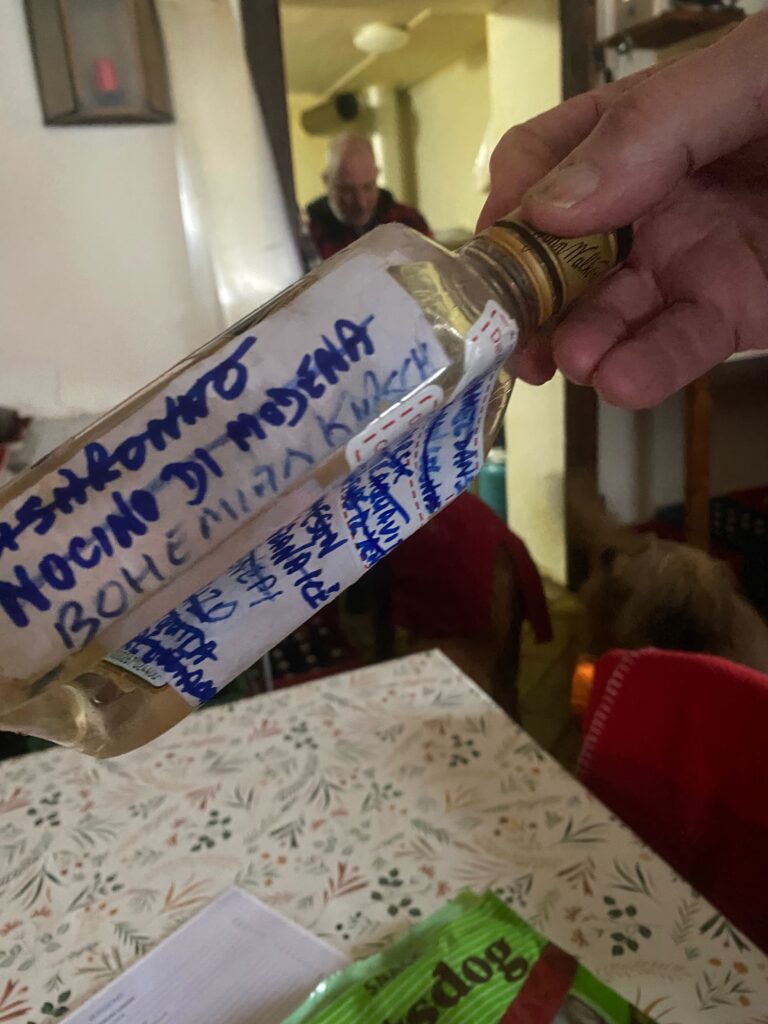
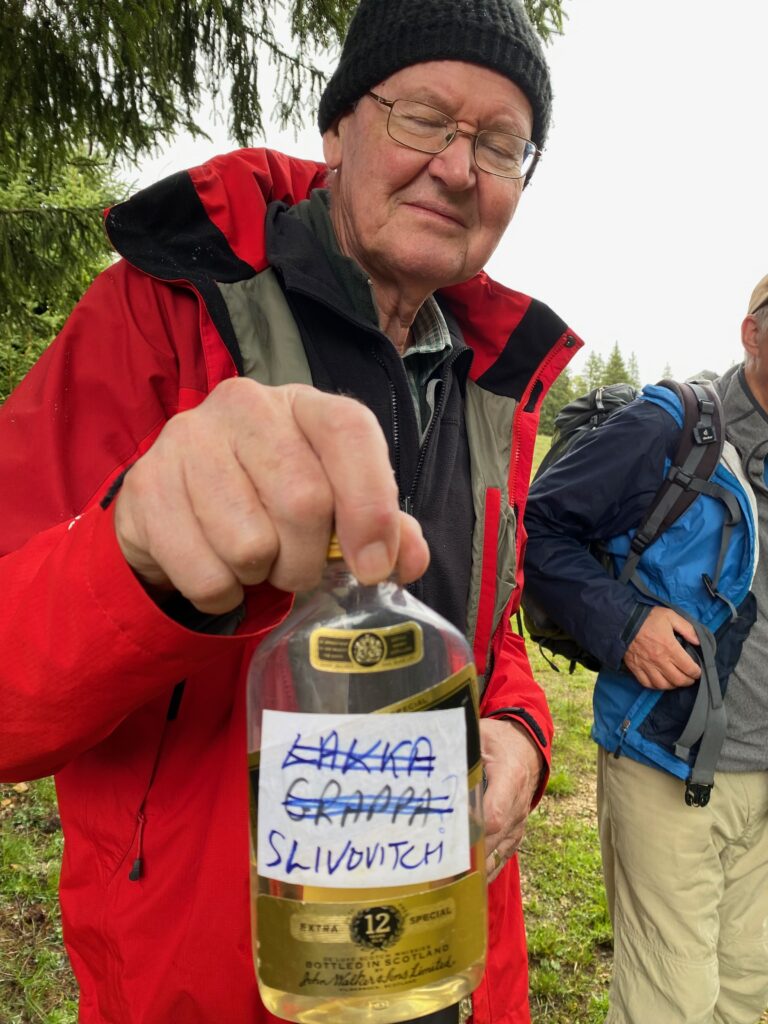
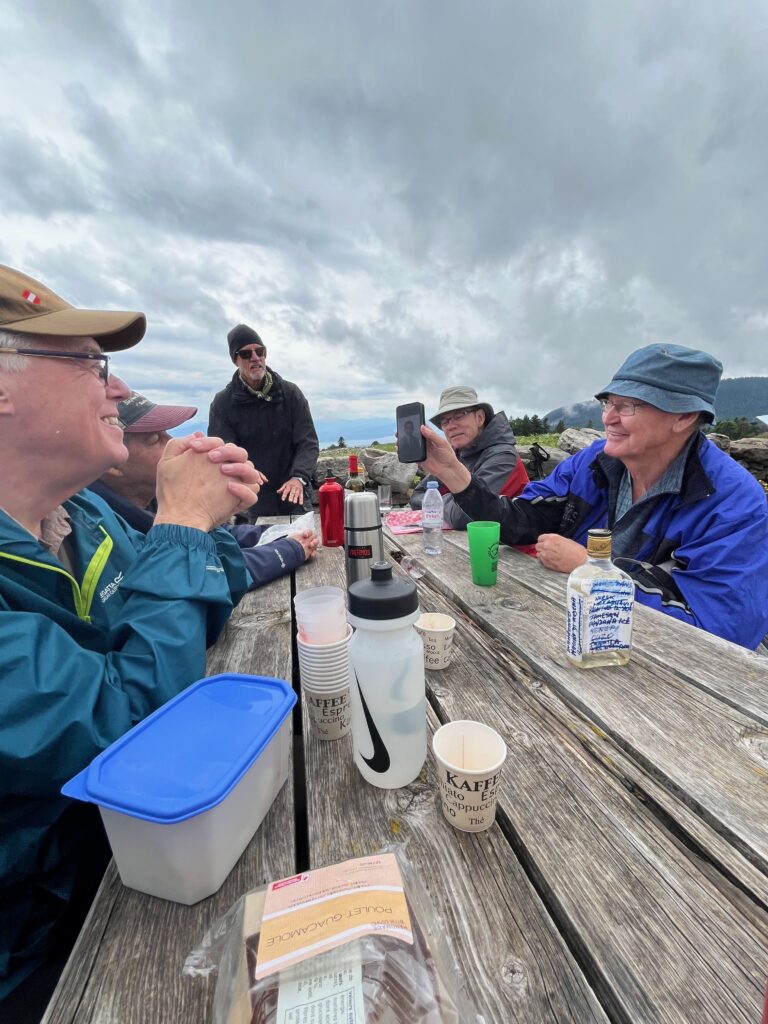
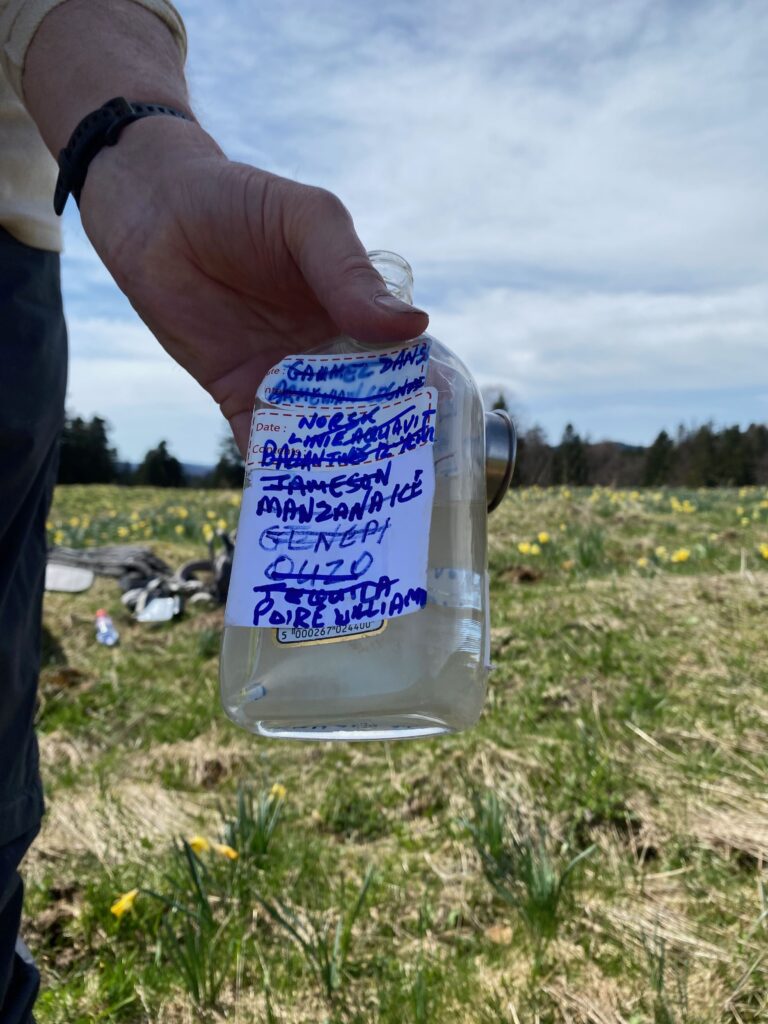
I understand that I’ve become a bit of a celebrity amongst the GIN hiking and snowshoeing community and there have been requests to document my life over the past five years or so.
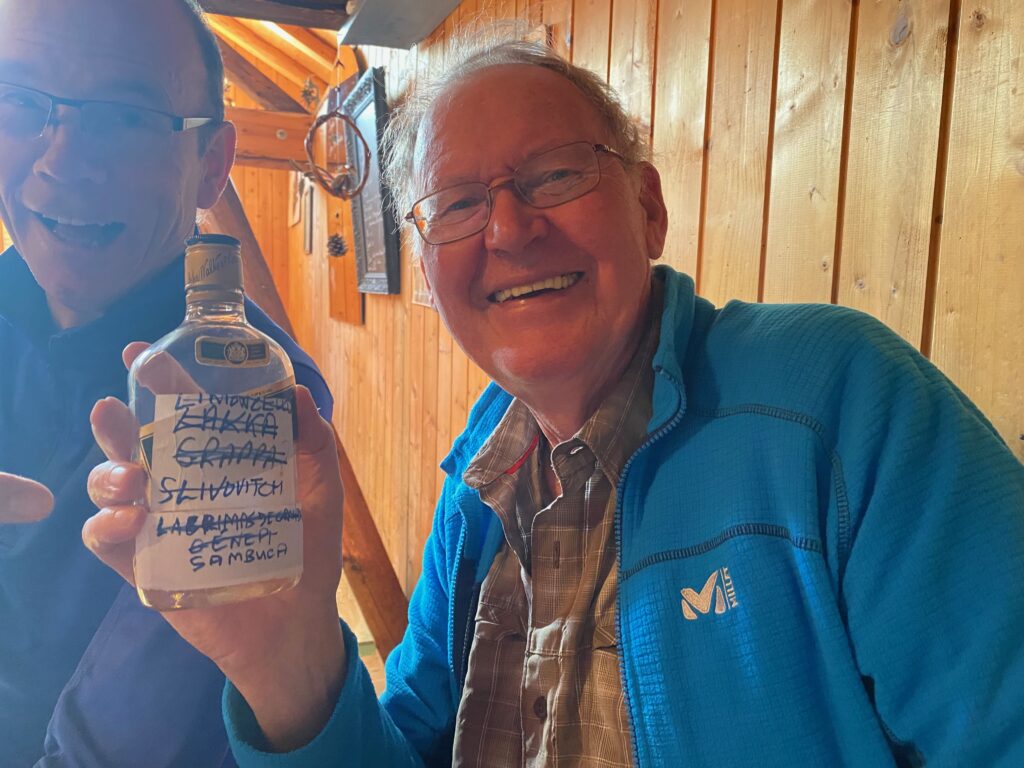
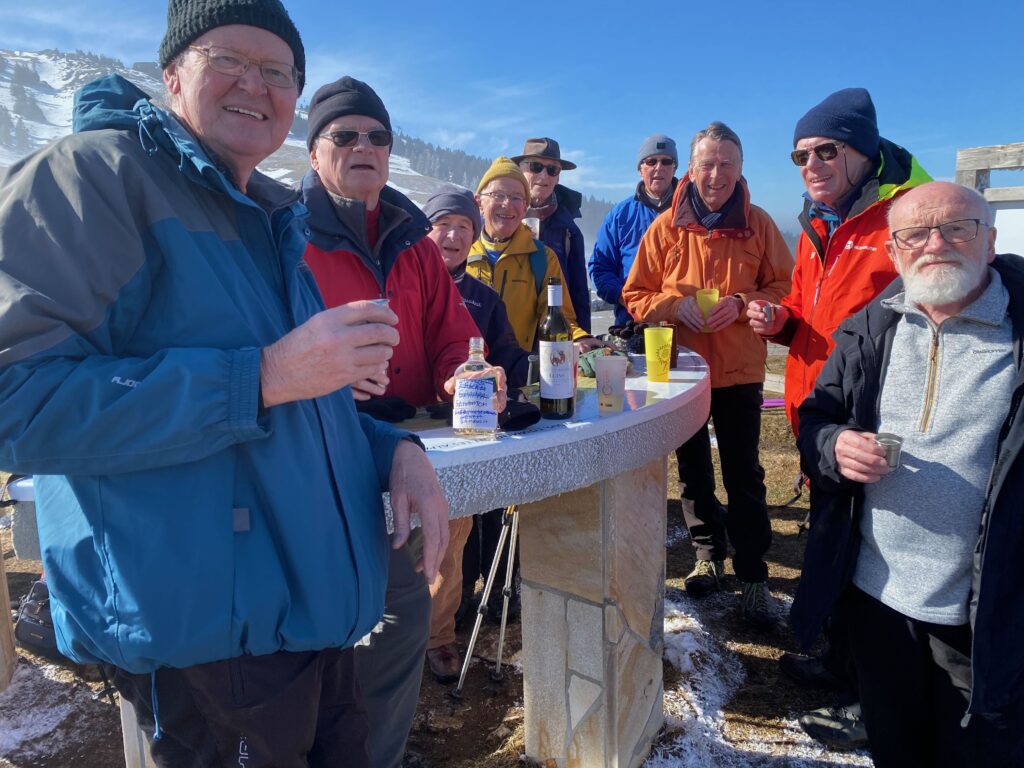
Well, I originally was a receptacle made of plastic containing 50cl of Johnny Walker Black Label 12 years old whisky, but these are distant memories. Since then I’ve had to suffer hot sun, freezing temperatures, wind, rain and snow in the side pocket of my owner’s rucksack with no consideration for my comfort. I’ve been out on many hikes and snowshoe outings and much to my chagrin, my contents have not always been appreciated or needed. Sometimes, the GINtlemen drink lots of wine from my glass cousins, so they’ve had enough alcohol by the time my contents are offered. I’ve been pulled out on the top of mountains, and in woods and refuges, and been drunk from shot cups, fellow plastic glasses, wine glasses and coffee cups. Some of the drinks I’ve contained have been a bit strong and apparently, some have been downright awful. Often noses have been turned up – you know who you are! However, some have gone down very nicely, thank you, and I’ve had some pleasant compliments.
There’s been a wide variety of drinks poured into and out of me and all have been recorded on cheap labels stuck on to my sides. I actually feel overdressed and as there’s hardly any room for more, I’m wondering if I will soon be consigned to those muddy and snowy trails in the sky.
So before that happens, here’s a list of the concoctions I’ve had to suffer over the years, in no particular order:
A hike organiser needs to keep a close eye on weather conditions. So it was with some apprehension when the late summer from the previous week turned into a forecast for early winter with heavy rain and potential for snow for a planned 2 day hike in Barme. So much had been promised by the organiser in terms of stunning scenery only available in fine weather. 12 enthusiastic participants had responded to an early call with happy memories of the Tour of the Muverans and the Tour of the Dents du Midi still in mind. When one potential participant, with a Philippines’ warm weather habit, literally got cold feet, it was an indication that the rest of the group would have to be consulted to check on their resolve. Happily, the first response from a member (one happy to frolic in the snow) set the tone and suggested that this GIN group is more than used to adversity. After this, no-one else dared back out and the organiser had shared the weight of decision-making responsibility.
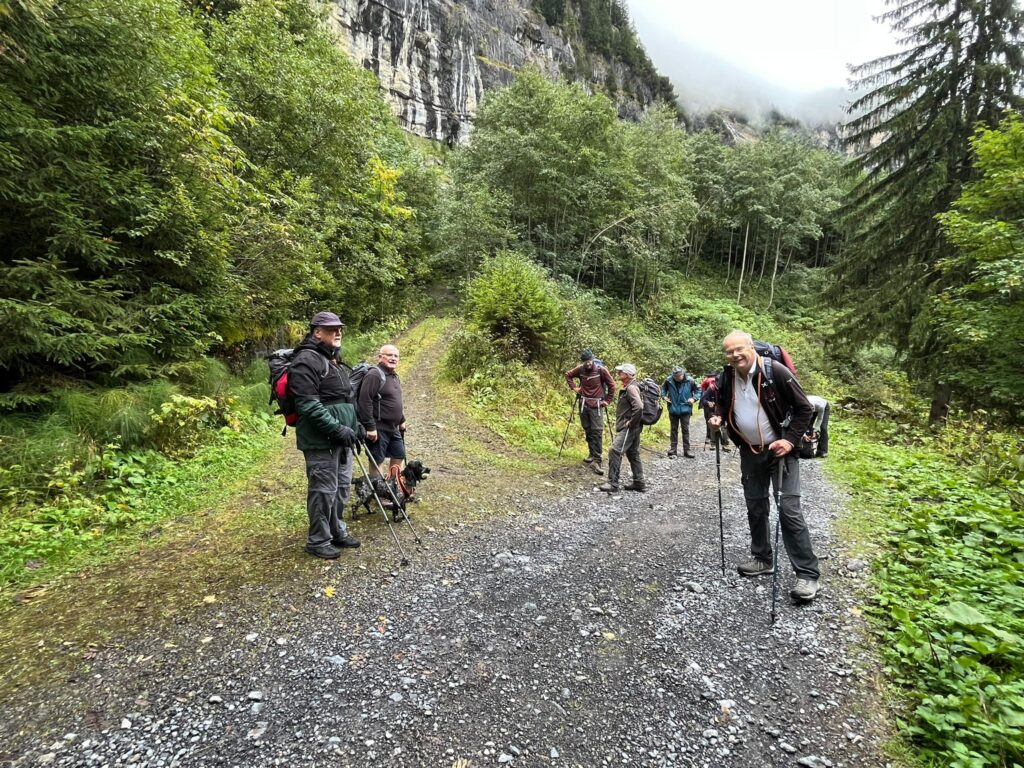
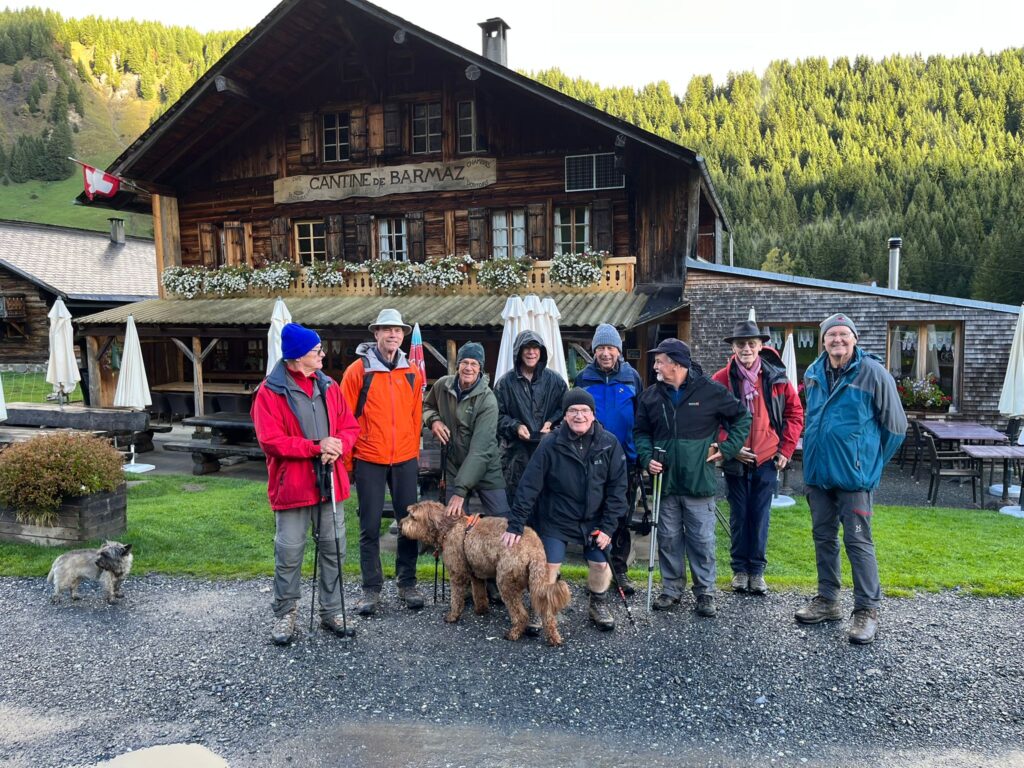
Backpacks were loaded with wet weather gear and layers of warm clothing (and in some cases copious supplies for canine friends) and then covered with waterproof membranes. The journey from respective homes to the Grand Paradis parking meeting place in the Portes du Soleil at the far end of the valley from Champéry was mostly smooth. The 11 eager participants arrived on time and were soon talking about the sole hiker who had decided that the best waterproofing was bare legs…. well, the Scots do have experience in this domain. The party consisted of Mark2Rs, Mervyn, MikeH + Rocco, MikeM + Nessie, Nathan, PeterS, PeterT + Kobie, Ralph, RichardS, Rob and Stephen (leader). As was commented, mad dogs and Englishmen were certainly present on this occasion as well as a representative sample of other nationalities with similar tendencies.
All present and correct. The team sets off.
The dogs set off excitedly, happy to also be part of this adventure, and the group followed in a more measured manner. There was a request for a coffee stop but unfortunately the one suitable restaurant had decided to take a few days off. So, we started the initial climb, past the closed restaurant and up towards the threatening sky and our luncheon spot. The rain held back and as those aging bodies warmed up there was perhaps a greater understanding of a choice of shorts. We started to find our rhythm with a group of usual front runners and backmarkers and those happy to be in the middle or alternating between positions. Plenty of time had been allotted for this shortish but steep ca. 500m climb to the Refuge de Bonavau at 1552m.
On the way up. No rain and warm….maybe the Scotsman has got it right
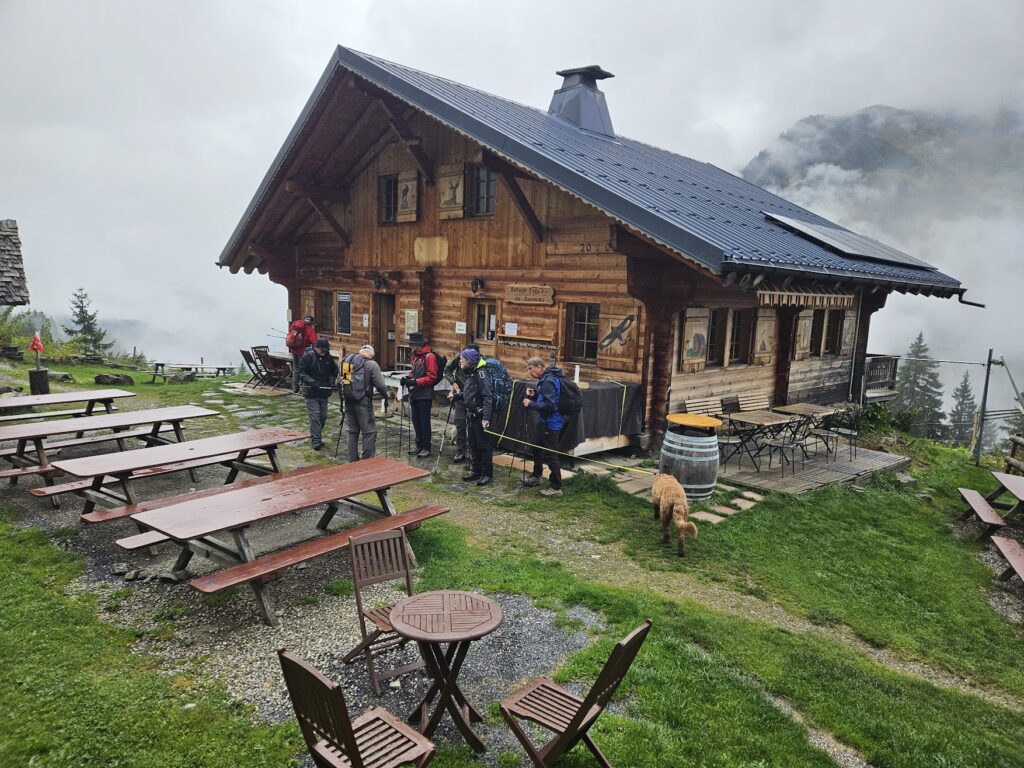
Nathan, with his dedicated trek tracker, is a dangerous companion to a hike organiser as he always seems to know in advance the exact location, elevation, steepness of climb/descent, etc. so it’s impossible to suggest any route is less arduous than reality. We arrived in good time at the refuge just as the rain started to fall and we installed ourselves in the dry as the only customers of the day. The refuge has checked the day before that we really would be coming as all their other reservations, including the overnight stays, had cancelled due to the weather forecast.
Good spirits and good beer.
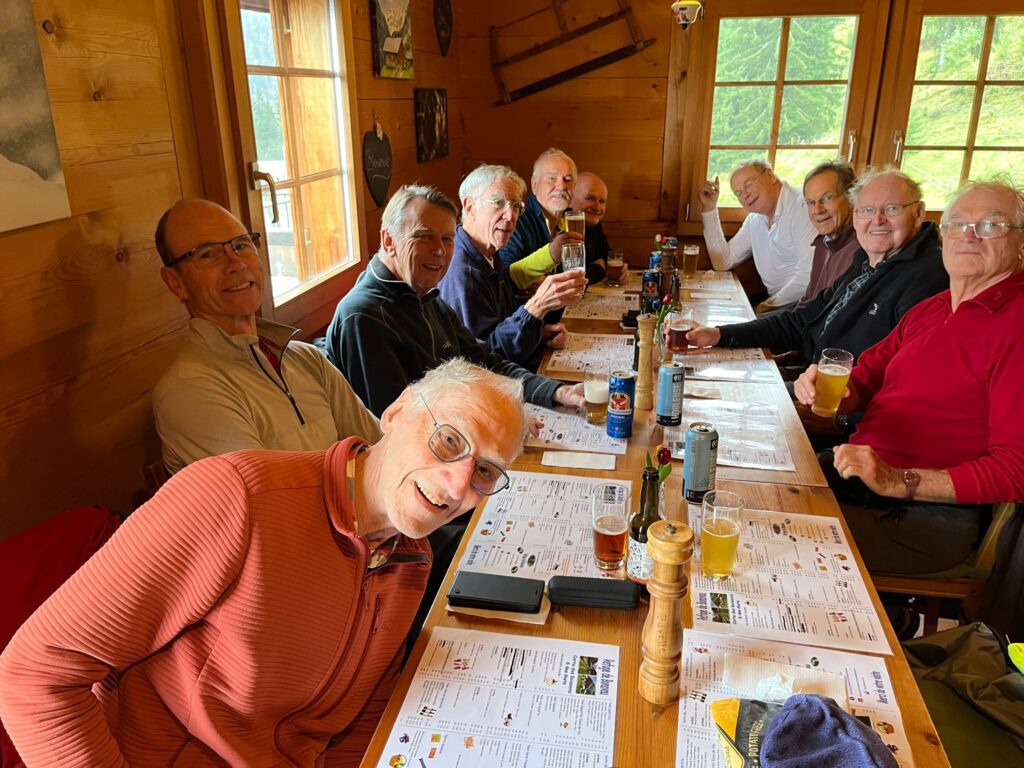
Plenty of banter over lunch and memories of the first day of the Tour des Dents du Midi hike which had passed very close to here (but without lunch….a story often brought up to try, unsuccessfully, to embarrass Mervyn, the organiser of that great outing). The mountain fare was good with mostly a selection of croûtes and omelettes chosen, washed down with sufficient beer but leaving room for the tarte aux myrtilles before coffees. The dogs too had their nutrition, Kobie only being satisfied when the 80CHF bag of mega-chews was eventually opened. Unfortunately, we did have to leave this warm cocoon and venture out into the cold and now increasingly wet world. However, it appeared that all was not well with Rocco and his concerned owner, Mike, who felt that there was canine over-excitement. He took the difficult decision to head back down to Grand Paradis and onto St. Luc, a day earlier than initially planned.
After lunch outlook was not so promising.
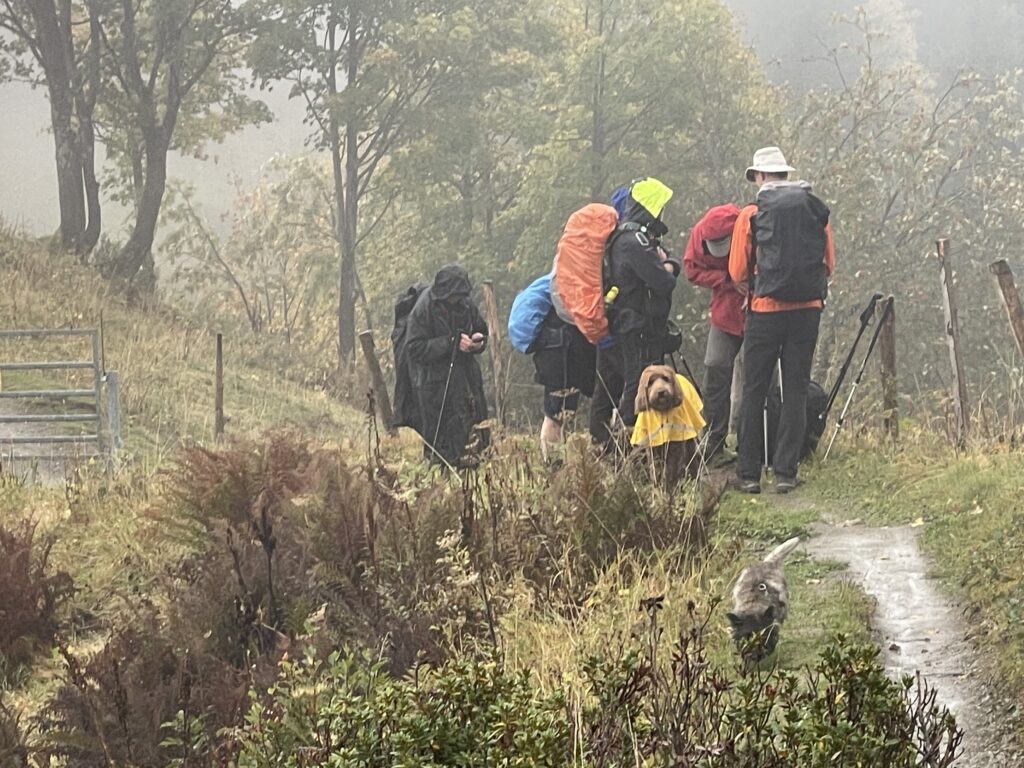
By chance, Mike missed the wettest, muddiest, slipperiest, and overall not a very pleasant climb up to the col at 1793m and then sliding downhill to Barme. Normally this is a short and scenic walk but in these conditions, with little visibility and heavy rain, it seemed unusually long….atlhough Rob did claim to like these familiar conditions. However, expectations had been set for the rest of the hike…..Day 2 must be better, mustn’t it?
A pause at the high point before descent into Barme
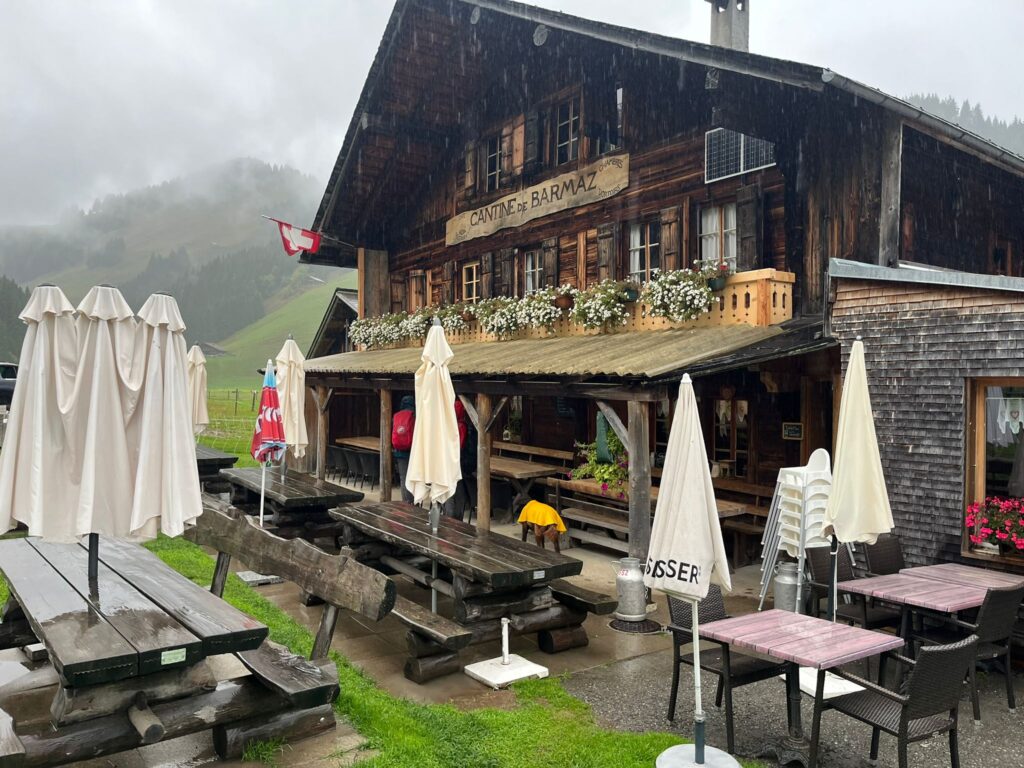
The Cantine de Barmaz was welcoming, serving us hot drinks on arrival as we shed wet clothing and recovered from the afternoon’s exertions. The owner/waiter didn’t seem over stressed as we were the only customers (although another couple appeared for the evening meal…..from where and to where we do not know).
A warm, dry haven at last.
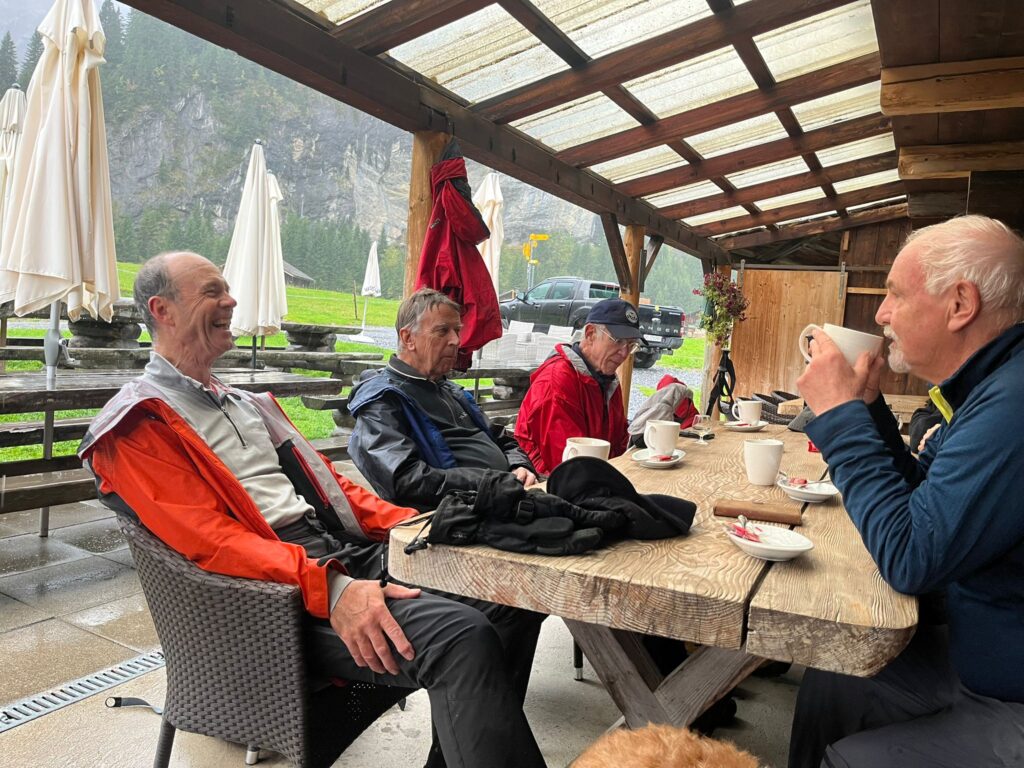
Out of the rain….time for a warm drink and relaxation
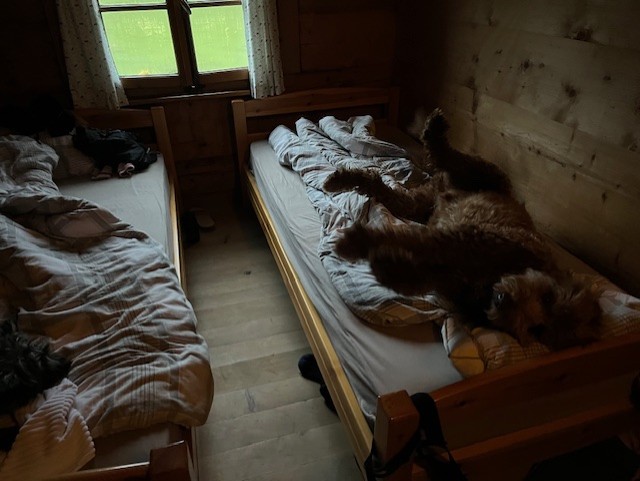
Feeling slightly less damp we moved operations to the bedrooms where the only predetermined arrangements were for the dogs and their owners, one individual room and one agreed double room. The rest of us looked around and hoped that we had chosen room mates with no unpleasant nocturnal habits. From the discussion the following morning it seems that we mostly succeeded. The rooms were compact, especially for PeterT and MikeM who had to share their accommodation with Kobie (no need to mention Nessie as she seemed to slot in unnoticed anywhere). There was a relief that MikeH and Rocco didn’t have to share this room as the owner was adamant that there could only be one room with dogs.
Dog tired …..but where do Peter and Mike sleep?
The bathroom facilities were also interesting with two closed showers , three basins and one open toilet all within a confined area. Happily, we discovered much more private toilets downstairs for the more meaningful visits.
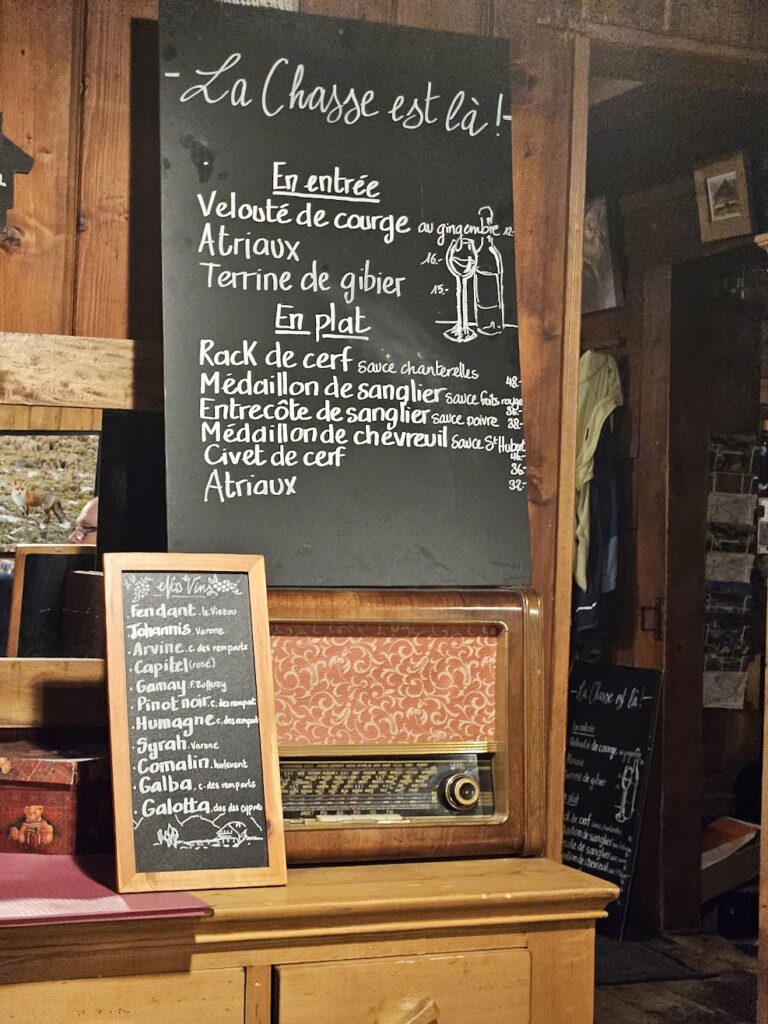
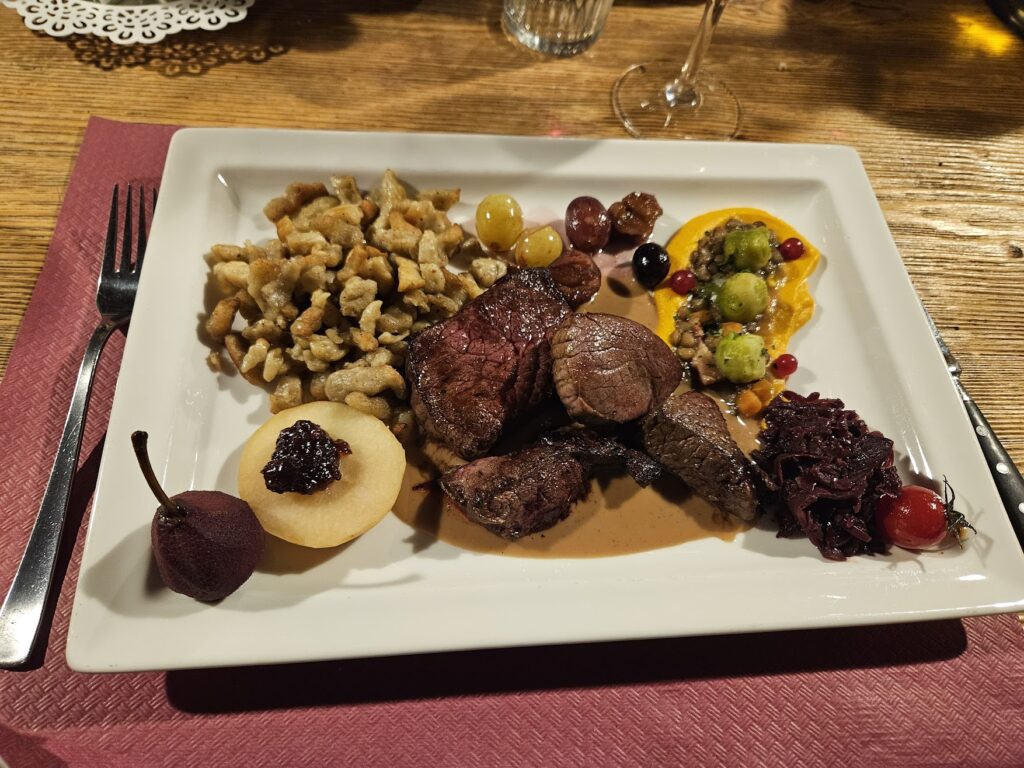
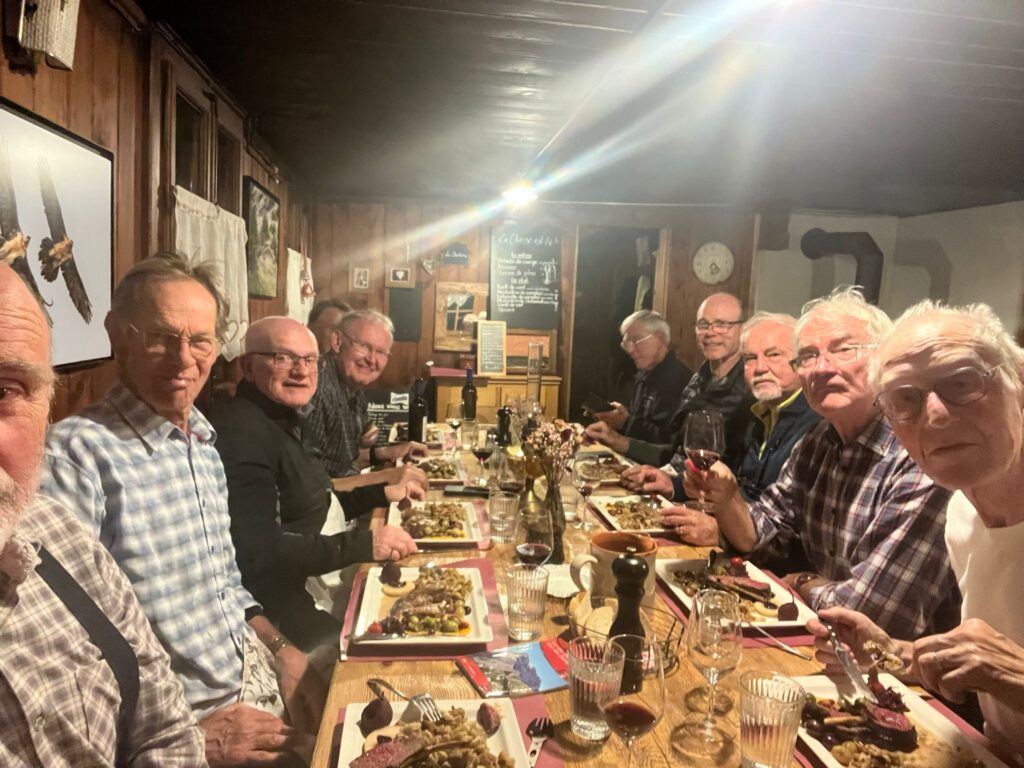
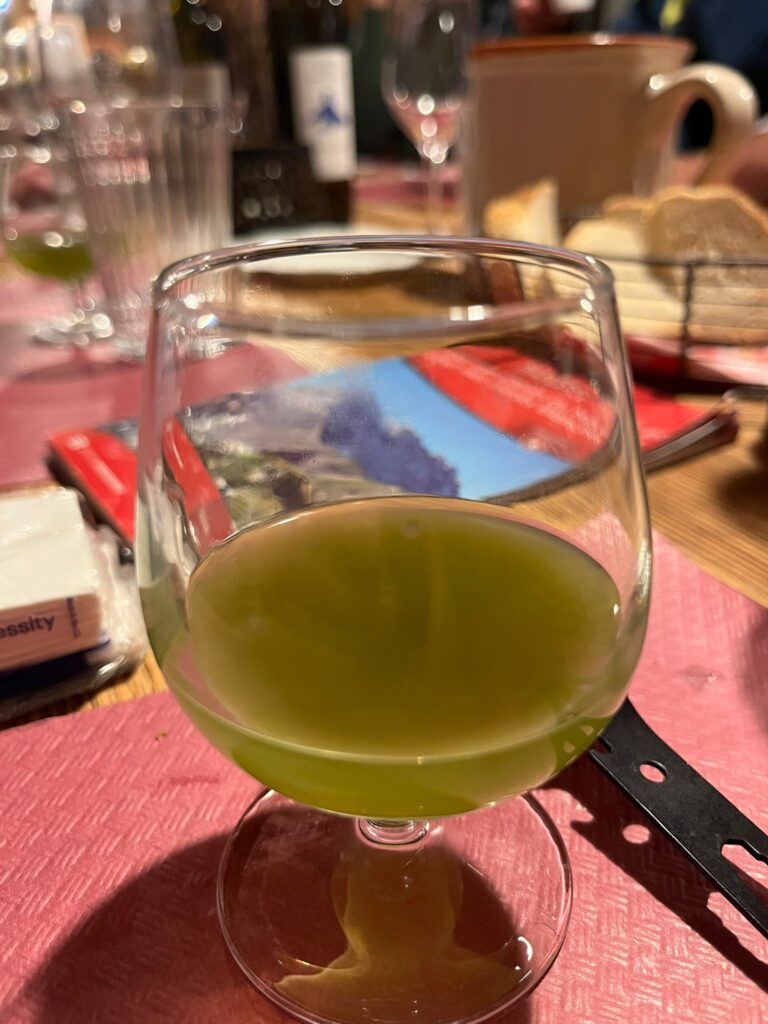
After a change of clothes and a time for general relaxation, we congregated for the apéros before making our meal choices. With a room to ourselves, equipped with a stove, we soon were enjoying the warmth and letting the afternoon conditions recede into the distant memory (some poetic licence here). Were we all game for the game on the menu, especially when we were told by the owner that this was local. Wines were not quite so local but came from Saillon, just a little further down the Valais. Since MikeH had made a generous parting gesture of offering us some drinks, we decided to opt for one of the better bottles on the list to toast our friendship at his expense. It was very drinkable and, unfortunately, set the standard for the other bottles consumed, much to the concern of the leader/accountant. In fact, we didn’t hold back in this convivial atmosphere and enjoyed not only ample good wine but also copious helpings of cerf and/or sanglier in rack, medaillon or entrecote form with all the trimmings, without forgetting starters and desserts. Such were the helpings that Kobie benefitted from a large meal of left-overs the following morning….a veritable doggie bag. By the time we were at the coffee stage several were mellow enough to be persuaded to have a glass of the homemade pine liqueur. Sadly, the accountant was also mellow enough to allow this. Added to crème brulée in small quantities this liqueur was truly excellent but in pure form it transformed to a green sludge with a very unpleasant aftertaste, rivalling the worst of Richard’s flask offerings. Amazingly, Mervyn and PeterT seemed immune to these flavours (aftermath of COVID?) and were happy to help out those with more sensitive palates. Even they could not finish all 7 glasses.
A great choice of chasse and wine. No prices on the latter…..
Game for this plate of food.
Happiness is a warm room, warm food and warm company
To rival any of Richard’s
Replete and tired from the day’s efforts, people started drifting off to bed at an unusually early hour, leaving a hard core to have a final rinsing beer and to listen to the calls of amorous wild animals across the valley, mingled with the bells from more domesticated animals. The night passed without major incident, no loud snores or rampant dogs, just the frequent creak of old doors as aging men needed to make use of the open plan bathroom. The dog room had the worst of this as the only place for Kobie was in front of the door, causing a large obstacle for exit. Ironically, on an informal count the following morning, the human content of this room claimed the maximum number of nocturnal reliefs.
Is that sunshine behind us?
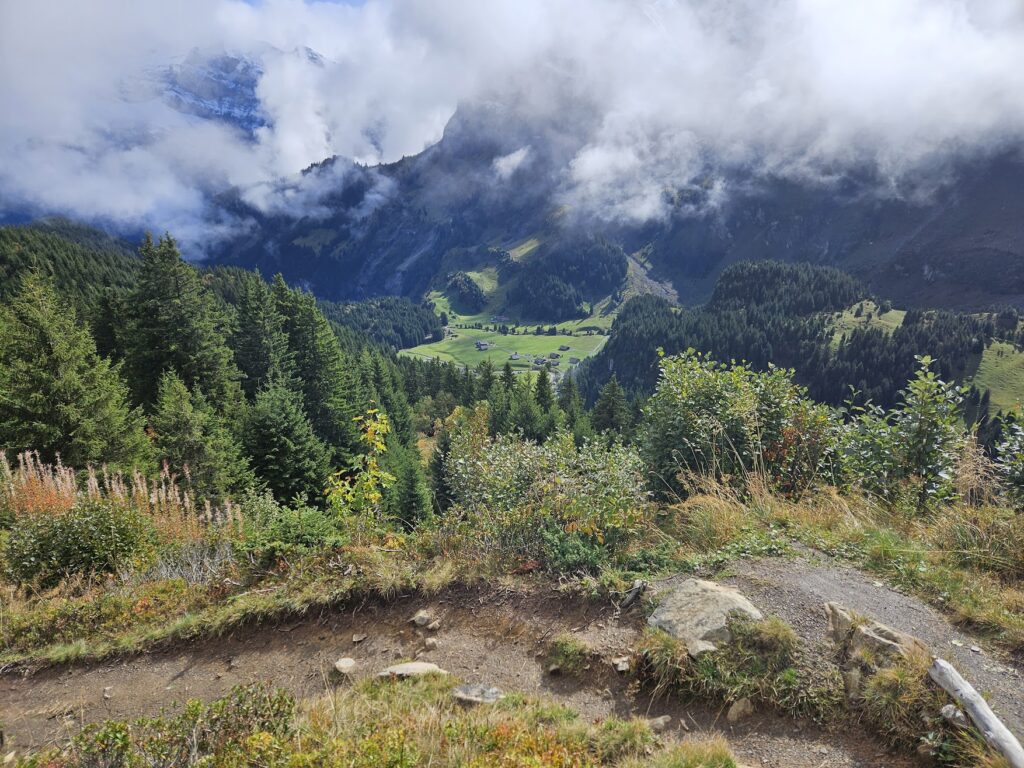
A new day dawned……and it was still raining. However, there seemed to be better visibility at times. MeteoSuisse promised a drier day from 09.30h until 16h, almost perfect for the planned walk. So we enjoyed a leisurely breakfast and repacked our backpacks ready for the rain to stop….which it did but visibility was still poor. Backpacks were left at the Cantine as we would be passing by again on our final way down and could pick them up them. The walk up from the Cantine to the end of the Barme valley can be spectacular under good conditions. We had tantalising glimpses between rising and falling cloud and started to gain an appreciation of our location. New snow on the peaks added an additional quality to those ethereal glimpses. We even managed to see some chamois high up on the hill, which Kobie felt obliged to get closer to. By the time we reached the end of the valley, we had a fairly good view of the impressive Dents Blanches and, looking back, the Dents de Midi were also making a partial appearance.
Majestic Dents du Midi
We met your cousins last night….
Richard, Mark and MikeM decided against a longer uphill loop to see the bird station at the Col de Bretolet. This added an extra 3-4 kms to the circuit. Instead, they took the ridge walk back towards the lunchtime Cantine des Dents Blanches at a leisurely pace (allowing time to find a wayward Nessie on a couple of occasions) and secured our table in the near empty restaurant. The rest of us made the detour. This involved a steep up and as we climbed the visibility reduced. At the top, on the ridge, we had zero view to our left and to our right and it started to snow. Not ideal conditions for seeing birds.
Up into the cloud and the bird ringing station
As we began the tranverse across to the bird ringing station, there was a hint of movement in the cloud cover. As we arrived, there was a biblical moment as the clouds parted and showed the Dents Blanches appeared in all their glory. Magnificent.
Rock and awe
The Lead Ringer, one of the two paid employees at this Swiss Ornithological Institute station along with several volunteers, gave us a fascinating description of their work and trends in migration. Over 10000 birds are ringed annually between April and October, at least half of them being chaffinches (what is a chaffinch in French?). Migration trends clearly indicate errors in President Trump’s theories on (or lack of) climate change. As we were listening we had a fly past of a bearded vulture and a griffin vulture. PeterS was able to make an internation connection with ornithological activities in South Africa. Interestingly, the work of this ringing station is not advertised strongly in Switzerland since there is a body of people who are not in favour of the stress to the birds despite the information and understanding this generates.
After three isolated months here he’ll even talk to the GIN Group
We retraced our steps enjoying the view and the autumnal colours of the azaleas and myrtille plants on the hillside. Amazingly, there were plentiful berries still on the plants….if only we had picked up that myrtille comb from the Cantine. Back on the ridge, the clouds were clearing from the Portes du Soleil side and we had a good view of the new border house at the Col de Cou. Due to the time, we headed straight down and along the ridge that the alternative party had walked earlier. The views on both sides were great, enhanced in some ways by the still swirling cloud and the uncertainty of how long we would have them. The snow had stopped and it was not as muddy underfoot as the day before. We made good time despite a seemingly endless zig-zag descent through the woods along the chemin “Nature”.
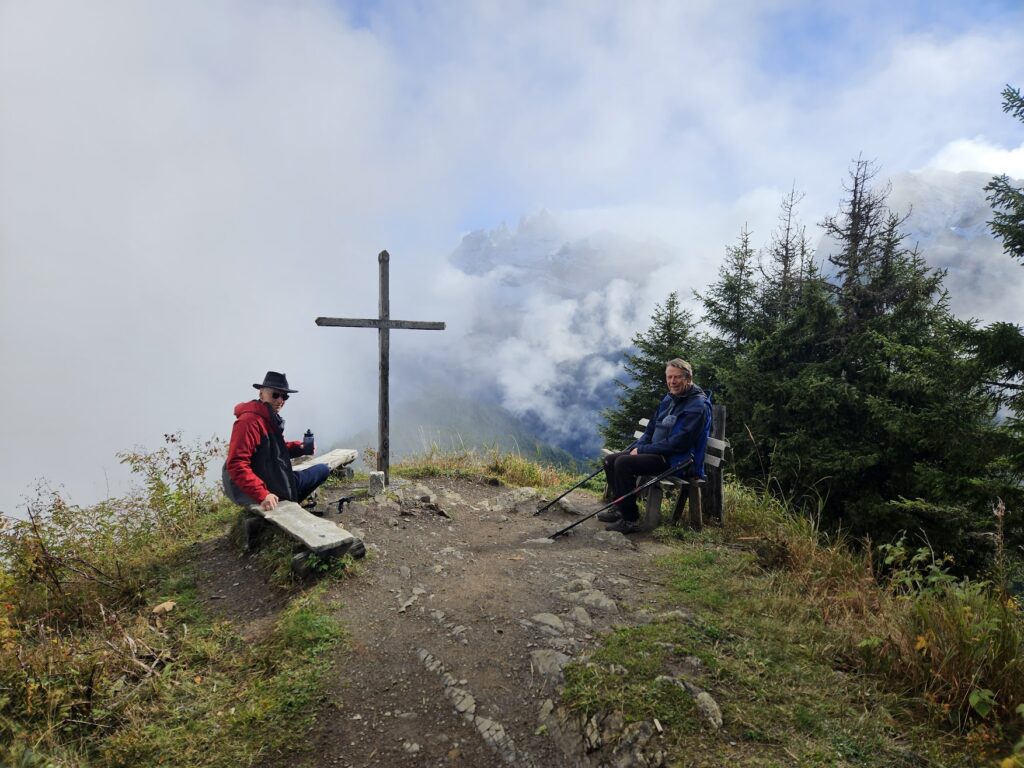
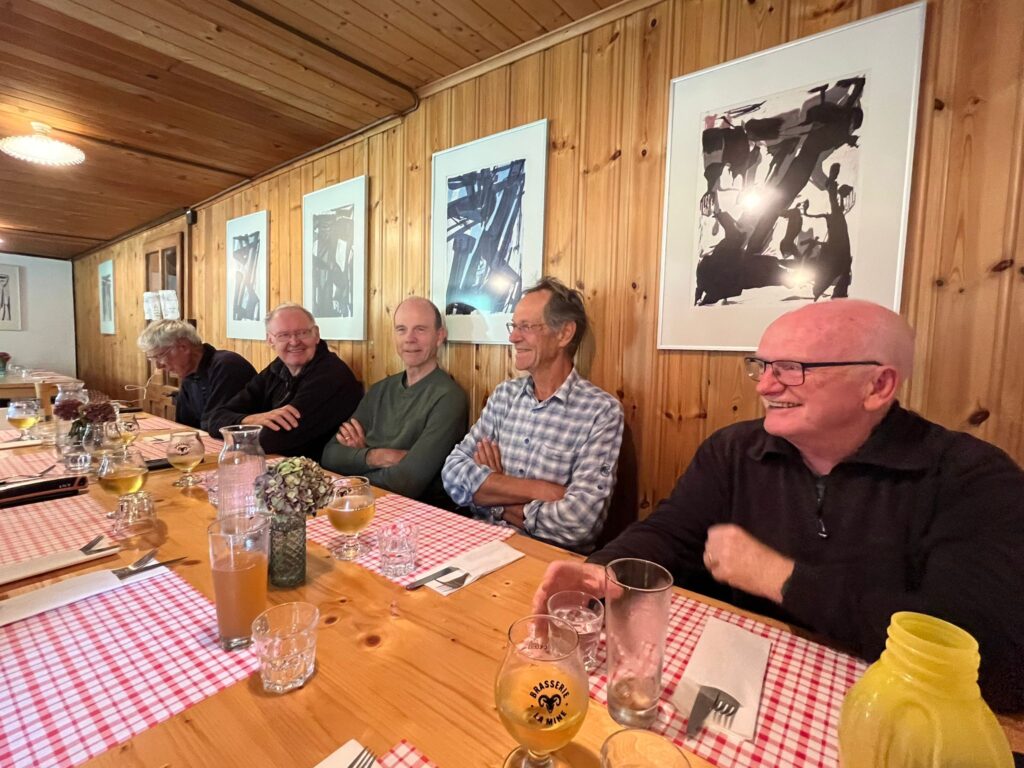
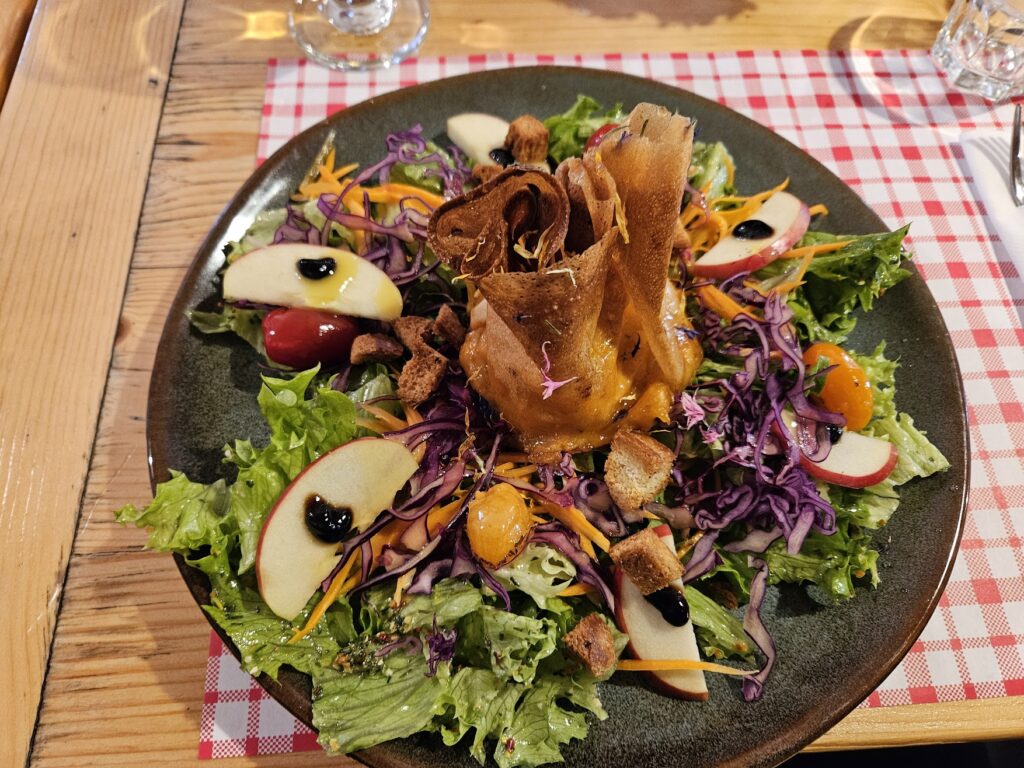
We arrived at the restaurant only about 15 minutes after the reservation and reunited with the rest of the group. There was another opportunity to sample local game but for some reason we all thought that would be an over-kill. Instead, the more modest ordered salade de chevre chaud and the more gourmand went for the croute and risotto options. Some people still had room for dessert and a chance to sample another tarte aux myrtilles. The food was excellent and we marvelled how two restaurants in a small hamlet could have such good kitchens. The famous flask at last made an appearance and several sampled it’s syrupy delights. If only we had known the night before…..
Appetit refreshed. Ready for more game?
A healthy salad is a sensible choice
After lunch we recovered our backpacks and headed the direct route home. A descent of ca. 500m over 3-4km, i.e .very steep in parts. However, this was a good quality gravel track and the rain was not due until 16h. At the bottom, we passed again the closed restaurant. Although part of the initial plan to stop here, this closure was a blessing as the budget had already been blown from the excesses of the night before and the rain was starting, very much on cue. We were keen to get back to the cars. Discrete top up contributions were made to the grateful accountant, so that the books balanced.
Farewells were exchanged and we all returned back to our homes with warm memories of another memorable GIN hike. GIN really is a great organisation….friendship, exercise, tolerance and a lot of fun, despite frequent discussion over aches and pains.
Bloggers note: Many thanks for all your photographic contributions. It was not possible to use them all! I’ve chosen a representative sample without reference to who took the photo