Puzzle 1 (2 circles and square on tangent)
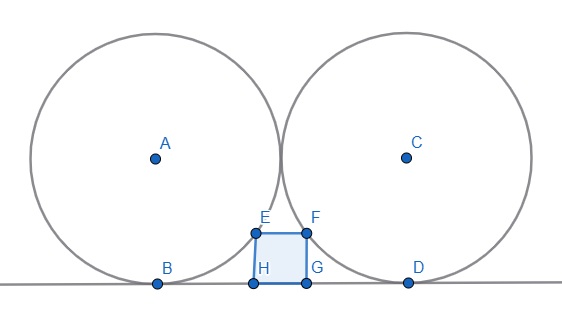
Initially posed by Nathan. Given 2 circles, radius r, with common tangent, BD, Find the area of the square EFGH.
Puzzle 2 (Set of Christmas puzzles)
This is a set of Christmas puzzles, shared by Peter Taylor
https://www.sciencealert.com/mathematician-shares-10-festive-brain-teasers-that-anyone-can-try
Puzzle 3 (Normal to circle diameter)
Mike Price found this in the Guardian. This was posed by a Russian prime minister, Mikhail Mishustin, on a visit to a school.
“How to drop a perpendicular from any point onto a diameter without using any measuring device. No compasses, no marked ruler, just a pencil and an unmarked straight edge. “
https://www.theguardian.com/science/2021/sep/20/can-you-solve-it-russias-prime-minister-sets-a-geometry-puzzle?CMP=share_btn_url
Puzzle 4 (3 switches)
From Peter T:
You are in a room that has three switches and a closed door. The switches control three light bulbs on the other side of the door. Once you open the door, you may never touch the switches again. How can you definitively tell which switch is connected to each of the light bulbs?
Puzzle 5 (Pacific + Baltic + Arctic)
From Nathan:
Solve this cryptarithm: PACIFIC + BALTIC + ARCTIC = CCCCCCC.
Standard rules apply: each different letter stands for a different digit and each different digit is always represented by the same letter; no leading zeros are allowed.
Puzzle 6 (Height of man)
From Peter T
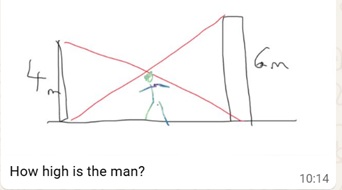
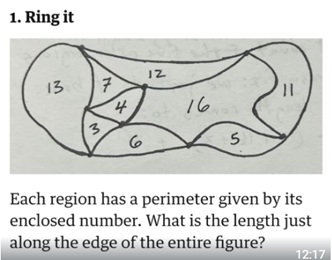
Puzzle 7 (Perimeter of graph)
From Mike Price
Puzzle 8 (Sum of last digits)
Also Nathan:
Let f(n) = Σ i, and let d(n) represent the last digit of f(n) when the latter is expressed as a decimal integer.
Now let g(m) = Σ d(i). What is the value of g(2000)?
Puzzle 9 (Distance tangent to diameter)
Another from Nathan
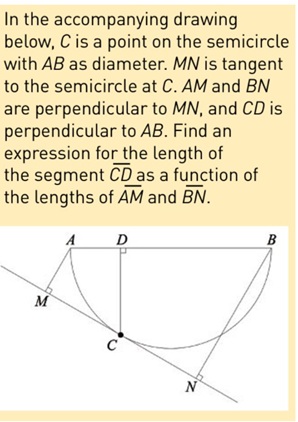
Puzzle 10 (Set of integers, what’s not in set)
A set of integers has the following 3 properties
- is in the set
- If is in the set then is in the set.
- If is in the set then is in the set.
Find all the integers which are not in the set.
No higher maths is required. Certainly not set theory. Just apply the 3 rules.